
You’re probably aware that George Washington is the only US President who never lived in Washington, D.C., during his time in office. While the Father of His Country did lay the cornerstone to what would become the White House (wearing his Masonic apron, no less), the first President to live there was John (and his wife, Abigail) Adams who stayed in the unfinished and freezing cold mansion a short time before the newly-elected Thomas Jefferson took office. And every Chief Executive since then has resided there.
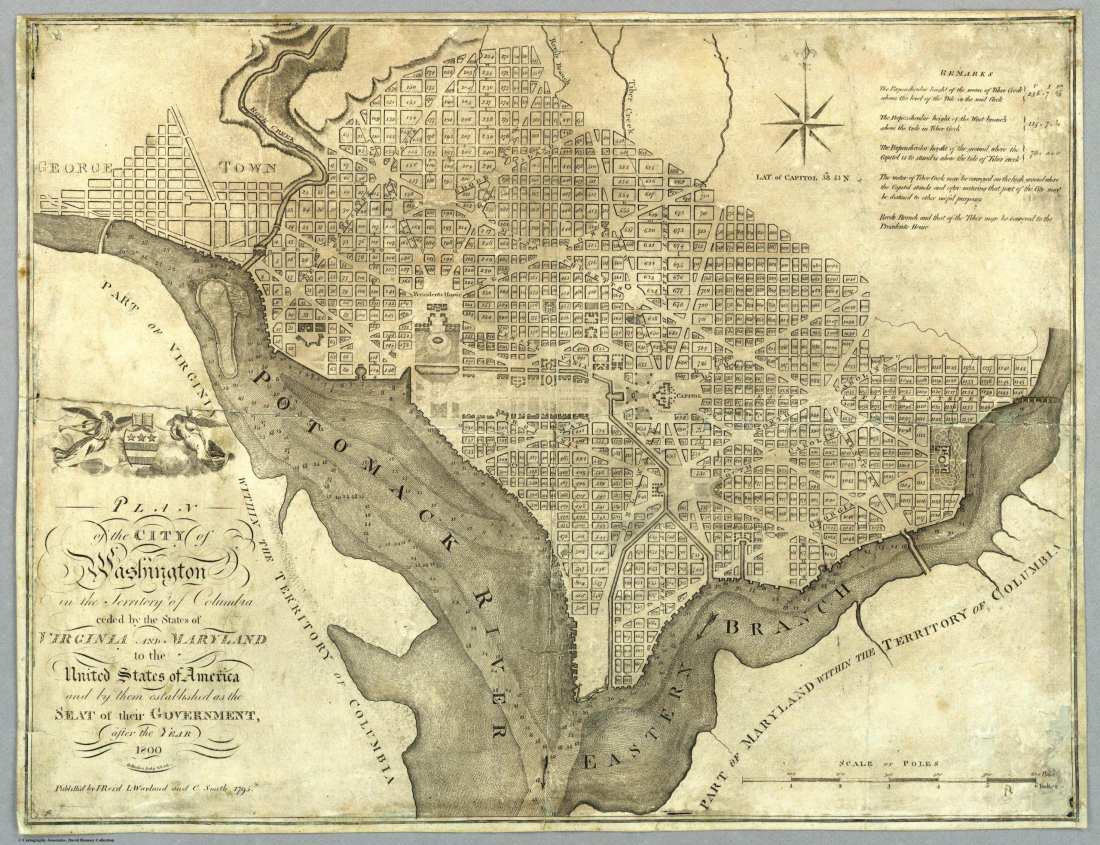
The story of the building of the city is as interesting as it is long. We won’t delve into that in this format, but you should know that the plan to build a permanent and new capital city for the new nation was approved while Washington was still in office. The next step after the approval of the (swampy) land was the design. Thomas Jefferson, ever the designer/architect and Washington’s Secretary of State, put in his two cents regarding building design, but it was a French military officer who had fought with the Americans against the British over a decade earlier who conceived not only of a general style for the architecture of the buildings but also of the overall plan for the city as a whole. His name is Pierre L’Enfant.
L’Enfant’s plan has undergone several changes over the past 220+ years, but the essential heart of the city’s layout and building design is his. As far as cities built as national capitals go, the capital city of the United States remains one of the most beautiful and beautifully designed. The nations of Brazil (Brasilia), Myanmar (Naypyidaw), and Pakistan (Islamabad) all have purpose-build capital cities with varying levels of beauty and livability. Washington remains one of the most beautiful (St. Petersburg, Russia, was also purpose-built as Peter the Great’s capital city, and it is absolutely beautiful, but the Soviets moved the capital to Moscow).
But there’s an irony to the building of the US capital city as you will soon see. L’Enfant’s plan called for the use of sandstone, a plentiful, nearby, and (relatively) easy to manipulate stone building material. While later builders in the city used marble and other stones, much of the original construction of the major buildings of Washington were made of sandstone. The stone was cut, shaped, loaded, hauled, unloaded, shaped again, and then laid to construct the buildings we know so well today. Many of the masons who did the laying stonework were Scots. Scottish stone masons are famed for their craft, and some were “imported” to the United States just for this purpose. However, the Scots, as important and as skilled as they were, did not do the heavy lifting.
No, the backbreaking work of building Washington, D.C., the capital of a nation built, as Abraham Lincoln would say several decades later, on the proposition that all men are created equal, was largely performed by African slaves. It is said to have grieved the abolitionist Adams to see enslaved persons working on liberty’s capital, specifically the executive mansion.
Interesting, isn’t it? For a nation where many people attempt to define what it means to be an American by having been born here or by displaying a certain cultural, ethnic, or linguistic identity, to have the capital city of that nation designed and built by people from Africa, France, and Scotland (among other places).
So, to argue that foreigners and immigrants built this nation, it is true–and literally in the case of the nation’s capital city.

 The Rest of the Story