
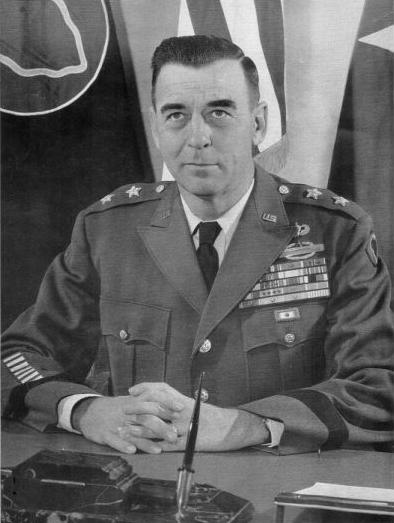
General Edwin Walker was a decorated soldier who was a career soldier up until the time he, well, wasn’t. Walker graduated from West Point. He commanded troops in World War 2. He fought in Korea. Then, after Korea, something either happened to Walker or he felt less need to stay quiet. What happened was that Walker became political and vocally so. Now, there’s nothing wrong with military people having an opinion. The issue arises when they let those opinions determine if and when they obey orders or they use their opinions to coerce people under them to make choices based on those opinions. And that’s what Walker started doing in the 1950s.
You see, General Walker fell into bed with extreme right-wing politics. He was an extreme anti-communist (ok, nothing wrong with anti-communism), but he bought into the idea that much of the US government and military were agents of the Soviet Union. This was the period of the Cold War, and America saw the USSR as its mortal (and moral) enemy. Walker joined forces with people like extreme racists, John Birch Society folks, and other radical right-wing groups.
In the mid-1950s, President Eisenhower gave Walker command of the troops detailed to insure that the segregation of Little Rock Arkansas schools went off without interference from violent racist groups. To say that Walker found the duty distasteful is an understatement. He carried out his orders, but he didn’t like it and said so. He threatened to resign (not retire), which would have meant he was giving up his military pension. But Ike offered to re-assign him, and Walker accepted. But the changing political and social landscape proved too much for him to keep his opinions quiet. When the University of Mississippi was integrated in the early 1960s, Walker decided it was time to resign.
The now former general decided to enter politics as a pro-segregation, anti-communist, pro-Bible/Christian, and anti-, well, anti pretty much everything candidate. And he decided to run for governor of Texas. He gave a speech in which he said that he had been “on the wrong side” during his work in Little Rock, but that now he was “standing for the right,” and he probably didn’t see the irony of his words. And he drew adoring crowds in a state in the south that was still largely living separate existences between the black and white population. Fortunately, his brand of extremism was defeated by the more centrist appeal of John Connelly in the election.
But his anti-communist views were some of the most troubling. He was firmly convinced that Franklin Roosevelt, Harry Truman, and even Dwight Eisenhower were all Russian/communist plants in our government, hell bent on the destruction of the nation he’d sworn to protect and defend. And this anti-communist stance drew the attention of a man who wished Walker dead. One evening, as Walker sat at his desk in his house in a Dallas suburb, a shot rang out. Walker grabbed at his forearm, as splinters from the shot entered his body there.
He leapt up and ran to the window. There, he saw where a bullet had shattered the window sill. It was the splinters of metal from the bullet that had fragmented when it hit the sill that had pierced the former general’s arm. He was lucky to be alive. A few inches to the right and a bit higher, and the shot would’ve pierced his anti-communist brain. And that’s interesting that the shooter was fairly close, on the same level even, as Walker, but still missed the headshot.
Eight months later, Lee Harvey Oswald, who’d failed to kill Edwin Walker, got his headshot with a much more difficult shot into the brain of John Kennedy.

 The Rest of the Story