On an Unfit Mother

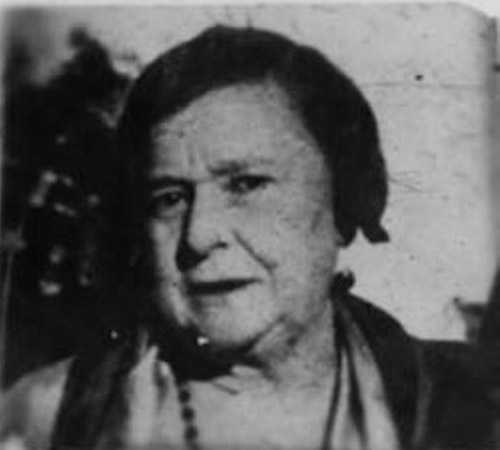
Are good and bad people “made” by their environments or are they born that way? Ask anyone from a psychologist to Lady Gaga, and you’ll get a wide swath of opinions. Maybe the film character said it best, that perhaps it’s a little bit of both at the same time. At any rate, Kate was born Arizona Donnie Clark in Missouri in 1873 to what we would refer to as a normal family. Her parents and friends called her Arrie after her given first name, but she later said she never liked that moniker. So, she preferred to go by Kate.

At the age of 21, she married a man named George, and the couple moved to Tulsa, Oklahoma. To say that the newlyweds fought would be an understatement according to their neighbors. Now, growing up in Alabama like I did, we’d’ve referred to somebody like George as no-account. A later report described him as shiftless. Same difference. George drifted from one low-paying job to the next, never seeming able to hold on to a job for too long before getting fired for doing something dumb or showing up to work intoxicated or interminably late.

One thing the couple did well was have sons. Four of them, in fact, over the course of seven years. And, with each birth, the family grew more and more impoverished. If the family was know for anything in the local community, it was that those boys were wilder than a bunch of feral cats, making even their daddy seem respectable by comparison. Herman, the oldest, got arrested at age 13 for running over a local child with a vehicle he’d “borrowed.” All four of the lads were illiterate; the parents had no interest in sending the boys to school because they couldn’t see the sense of learning anything. Hell, what little learning their parents had didn’t help Kate or George at all, it seems.

The boys’ crimes increased in severity with their ages. By the time Fred, the youngest, was 17, the boys had committed armed robbery and had been accused of killing a police officer. Herman died at age 33 after a gun battle with police. Eventually, Lloyd, Arthur, and even young Fred all found permanent lodging in various state penitentiaries across the middle west. By 1928, father George was done; his sons’ escapades were too much even for him. He left Kate, some said, because she didn’t care what her boys were doing. Besides, George had heard the rumors around town that Kate would have men over to the house when he wasn’t there. George blamed his now-estranged wife for the plight of his sons, saying that she never taught them any discipline at all.

For her part, Kate didn’t care what George did. After her living three boys were put in prison and George left, Kate took up with an unemployed man in Tulsa. Then, Arthur and Fred were released. They didn’t need much persuasion to convince Kate and her new beau to join them in a move to St. Paul, Minnesota. It was there that the group, joining forces with other known criminals, became a true menace to society. By 1933, they had so much power in the Twin Cities that they even had bought off the chief of police there. They expanded their reach even more by branching out into the lucrative kidnapping business. Kate was the key in this new enterprise; she was the one who would launder the money to make sure it couldn’t be traced back to anyone associated with their new criminal capers. If anyone said that crime didn’t pay, they never spoke to Kate. She was thrilled in a way only a mother can be by how much money her sons brought in through their illegal activities.

Finally, in 1935, the Federal Bureau of Investigation got a tip that Kate and the boys were hiding out in Florida in a rented house. The FBI raided the house, and, in the ensuing gun battle, Kate and Fred, her favorite, were killed side by side. FBI Director J. Edgar Hoover called Kate “the most vicious, dangerous, and resourceful criminal mastermind of the past decade.” That’s saying a lot considering that she was a contemporary of Al Capone and other Chicago mafia types. Some today argue that Kate never really partook in the robberies and the murders and the other illegal activities, that she was a willing stooge in the organization at best. But many hold to the theory of Hoover and others in law enforcement that she was the brains behind it. After all, her boys were simply too dumb to do it all themselves. Isn’t it a good mother who encourages and helps her boys as they try to achieve their goals?

Either way, Kate “Ma” Barker won’t win any Mother of the Year awards.
On a Free Breakfast

We in the west generally believe that the “free school lunch” is something that children in need should have access to in order to achieve academic excellence. That concept is fairly new in education, and there’s even some pushback in some quarters today with an increasing number of people questioning whether it is the responsibility of publicly supported schools to provide that nutrition. However, the argument has been made and the prevailing attitude is that free school lunches should be provided.

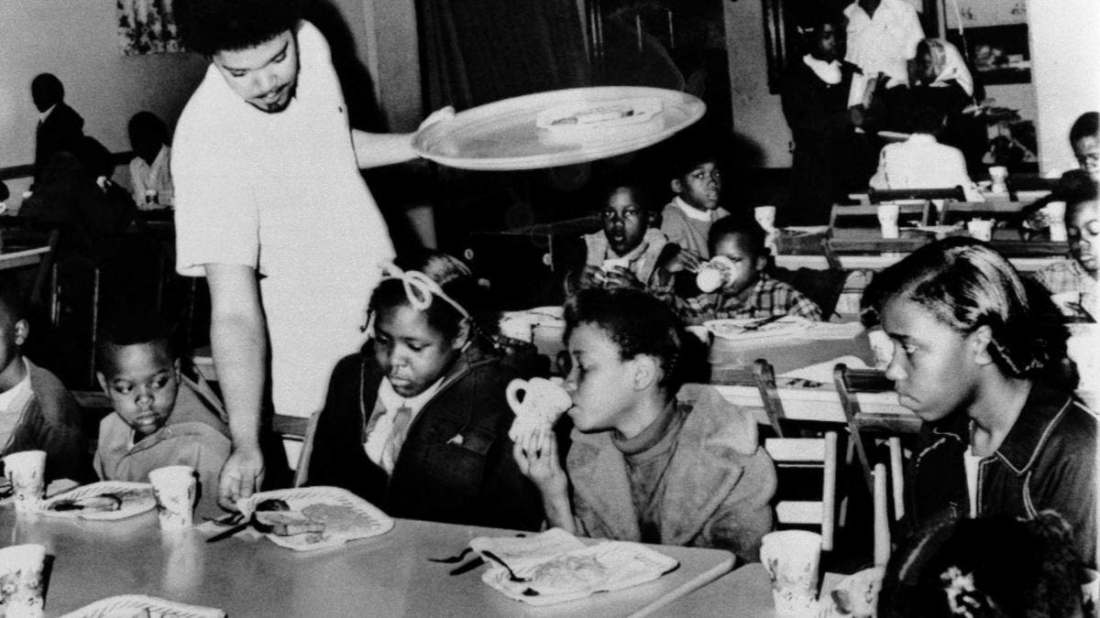
Interestingly, that type of free food program for lower income children started not because of a government program but began through a non-profit, private organization that worked in inner-city communities to better the lives of the citizens there. The first free meals for poor kids weren’t lunches, either, actually, but they were breakfasts. This group, a group that also had political goals, began serving low income kids in poorer sections of Oakland, California, in the late 1960s. They knew that people would be more receptive to their ideas if they were a positive contributor to the community to begin with. A local Episcopal Church building was used by this organization to give the free breakfasts to the kids. The volunteer group had gone to local grocery stores to solicit donations and had even consulted with nutritionists to see what types of food would pack the most punch for the kids throughout the day.

The results were astonishing.

Teachers and the school administrators reported almost miraculous improvement among their students who were receiving the free breakfasts before school. Test scores, good behavior, attendance, and over-all well-being showed significant increases. The kids were attentive as well; teachers said that the fed children stayed alert longer, they weren’t getting sick as much, and their prospects for school achievement increased. The volunteers were thrilled with their report card; they quickly expanded the program to other communities across the US. Schools in low-income neighborhoods of Detroit, Chicago, New York, and other large cities began reporting similar results to those in Oakland. The program was a success.

And that’s right about the time that the United States government began to take notice. Mainly, one agency of the federal government took umbrage with the efforts of the group. You see, the head of this governmental agency was such a racist that anything that helped minority people was seen as a threat to the nation in his eyes. He declared war on this program and its volunteers. He began ordering his offices around the nation to begin a whisper campaign against the free breakfast program. Parents were sent notices (ostensibly from the schools themselves) hinting that the group was secretly poisoning the children with the free food. And he ordered them to begin photographing the children as they left the places where they ate in an effort to intimidate the kids and pressure them to not return. The free breakfast program was shut down through this systematic harassment by the government.

What type of governmental bureaucrat–no, what type of human–would stoop so low? The program was good; it was free; no tax money was being spent, and the positives overwhelmingly outweighed the negatives here. Who would do this type of thing?

Well, luckily, cooler (and less racist) heads prevailed. Seeing the benefits of the program, the US Office of Education (what the Department of Education was before that agency was set up in the late 1970s) began offering free lunches and free breakfasts to low-income families. The program started by the volunteers in Oakland in the ’60s was reborn, and millions of low-income children have been helped.

But that success never would have happened if J. Edgar Hoover hadn’t’ve hated the Black Panther Party so much.

On A War on Terror

When the terrorists attacked the United States and so many people were killed, it was a given that the federal government would spare no effort or expense to seek out those who were responsible for the attacks and prosecute them to the fullest extent of the law. Those who refused to be arrested were, with public approval and loud acclaim, killed by the federal authorities. It’s what our government does to a) get revenge for the attacks and b) show other potential terrorists that they, too, will be met with swift retribution and justice if they try similar atrocities.

Terrorism has fear at its heart, of course. It’s in the name, after all. The purpose is to cause public panic and make the attacked populace take notice of the issue the terrorists want them to see and, it is hoped, pressure the government to change their public policy. Of course, sometimes, terrorists simply wish to cause chaos. And that seems to have been a large part of these attacks.

Raids on terrorist cells netted over 3,000 suspected or known terrorists. They were rounded up and jailed without trial. Judicial processes were eschewed. The government said that they couldn’t take the risk that someone who might be a terrorist but they didn’t know for sure couldn’t be allowed to go free. It was better, the government said, to err on the side of caution and public safety. I can’t say that I disagree because of my fear of such acts. And the government deported several hundred others even loosely affiliated with the terrorists. Again, I get it.

Fears like mine led, as you know, to a strong fear and reaction against “foreigners.” Thus, anyone who was not seen as easily identifiable as, for lack of a better term, “American” was instantly suspect. The government advised Americans that if they even suspected odd behavior or even something that smelled faintly anti-American, they were to report it to the nearest law-enforcement authorities. A spate of paranoid reports followed the terrorist attacks for some years afterward. One story told of arrest made of a person who simply refused to put his hand over his heart at a public playing of The Star-Spangled Banner because such a person, it was reasoned, must be against America and therefore a terrorist. That made him an instant suspect.

And that’s what terrorism does. It makes us crazy. It seeks to drive us to lie sleepless at night and peek out our curtains at the new neighbors. It wishes to divide us and suspect each other of being that difficult to define thing: Un-American. In this case, the President said that the terrorist attacks, “poured the poison of disloyalty” into our national consciousness. The President also said that the terrorist “must be crushed out” of existence because of what they’d done to the United States.

And, so, new federal agencies were set up, as you are aware. Huge budget increases were passed that allocated money to fight this war on terror. A young man in the federal government, only aged 24, was tasked with not only ferreting out people in the United States who might have terrorist ties, but he was also tasked with setting up the department specifically designed to fight those who might make war against our ways of life and create social instability.

The terrorist attacks we’re speaking of were the bombings of the offices and homes of several government officials over 100 years ago, in 1919, by so-called anarchists. And, of course, you know the young man and the newly-formed government agency he headed up.

The agency became known as the FBI, and that young man was J. Edgar Hoover.