On a Returning War Prisoner

Andras Toma had been a 20 year old Hungarian soldier when he was captured by the Soviets near the end of World War 2 in 1945. Toma was taken to a POW camp near what is now St Petersburg, Russia. The German soldiers and their allies, including captured Hungarians, often had to trek across hundreds of miles of countryside by foot when the war ended and they were released from custody in order to return to their homelands. I have some friends in Western Germany, near Cologne, who had their ancestor show up unannounced at the front door of the family homestead in 1947, fully two years after the war ended. They thought he was dead. That wasn’t an unusual event. Toma, too, had to stay some years in Soviet custody before his release, and his family had long since though him deceased in the war.

But Toma had survived. After the POW camp, an illness saw the young Hungarian transferred to another facility, a Soviet hospital, still deeper in the Russian interior. He languished there for several months, and then he was transferred to yet another facility, and that’s when he lost track of time. He didn’t realize how long it had been since he was put in the facilities. Back home, since he didn’t return after the war, his family had him declared dead. Again, this wasn’t unusual for families whose sons, husbands, brothers and other relatives didn’t come back.

Meanwhile, Toma was having trouble communicating with the doctors and the staff of the medical facility. Hungarian is a rich language, but it’s also one of the most difficult languages to learn. Besides, it’s not spoken much outside of Hungary. And Toma knew no Russian. So, when the doctors made their rounds and the nurses brought him his food and checked on him, there was almost no interaction between Toma and them. Apparently, he had no conversations with them at all while he was there.

Then, a doctor in the hospital who was from Czechoslovakia noticed the man. the doctor soon realized that, because of his name, Toma was most likely Hungarian. The man, curious as to what seemed to be a patient with no obvious or visible issue by that time, arranged for a records check on the Toma, and the entire story came to light. It seems that, for some unknown reason, Toma had ultimately been placed in a Soviet mental institution. His inability to speak Russian (and the Russians’ lack of Hungarian language skills) had allowed him to stay in the mental facility for an inordinate amount of time both unchallenged and unchecked.

And that’s how Andras Toma finally made it home to his family in Hungary after the war. He was given a hero’s welcome, and he was awarded back pay for all his time in the service, even though the war had ended some time earlier. The joyful reunion between Toma and his family occurred on August 11, 2000.

Because he didn’t speak Russian, Toma had been a POW for over 55 years.

On a Migration

Yes, Virginia, there really is a Transylvania. It is today part of Romania, a part, in fact, where I lived for about two years in the 1990s. And when I was there, I quickly learned about the unique nature of the settlement of that land over the past 800 years or so. You see, 800 years ago, that part of the world was being overrun by invaders from the south and east. The Hungarian king, who ruled Transylvania at that time, was worried about all the groups who were encroaching into Europe and threatening his kingdom. So, he issued an invitation to people to come and have free land along his eastern border–the area of the eastern edge of what has traditionally been Transylvania. And the people he invited were from what is now Germany, many of them from economically stagnant areas of the eastern provinces.

And the hardy German people he invited were given the freedom to build walled cities and smaller fortified villages built around churches as a way to created a line of linked fortresses along the border. Now, Transylvania sits in the curve of a series of mountains known as the Carpathians or, more colloquially, the Transylvanian Alps. The idea of the Hungarian king was that once the invaders crossed the mountains (no small feat), they would be met with this system of fortress cities and villages that would act as a deterrent and, hopefully, cause the invaders to turn around and go home.

Seven large walled towns were built along the border. Dozens of smaller fortified church villages linked these larger towns. The towns and villages look like something that was taken from Germany and transplanted into Transylvania; they’re designed and built in the style they had built at home. And that makes sense. Many of them have been unchanged over the centuries, and today, some German tourists come to Romania to see what German villages looked like centuries ago. Hermannstadt, the largest of these walled towns, is called Sibiu today. Several walls ring the town even today, and there are defensive towers built and maintained by the various guilds in the town to protect their homes and businesses. All the large towns were built like this. In fact, the German name for Transylvania is the Seven Forts–Siebenburgen, in German.

Up until the post-World War 2 decades, Transylvanian towns maintained mostly German majorities. Interestingly, as soon as communism fell in the early 1990s, many of the Germans–after 800 years–decided to return to Germany.

And that takes us to one of the German towns where the ancestors of the modern Transylvanian Germans came from all those centuries ago. In the record books of one town in eastern Germany, there is a curious reference to the original migration of a large number of the town’s citizens who answered the Hungarian king’s invitation way back then. The curious passage dates from 1384, and it reads: “It’s been 100 years since our children left.” In the same town, the old church had a stained glass window depicting and referring to the migration as well, showing a person leading a group of migrants out of the town and, presumably, to Transylvania. The person leading the group was dressed in multi-colored clothing and was playing a wind instrument.

Of course, the German immigrants to Transylvania weren’t led there by a Pied Piper, but the documents and church that describe that migration are absolutely from the town of Hamelin.

On an Unusual Pacifist

Conrad Haas should not have been a pacifist. Given his position in the Austrian Army’s artillery corps, Haas spent most of his adult life figuring out how to best use gun and cannon fire to kill large numbers of troops. And, during the time that Haas lived, artillery killed more soldiers than any other type of weapon did.

Haas was born in Vienna and raised in a middle-class family. He studied artillery in college, and became an army officer in charge of munitions for the entire Austrian Army soon. When it came to artillery, Haas was somewhat of a savant. He not only could calculate distance and elevation of the weapons to fire accurately, but he also knew how to best conserve fire and make it effective when it counted most in battle. Such skill soon made him known throughout Europe, and he was invited to Romania to teach in an army artillery school there.

Now, you’d think that a person who knew about how to effectively cause death and destruction through artillery wouldn’t have many qualms about his job, but Haas did. In fact, he began to see that his job was that of a sort of artillery grim reaper, a person who sowed disaster and mayhem. And that made him become a pacifist while he was still in the employ of the military.

He began to tinker with the artillery and the calculations needed to shoot projectiles long distances. And this led him to try to see another possible application for artillery than that of death. What Haas came up with was revolutionary for his time. In addition, he began writing treatises about disbanding and disarming the military. “Mankind should pursue peace and not war,” he wrote. “The day will come when the powder will stay dry, the leaders will keep their money, and the young men will not die.” You can imagine that these types of writings made him some powerful enemies.

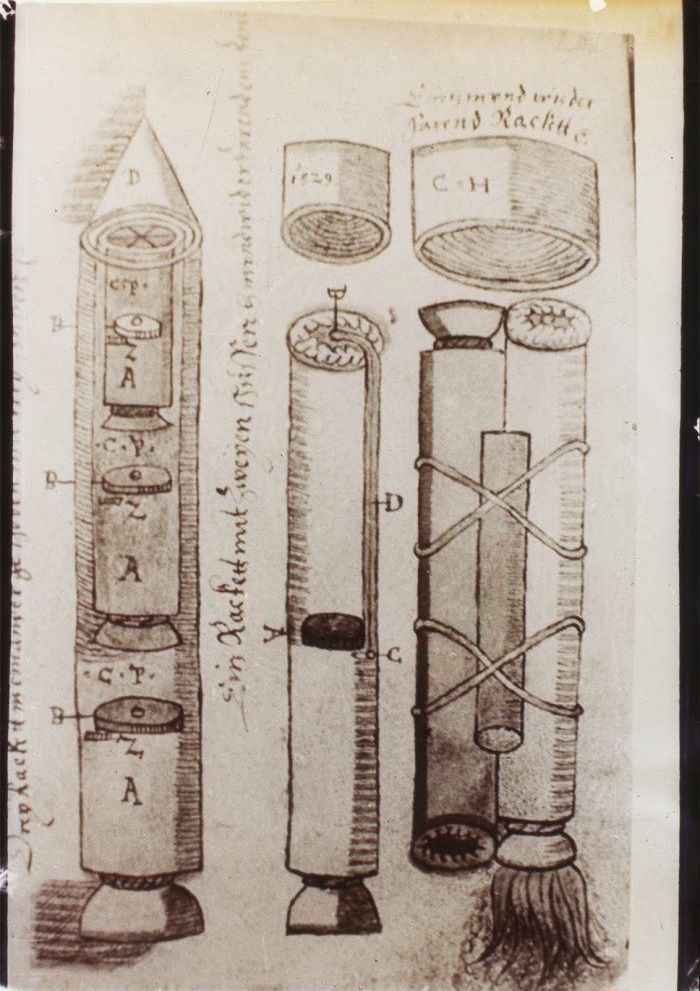
And those enemies would have done something about this artillery officer cum peacenik if what Haas proposed to do with artillery didn’t interest them so. You see, it was Conrad Haas who first came up with idea of launching not an artillery projectile, but, rather, a rocket into space. His concept was a three-stage rocket made up of a combination of solid and liquid fuels that would help the rocket break the earth’s gravity and cause the projectile to soar into the upper atmosphere.

He also came up with what is called a delta-shaped fin (the types we see on rockets today) and even a cone-shaped exhaust that would focus the power more directly and in a less diffused manner. And we can imagine that armies certainly liked the military capabilities that Haas’s ideas brought. So, his pacifism was ignored.

Of course, when Haas thought of all this, the practical application for such technology was years away.

After all, it was the 1550s.

On a Designing Professor

Hungarian culture is rich and varied, and their history is filled with heroic legends and warriors. Linguistically, the nearest neighbor to the Hungarian tongue is Finnish, then Estonian. Hungary has produced music, art, literature, dance, and architecture that the world envies. So, a creative, proud, productive people. Not too shabby for a nation with a population slightly larger than that of New Jersey. During the years of Communist rule, the proudly independent Hungarians bristled at the bridle of Soviet influence to the point that they rebelled against the Soviet Union in the 1950s. Although this uprising was quelled with Russian tanks, the Hungarians were one of the first Warsaw Pact countries that celebrated their independence from Russian rule in 1989.

Erno was one of those celebrants. He was a designer and professor by profession, and he was born at a time when Hungary was under the influence of Nazi Germany–1944–in Budapest. His father had a good reputation as an airplane designer, and his dad’s skills were put to use by the communists after the war. Erno’s dad was his hero, so it made sense that he would follow in his father’s footsteps and become a designer, too.

Between his father’s influence and his own personal skills, Erno was granted admission to the national design school in Budapest. From there, he entered the school of architecture. Geometry, shapes, the sculpturing of objects–these things enthralled Erno. He graduated with honors and was granted a teaching position in the design academy he had attended.

One thing that set Erno apart from other teachers in the design academy right from the start was his teaching method. He used his designing creativity to produce geometric shapes that he incorporated into this lessons. These tangible objects that his students could use and study helped them understand geometry and algebra and how those sciences and principles could be applied to designing art and architecture. As a result of these ground-breaking teaching methods, Erno proved to be one of the most popular professors on campus.

So, when the communists were thrown out of power, Erno indeed celebrated. He was now free to enjoy the fruits of his designs an creations. He was eager to do this because one of his teaching tools had been produced by the Hungarian communist government and sold. Sold world-wide, in fact. Sold almost 400,000,000 units, in fact. Oh, the communists had allowed Erno to keep some of the profits from his little teaching tool, but, now that the communists were gone, Erno was excited to see what he could do with his little geometric shapes in the free market.

You know the most famous of these as Rubik’s Cube.