On a Bureau Chief

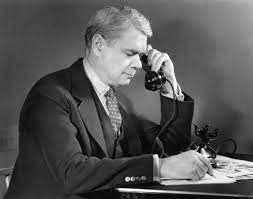
The Chicago Tribune was historically a conservative paper in a fairly moderate to liberal town. Run by the McCormick family, the paper reflected the conservative American values of that family. And practically none of the paper’s reporters was the best embodiment of those values than the firm’s Washington bureau chief, a man named Arthur Henning. Over the course of almost half a century, Arthur Sears Henning reported back to Chicago all the news that the conservative slant of that esteemed newspaper could print.

Henning began reporting from Washington for the Tribune back in 1907, during the William Howard Taft administration. Back then, and up until Teddy Roosevelt a couple of years earlier, most presidents of the United States never held press conferences where reporters could ask questions. No, any time the Chief Executive wished to convey a message to the press, he would call certain reporters to the White House for a meeting. Henning was one of the few that Taft favored, and he was a frequent guest for White House sit-downs with the president. That gave the Tribune many scoops over the years. And it also gave Henning unique insight into the workings of the White House. He got to know the next several presidents well as reporting on what he saw and learned from them.

Woodrow Wilson, he said, was not patient with unintelligent people. Calvin Coolidge, a man notoriously taciturn, would “talk your ear off,” if given a chance. Taft, a large, jovial man, was remembered by Henning as laughing and making his large belly shake like Santa when he told jokes. But Henning had little use for Franklin Roosevelt. The McCormicks were completely against FDR and his New Deal plan for dealing with the Great Depression. And Arthur Henning wasn’t writing anti-Roosevelt news stories simply to please his boss; according to a colleague, Henning was a True Believer. He actually agreed that the policies of the Democrats was tantamount to socialism. Henning would be more at home today on some right-wing media show. Which was interesting, because he had the reputation of being a fun-loving, kindly man who was often generous with his friends.

But that’s not why we remember Arthur Henning. You know about him because of only one story he wrote and for no other. In fact, we can narrow it down even more to three words he penned that you have most likely heard or at least seen. You see, when Roosevelt died near the end of World War 2, the nation worried that the new president, Harry Truman, might not be able to lead the nation like FDR had for over 12 years of first the Depression and then the prosecution of the war. But Truman brought the war to a successful conclusion in the months after assuming the office mostly by following Roosevelt’s blueprint. The peace that followed, however, proved daunting. Inflation, the re-absorption of the millions of service men and women into both the economy and society, the housing crisis, and the rise of communism after the war tested Mr. Truman’s mettle. As 1948 rolled around, it seemed that Truman might suffer an ignominious defeat in the election that year. After all, in the UK, Winston Churchill himself had been ousted after the war ended because people wanted a fresh start.

Henning reported throughout the summer of 1948 about the state of the election. He wrote stories for the Tribune detailing how unpopular Truman was to a wide swath of Americans. So it was no surprise that when election night rolled around, Arthur Henning turned in a story that everyone, including this experienced Washington bureau chief, expected.

The story’s headline?

Dewey Defeats Truman.

On a Nervous Singer

The room began to fill with partygoers, and the sight of all those happy people coming into the union hall gave Ethel the shakes. “Why?” she said to herself; “why would I agree to sing at a New Year’s Eve party in front of total strangers?” The 18 year old girl retreated to a corner of the hall in an attempt to steel her nerves.

A young man with a pencil-thin mustache noticed her sitting in the corner, twisting her handbag in obvious distress. He approached her and asked, “What’s going on with you then?” Ethel looked up quickly. “Hmm?” she asked. He repeated his inquiry. “What’s going on?” Ethel glanced around the young man and pointed to the incoming crowd of revelers. “That. Them. Those people. That’s what’s going on. I agreed to sing tonight, but now, I’m not so sure.”

“Well, can you sing at all?” the young man asked. Ethel looked up at him a bit surprised. “Well, yes. A bit,” she said. “Then, what’s the trouble?” he wondered, and he pulled up a chair and sat next to Ethel.

She looked at him closely. He was somewhat handsome, she thought, with kind eyes behind his round eyeglasses, and he wore a nice smile. “I guess it’s nerves,” Ethel explained. “This’ll be the largest crowd I’ve ever performed for.

It was New Year’s Eve, 1935, and the Union Hall in New York City was buzzing with excitement. The Great Depression had put a damper on such celebrations in recent years, but the Roosevelt New Deal programs had begun to have a positive effect in some segments of American society by that point. The Union Hall was where what we today might refer to as socialists would meet to discuss how they could help affect even more change in the capitalist system. As they saw it, the moneyed interests represented the biggest culprit in the crushing of the American worker underfoot in recent years. The hall that night was filled with other, young and idealistic young people who put economic theory on the backburner for one moment and wanted simply to have a good time and welcome in what they hoped would be a better year to come for their cause.

And Ethel had agreed to sing. And now she was having second thoughts.

Well, the young man calmed her down. He politely excused himself and returned in moment with a drink that Ethel gladly accepted. She gulped it down, and he smiled at her. “Say, let’s go there (he pointed at this point to a nearby room), and you can sing to me to practice. It might also calm you down some.” Ethel smiled and agreed.

And it worked. Ethel sang that night, but she was singing to her new friend, the young man with the nice smile and the kind eyes and the round glasses and the dapper mustache. And he was waiting for her when she came off the stage to a nice round of applause.

“What’s your name?” he said over the clapping. “Ethel,” she answered, “Ethel Greenglass. And what’s yours?”

The man who would become her husband three years later, the man who would become the father of her two sons, and the man who would seal her fate, answered.

“Good to meet you. I’m Julius Rosenberg.”

On an Odd Propensity

There have been 14 Presidents of the United States of America since World War 2. Of those 14, six of them share a common characteristic that is also shared by around only 10% of the population of the world. What could that be, and why have so many presidents in recent decades shared this propensity?

Psychologists have argued that one reason for the high incidence among presidents is that having this characteristic causes one to have a wider scope of thinking, making them if not more effective as presidents, at least it could help explain why they are at least attractive as candidates. People who are like this tend to face challenges better and share an “outside the box” thinking ability. They tend to be able to generate ideas given a certain set of parameters better than the rest of us. I say “us” because I don’t fall into this category.

On the other hand, some researchers say it’s all down to chance and that this particular propensity has nothing to do with electability.

I’ll even provide the list for you so you can maybe see or decide what these six men have in common: Harry Truman, Gerald Ford, Ronald Reagan, George H. W. Bush, Bill Clinton, and Barak Obama. If you’re wondering, that three Republicans and three Democrats, so it’s not party affiliation. It’s something else these six men share.

Well, obviously we’re talking about a physical characteristic to a degree. And that’s what researchers find so interesting, because scientists simply don’t know what causes it. Some studies say that this trait is connected to the development of speech and language, but nothing has been conclusive. Statistically, the 10% and the 90% differ in intelligence tests scores by a whopping 1 point. Left to their own devices, they tend to take tests faster than the 90% as well.

Interestingly, it has shown up to a higher degree in people who are really good at math (another reason I’m not in this group). Low birth weights seem to contribute to the likelihood as well as problems during childbirth. Higher cancer and depression rates occur, but they have lower rates of ulcers, arthritis, and even bone brittleness. And, we have to hand it to them; many people who are in symphony orchestras have a higher chance to be this way as do many pro athletes (tennis and baseball players, mostly).

Give up? Some clues were dropped in this essay, so you should’ve guessed it by now. What do six of the last 14 presidents have in common?

They were left handed.

On a Complete Rehab

Lorenzo Winslow is a name you probably don’t know. Lorenzo was a high-priced architect on the East Coast in the middle of the last century. During World War I, Lorenzo was in the Army Corps of Engineers in France, and, after the war, he studied architecture in Paris. Coming home after his education, Lorenzo worked for a prestigious architectural firm in North Carolina. Eventually, he moved a bit north and began specializing on designing houses and, for a time, he was employed by the US Government where he worked on a partial rehab of the Statue of Liberty. However, Lorenzo’s passion was private residences. He received a call one day about a commission for a house that would prove to be one of his most challenging.

It was a rehab job, he was told. The house was one of those old, early American Eastern Seaboard piles that had been allowed to fall into decline over the decades. Lorenzo made the trek to the house to see it for himself. The resident met him and took him on a tour. Impressive place, he thought, old but with potential. It worried him that the floor slanted and the old chandeliers shook when one walked on the floors above them.

After a more detailed inspection with his engineer, Lorenzo informed the client that, yes, the house could be salvaged, but it had to be immediately gutted, leaving only the shell from which to reconstruct the house. The client questioned that level of reconstruction; the price Lorenzo quoted for the repairs rivalled what it would cost to raze the structure and rebuild from the ground up.

Lorenzo argued against that. He said that the 150-year-old house had good bones and some historical significance and should be saved, if possible. The client rubbed his chin in thought and agreed. Lorenzo further told the man that he had to vacate immediately, that parts of the structure was unsound and was in danger of collapse. The man’s wife balked at this despite the fact that a piano on the second floor almost fell through to the floor below. The wife loved the old place since the family (a daughter also lived there) had moved in a couple of years before, taking possession from another family who’d lived there for over a decade. Finally, and reluctantly, the wife agreed to move out while the rehab took place.

Soon, Lorenzo’s contractor had all interior walls removed. The house barely resembled what it was before, and the client began to question whether such drastic measures were needed. Lorenzo insisted that they were. He took the man on a tour of the work, and he pointed out that, sometime in the past, the structure had even suffered a fire; burn marks on some support timbers and scorches on the masonry proved his point. The client showed up several times during the almost three-year rehab and walked through the changing interior of the house. He was always amazed at the scale of Lorenzo’s vision for the work.

As these things often do, the project ran over time and over budget. Both of these contingencies angered the client. He didn’t exactly blame Lorenzo, but, being a man who usually pinched pennies, he felt that somehow he had not gotten his money’s worth out of the reconstruction.

“I could have done all of this for half the money and half the time,” a frustrated Harry Truman said on his first night back in the renovated White House.