
On a Ruptured Appendix

Appendicitis is handled fairly easily by hospitals and doctors today, but that wasn’t always the case. Before the wide-spread use of antibiotics in the years following World War 2, the infections caused by ruptured appendixes proved to be over 80% fatal according to some medical sources. That infection–peritonitis–was the issue in this case.

Erik was said to be a stubborn man. His wife, Bess, said in later years that she had to beg and beg Erik to go to a hospital and have his appendix checked out. When he finally did go, and the doctors removed the appendix, it was too late. The ruptured organ had infected the stomach cavity. See the paragraph above to understand Erik’s chances of survival in this situation.

The stubbornness that characterized his hospitalization manifested itself early in the man’s life. He ran away from his Appleton, Wisconsin, home at the age of 9. At the end of the 19th Century, that type of thing was not as uncommon as it may seem. However, Erik ran away because his clergyman father and he fought with each other all the time. Dad had plans for his son, but Erik had other ideas about what he wanted to do in life.

Bess had been a blessing to Erik. The pair met and married in 1894. While they never had children (Bess, her family said, was infertile), she looked after a wide variety of pets the couple adopted throughout their marriage while Erik worked and provided for them.

In his hospital bed, Erik’s temperature reached 104 degrees. The stomach interior was septic. The doctors tried another surgery in an attempt to introduce some anti-bacterial serum, but it had no effect. “Bess,” Erik said, in the last words he would utter in this life, “I’m tired of fighting.” She held his hand as he passed. Erik became simply another statistic, someone who died of an infection that is easily dealt with today.

For the next decade after Erik’s death, Bess tried to make contact with her husband through seances and the use of mediums, but she knew that they were all fake, all charlatans. She wanted to prove that they were all crooks, in fact, and called them out when they couldn’t communicate with Erik. And, Bess also knew that Erik would have approved of her efforts.

Of course, we know Erik Weiss by his stage name.

You see, besides being a wonderful magician, Harry Houdini had also made quite a splash as a debunker of spiritualism.
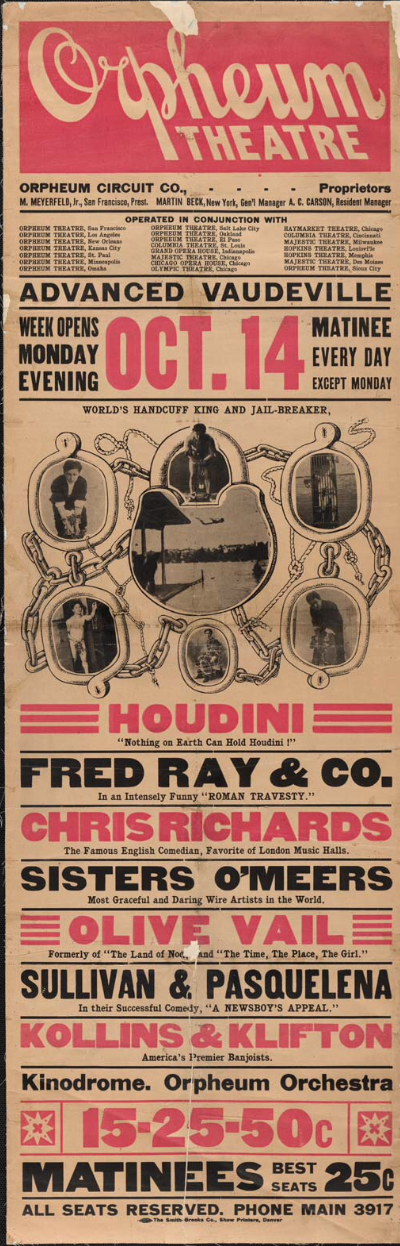
On a Vaudevillian


Vaudeville is largely unknown by most people in the world today. 120 years ago, vaudeville was the major form of entertainment in most small towns. Films were in their infancy, and they had yet to make an impact in the American psyche.

Vaudeville acts would tour the country, and, if you lived in a certain town, you might see a different act every week at your local theater. The act would contain everything from musical numbers to small dramatic works, magic acts or even trained animals.

A baby named Joseph was born to a vaudeville family in 1996 in a small town in Kansas. Joe was born there simply because that’s where the family happened to be performing that night. So, it is entirely fair to say that Joe was born to the stage. His dad partnered with a magician who would later go on to great fame, a guy named Harry Houdini. Joe’s dad would perform with his wife and, after Houdini did his magic act, Dad would also sell elixirs and patent medicines to make a few extra bucks.

Joe got in on the act within a few months of being born. As his mom would play the saxophone on the side of the stage, Joe’s dad would toss his young son around the stage, and the baby would giggle. This delighted audiences after they recovered from their initial shock of seeing a child being thrown around so casually. But Joe learned early how to land like a cat; he later said that the secret was to go limp and then catch yourself with an arm or a foot. “Most people don’t last long in this business because they don’t know how to do that,” he explained.

Early on, Joe realized that the laughs from the audience would be greater if he did not giggle so much when his dad tossed him around so cavalierly. So Joe learned to show no emotion during the act. His deadpan face caused the audience to roar even louder. That meant more money for the family.

Years passed , and Houdini left the act to go on to bigger and better things. Joe’s dad began drinking heavily. The family tried to improve their fortunes by going to the UK on tour, but that venture failed miserably and put the family in debt. Joe’s mom eventually took her son and came back to the US. More years passed, and Joe served in France in the army during World War 1.

In New York City, Joe met a guy who worked in the burgeoning new film industry. On a tour of a New York studio, Joe expressed his fascination with the medium, and he asked if he could take one of the cameras home with him. There, he took the contraption apart and looked at it carefully. The next day, he came back and asked for a job and was hired as a bit player and “gag man.“

By 1920, Joe earned his first starring role in a full-length motion picture. Soon, he was one of the biggest stars in the genre, writing, starring in, and even directing his own films.

In an interview, he talked about his early days in vaudeville and how he got the nickname by which he became known around the world. “As a baby, I fell down some stairs and landed at the bottom without being hurt. Harry Houdini laughed at that and said, ‘That boy’s a real buster!’”

Thats why you know him as Buster Keaton.