On a Polite Man

March 4, 1889, was a cold and rainy day in Washington, D.C. The newly elected Benjamin Harrison was due to be sworn in that day as the 23rd President of the United States. Harrison, a Republican, had been elected in an incredibly close and sometimes bitter election, defeating the Democratic incumbent, Grover Cleveland. In fact, Harrison had lost the popular vote the previous November, and he won the electoral college vote because he had narrowly won the state of New York despite Cleveland’s workings with the Tammany Hall political machine there.

No matter. Harrison was the man of the moment, and he felt the hand of destiny upon him. He was the grandson of a previous resident of the White House, one William Henry Harrison, known as “Old Tippecanoe” for his victories in wars against first nations more than half a century before. And he had been a senator from his adopted state of Indiana and served that state well in the US Senate. Also, Harrison had seen a great deal of action in the American Civil War, working with General William T. Sherman to split the Confederacy in half in the war’s last full year. So, all of that background led him to the inaugural day, and the rainstorm that beset the capital that day.

Interestingly, Harrison’s grandfather has the distinction of serving as president for only one month. It was during his ancestor’s inauguration during a winter storm that Old Tippecanoe had spoken for over an hour, and, as a result, he caught pneumonia that eventually led to his death and the rise of his Vice-President John Tyler to the office. Benjamin Harrison was well aware of his grandfather’s legacy, and his planned remarks were purposefully short. He wanted to touch on several key issues, however, in his speech. After such a contentious election, he felt that the occasion called for extending an olive branch to the Democrats and to the southern states that still stung from the defeat in the war that was still fresh in many minds down there.

In many ways, the election was a choice between personalities, as many elections are. Cleveland had raised some eyebrows during his term by marrying a young girl barely out of college for whom he had been appointed a guardian after her father had died. Harrison, on the other hand, was seen as a steady, solid, traditional candidate in sharp contrast to that type of “unseemly” behavior. Much muck had been thrown during the campaign over Cleveland’s unusual marital choice, and that had also caused some harsh feelings between the two campaigns.

But Harrison wanted to rise above all that electioneering. After the oath of office, and as he stood to read his prepared speech in the pouring rain, it quickly became obvious that there was no way Harrison could read what was quickly becoming a smeary sheaf of papers in his hand. It was then that a man emerged from the crowd on the platform behind Harrison, a man who quickly stepped up and held his umbrella over the head of the new president and kept it there while he finished his inauguration address.

When Harrison finished, he looked up to see who the kind man was who had allowed himself to get soaked so that the new Chief Executive could read his remarks on that historic occasion.

Harrison smiled and nodded when he realized that the polite man who had held the umbrella was none other than Grover Cleveland.
On a Secret Cancer Surgery

The doctor said to the large, wealthy gentleman, “That thing is a bad-acting tenant, and I would have him evicted immediately.” It was the surgeon’s way of telling the man that the cancer that had been discovered on the roof of his mouth required surgery. The gentleman smiled at the doctor’s small joke, but the point was made. Surgery was scheduled.

Now, this was 1893, and a cancer diagnosis then was pretty much a death sentence. We forget how far cancer treatment has progressed in past 130 years since then. But at that time, well, all a surgeon could do was cut away until he felt the cancer was removed, and then everyone simply hoped for the best. Post operative treatment such as any type of radiation or chemotherapy was decades in the future at that point. But the gentleman trusted his doctor, and knew that the surgery was his best, and only, chance at surviving the bad “tenant.”

The patient was in relatively good health for someone of his size and age. In his late 50s, he stood almost six feet tall and weighed nearly 300 pounds and was remarkably active for his condition. He was what some today might call “fit-fat,” in that the weight he carried hadn’t reached the point that he was incapacitated by it. No, he worked for hours daily, walked often, and enjoyed life. However, he was an inveterate cigar smoker. And the cancer had come from. And the cancer–well, left unchecked, the man would be dead sooner than later. He was sicker than he realized.

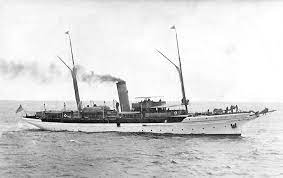
Now, this man was important to Wall Street, a man whose influence had power over the rises and falls of the stock market. To announce that he had cancer could affect the markets at a time when the United States was entering an economic downturn. Newspaper reports of the man’s cancer could send stocks tumbling. And if he were admitted to a hospital, someone might recognize him and spill the beans. So, this upcoming cancer surgery would have to be done in secret. And, so, a wealthy friend of the gentleman offered him and his doctor the use of a yacht, the Oneida, as a place for the surgery. The boat would be offshore of the man’s summer home at Cape Cod, Massachusetts. The story was put out that the gentleman wanted to relax and do some fishing for a few days.

A team of six surgeons performed the delicate operation despite the moving boat and the rocking waves. It took them only 90 minutes to remove most of the roof of the man’s mouth, much of his upper left jaw, and several teeth. And they pulled all of that through his mouth rather than create an incision on his face. The thought was that no one would know about the surgery to look at him–other than a tooth extraction. The skilled surgical team even managed to salvage his distinguished mustache.

The operation was a success. The surgeons removed all the cancer. The gentleman would live another 15 years, but for the rest of his life, he wore an artificial rubber plate inserted where the roof of his mouth used to be.

But, if you looked at President Grover Cleveland, you’d never know it.

On a May-December Romance

Frank’s Uncle Steve loved the teen dearly. The uncle wasn’t really an uncle, actually, but a close family friend and Frank’s dad’s law partner. The pair had known each other since Frank was born, in fact. And, despite the fact that Frank’s “uncle” was 28 years older, the pair fell in love even while Frank was a teenager.

Frank’s dad died in a vehicle accident when Frank was only 11. And when Oscar, Frank’s father, died, this Uncle Steve had become Frank’s guardian and protector since the two men were close due to being law partners,and since there was no other relative who could provide for the young person financially. Oscar had been stupid with his money; he gambled and gave away much of his wealth. That’s why Steve had to step in and take charge of raising the youngster.

Steven often brought the teen into his house, but there is no evidence that anything physical or sexual happened between the two at that point. Steve had been a confirmed bachelor his whole life, and it seems that his love for Frank was really the first time he’d shown any interest in, well, anyone at all from the perspective of love. Would it surprise you to learn that Frank’s mother approved of the relationship between Frank and this much older man? The mother did, actually. Steve even asked permission from Frank’s mom before he asked for Frank’s hand in marriage. Frank’s mom approved wholeheartedly.

Frank really liked photography and political science. At college (a college that Steve picked out and, of course, paid for), Frank excelled and became incredibly popular. Good-looking, smart, and with a maturity that belied the fact Frank was a teenager, several suitors tried to woo Frank during college. One almost succeeded, but Frank turned the boy down. After all, Frank knew that Uncle Steve was waiting. After graduation, Uncle Steve insisted that Frank take a trip to Europe to help “round out” the education received at college. It’s interesting that throughout all the college years, the trip to Europe, the various boys who tried to take Frank’s attention away, nothing changed Frank’s mind about being in love with Uncle Steve.

Finally, when Frank finished school and became 21 (and Uncle Steve was 49), the two lovebirds wed in a simple ceremony before only 31 witnesses.

It was the only time a sitting President of the United States, one Stephen Grover Cleveland, married in the White House. And his young bride, (who was christened Frank Clara Folsom), known publicly as Frances Folsom, would go on to have several children with Cleveland, including one named Ruth–whom you probably know as Baby Ruth because a candy company named one of their candy bars after her.