On a Therapist’s Notes

The psychologist watched through the window of his office as the patient left the building. He turned to his desk, picked up a large microphone, and reached beneath the desk where a recording device stood ready.

A metallic click was heard as he began the recording. He picked up his notebook of the details of the meeting and began speaking.

Meeting Notes for Patient 1548, David W., 9 October, ’31.

Patient spoke at length today about his childhood and his formative years. He began with some of his earliest memories of being raised by a nanny more than his mother and father. Patient reported that the nanny would pinch him and cause him to cry when handing him to his mother or father so that the parents would immediately hand him back to her. He only realized this as a young man, but, at the time, he saw this as a rejection by his parents.

He then spoke about his father, who he reports was a stern disciplinarian. Such was the harshness of the father’s discipline that patient’s brother developed a stutter in response to it. Patient says he was able to emotionally disconnect from the relationship early on. On the other hand, patient spoke fondly of his grandfather and grandmother, with whom he would spend many holidays. His father, wishing the young boy to learn discipline, sent him in to the navy at age 15.

The father then decided to send patient to university, but he says that he was not intellectually or emotionally ready for academia. He dropped out without completing a degree. Patient says that his failure at university greatly disappointed the father. When the war began, the father then insisted that the patient enlist in a front-line unit, but he says he saw only limited action despite being sent to the front lines. Patient seemed a bit embarrassed by his lack of heroism in the war. I reminded him that he performed well enough to earn the Military Cross in 1916, but he waved that off. His father, he said, was not impressed despite positive reports of his bravery by his senior officers.

Patient exhibited strong emotion when speaking of the death of his youngest brother, Johnny. The boy apparently died from seizures at age 11 when patient was 23. Patient said he wrote a strongly worded letter to his mother and father, accusing them of keeping Johnny caged in his room like an animal, and that his body was discovered much later after the seizure. Although he claims he “barely knew” his little brother, he felt it incumbent upon himself to chastise his parents for their neglect. When asked why he felt it was his responsibility to speak on behalf of a brother he had no close relationship with, patient tearfully admitted that he was writing his parents to take out his own lack of relationship and responsibility for his younger sibling and project it on her.

Patient agreed to return next week, and said he wished to speak of his new relationship with an American divorced woman.

Transcribe and put into patient’s file.

The psychologist turned off the recording device and sat back in his chair. He looked out the window at the London street that bustled with traffic. He let out a small sigh.

No one said that being a therapist to Edward, Prince of Wales, and next in line to the throne of the British Empire, would be easy.
On a Family Wedding

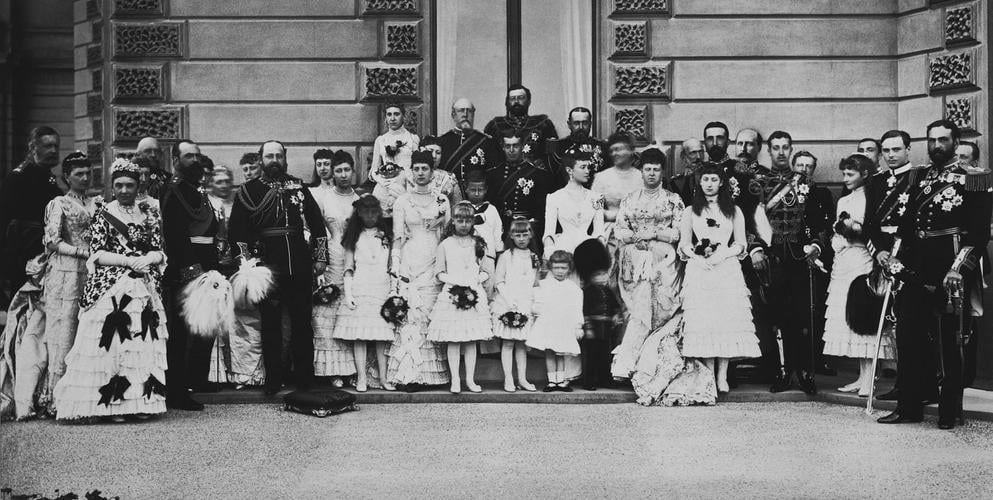
Weddings are usually joyful occasions for families. Large families especially mark weddings and funerals as major events in family lore. Those major life events are times of reconnecting with cousins and distant relations that you don’t normally get to see. That was definitely the case of a large family wedding that took place in 1913 in Berlin.

The bride, Vicky, was marrying a guy she’s gotten acquainted with the year before at, of all places, a family funeral. He was even a distant cousin, and his name was Ernie. Vicky’s dad, from the wealthy class, wanted everyone to come to the nuptials of his only daughter (and favorite child), so he sent word to all the family to make their way to Berlin in May 1913 for the wedding of the decade. He also wanted to use the event to bring the family closer. It’s difficult to keep so many people in touch, especially when there are as spread out as Vicky’s family was. So, the extended family began making their way to the city to witness what surely would be a grand time.

Since this family was from the land-owning class, many of the men in this large group were attached to the military, so the wedding party was resplendent with fancy dress uniforms and gleaming medals and swords. The women wore their best expensive gowns to not only the ceremony but also to the various balls and dinners held to celebrate the happy couple’s wedding. Tens of thousands of German marks were spent on the catering, the bands, the alcohol, the gifts, the decorations, and the cake (the height of which reached almost one story, according to one report).

And, so, it proved to be exactly what Vicky and Vicky’s dad wanted. It was indeed an affair that brought this large, wealthy family together in celebration. Yes, it proved to be an amazing time that was reported in all the papers, an event that people were destined to talk about for the rest of the decade.

Except they didn’t talk about it.

The wedding was forgotten in a little over a year, lost in the disaster that was to follow over the next five years.

You see, Vicky, the bride, was named after her great-grandmother, a woman named Queen Victoria of Britain. Her dad was Kaiser Wilhelm of Germany, and the cousins that came to the wedding–the crown heads of Europe, including King George of Britain and Czar Nicholas II of Russia, and all those other men who wore their uniforms to the event–they went back to their homes and their armies and navies.

And, within 16 months, they would start World War I against each other, in August of 1914 to be exact.

And Vicky’s wedding would be the last time all those royal cousins saw each other alive.

On a Name Change

What’s in a name?

My dad’s dad came from Greece to the United States in 1907. His Greek name was Papapistolos, a name so long it would need two mailboxes so all the letters could be seen by the postman. The family lore says that, since my grandfather wanted to work in the steel factories around Pittsburgh, PA, he chose the last name Millson as his “American” name. After all, he wished to be a “son of the mill.” I like that story, even if it’s probably apocryphal.

Families choose to change their names for many reasons. Sometimes, the act represents a new start as in the case of my grandfather. Sometimes, a name can be a tribute to the past or to a particular person or tradition. I’m thinking of some celebrities lately whose families chose more “American” sounding names and have Jewish heritage and who are now choosing to return to a name that reflects that heritage more. Sometimes, names are changed for political reasons.

During World War I, anti-German sentiment in the United States was so high (despite German being the second-largest ethnic group in the US) that many Americans with German-sounding names changed them in order to not have their loyalties to the US questioned at all.

George was one of those on the allied side who felt that his German-sounding last name might cause some to wonder where his loyalties really were. Mary, his wife, while not born in Germany, also had a German last name because both of her parents came from there. The couple discussed the issue at length. Their family was large, and whatever choice they made would have far-reaching impact on generations to come. Yet, anti-German feeling was so strong that there had been news reports of street violence against people who were discovered with names like Schultz or Mueller or Baum. Such stories frightened both George and Mary.

The couple decided to take the step and make the change. They weren’t sure how to go about it. They knew it would require much paperwork and legwork to accomplish, but they were willing to put in the effort. The next thing was for George and Mary to decide what their new family name would be. One man who worked with George suggested that they take the name of a famous nearby building. It sounded distinctly English, and no one could possibly mistake it for anything but. George ran the idea Mary, and she whole-heartedly agreed.

So, on July 17, 1917, King George V and Queen Mary abandoned the last name Saxe-Coberg-Gotha and chose instead the last name Windsor.