On a Complex Occupation

Imagine stumbling upon a large complex of buildings, so vast and so beautiful, that words to describe it would fail you. Imagine architecture so complex and intricate that it surpassed anything you’d ever seen in your lifetime. Well, such a place exists in this world today. It’s visited by thousands each year, and all of the visitors come away from the encounter stunned and awed.

One of the first men from Europe to bear witness to such a place wrote of it saying, “The pen cannot describe what it is like; there is nothing like it in the world.” Another early European visitor said that something so vast and exquisite could only come from the hand of someone like Alexander the Great, or, he argued, perhaps the Romans could have conjured such grandeur but no one else.

Wrong on both counts.

Some Europeans saw it as something like an ethereal palace compound that was built for some special, holy king. Others insisted that the place was a palace constructed especially for one of the gods himself. In the early 1860s, a French explorer and naturalist said it was grander than anything designed by Europe’s greatest architects, decorated by painters and artists greater than Michelangelo, and that the entire place made all of the buildings in the rest of the world appear to be “barbaric.”

It was, and is, none of these things.

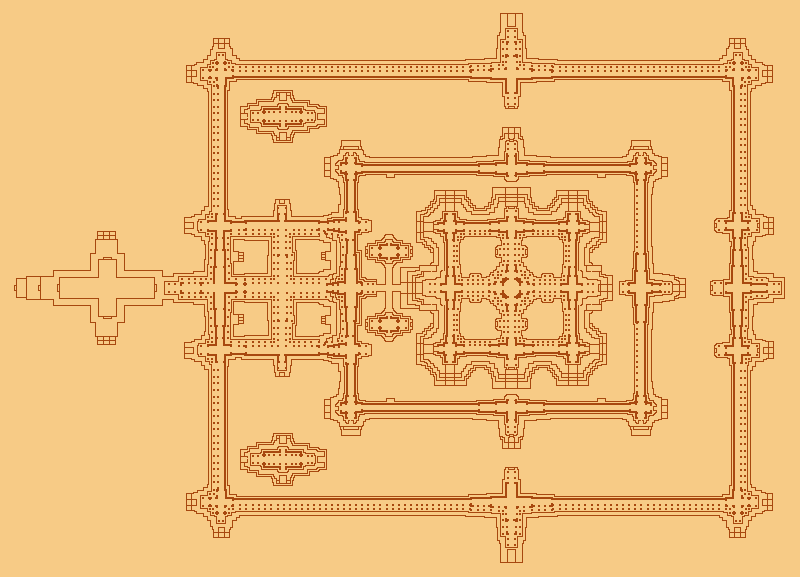
What we know for certain is that this complex was constructed using about 7,000,000 sandstone blocks. the largest of which weighs almost two tons. More stone was used in this place for construction than in all of the pyramids combined, while the area of the complex is larger than the area of modern-day Paris, France. What’s more, almost every square inch of this monstrous place features intricate carvings. It rises in parts to over 200 feet above its base, and, incredibly, records indicate that this amazing complex took place over 28 years to complete. We also know that it was constructed using rudimentary tools in the early 1100s A.D.

Yet, no one lived there. There’s not a trace of houses or household artifacts or anything used in daily living. And that is by design. The Europeans were largely clueless as to the complex complex’s purpose, the meanings of its decorations, and the intent of its planners. They didn’t realize that it was built first as a Hindu and then eventually turned into a Buddhist temple complex.

But Angkor Wat so captivated the French imagination that, under the pretext of saving the temple complex and its artistic treasures, the French government launched a military campaign that led to the occupation of Cambodia and Vietnam and the eventual establishment of French Indo-China.

On the Father of His Country

We all are familiar with the story. Every school child should be able to recite it. The patriots, led by one daring and experienced man, win a great victory over the colonial power and create an independent nation from a loose confederation of former colonies.

We even have a title for the type of man who leads such a successful military rebellion against the colonial master: The Father of His Country. Such a man as this should be lauded, shouldn’t he? Shouldn’t he have mandated federal holidays, celebrated for generations for his amazing contribution to the founding of the nation?

Fighting against the much better trained and much better equipped colonial power, this man used his cunning and small-group tactical experience to fight a guerilla war against the slower, larger colonial forces. It was the smaller victories, he always said, that would slowly chip away at the edifice of the entrenched European power until final victory was achieved. The result? Independence. Freedom. Peace. Prosperity. All the things new nations wish for themselves.

And, after the great victory over the European power was achieved, all that was left was for the will of the people to have this man elected as the first President of the new nation. He was the logical choice, obviously, because not only of his military victories but also because of his charisma, his way of commanding a room when he entered it. No one else in the new nation, it was said, could bring the disparate parts of the country together like he could, either. No one else had his stature, his beloved reputation. Yet, despite the acclaim, he characteristically insisted that he not ever become an emperor or a president for life. That was not his style. The people, he insisted, the nation–those were his priorities.

Yet, the new nation had its enemies. The old power base from the European colonial country still lingered in some pockets of the new nation. Internally, over 1/3 of the population did not like the idea of a new country led by this former military leader. Talks of civil war and rebellion filled the land. Yet, he held his loyal countrymen together by and large. They loved him, especially those who had served with him in the great Revolutionary War.

On top of this, he was a learned man. He had received the finest education possible as a young man, and he spoke several languages. He was also a poet, and he wrote extensively about basic human rights. “There is nothing more precious,” he once said, “than independence and liberty.” At his large but simple home, he enjoyed gardening and taking care of such animals as the fish in his pond, which he fed regularly. When, after a long career of public service, he passed away of heart failure at age 79, he was mourned by hundreds of thousands of his countrymen as, again, the Father of His Country.

Busts, statues, plaques, and monuments have been erected to him in the many years since his death. Streets and universities, schools, and even religious sites bear his name today. Even a city in the new nation was christened in his name:

Ho Chi Minh City.