On a Heroine

Louise Julien died at a much-too-early 38 years old of tuberculosis on the British island of Jersey. She went there in 1853 for her health after leaving France by way of Belgium, but by the time she reached Jersey, the illness was too far gone in her weakened body. Louise had been born in Paris, the illegitimate child of a seamstress and a minor Portuguese nobleman. Louise came into the world at a time of great upheaval in the history of France. Napoleon had only recently been removed and exiled, his attempts at European domination finally thwarted. France had to get used to a new government, and the changes brought about by the French Revolution and Bonaparte’s reign were still being processed by the culture and society.

From a young age, Louise was different than other girls. Strong-willed and almost foolishly brave, she eventually married a tailor but chose to go by the last name Julien rather than her husband’s name. She made money singing in workingmen’s clubs, becoming rather popular in those circles. And that experience helped her develop a sense that workers were, by and large, still at a disadvantage in French society despite the changes the revolution had brought. In addition, she made a reputation as a poet.

In 1848, France experienced another revolution, as workers rose up and demanded more rights and accommodation in the public weal. It began in Paris, and Louise was at the forefront of the movement. The Second French Republic was proclaimed as a result, and some major changes were made in society. But then, Napoleon III, the nephew of the former emperor, staged a coup and declared himself the new French Emperor. Again, Louise took to the streets in protest, urging her comrades to march against the illegal takeover by public demonstrations. The will of the people must be heard, Louise said, and the only way those in power would hear the people’s voice would be through mass demonstrations. In a skirmish with government troops, Louise was injured and then arrested by the new government for being a dangerous revolutionary. It was in prison that she contracted the tuberculosis that eventually took her life on Jersey.

At her funeral in Jersey, the famous author, Victor Hugo, and the poet of the Second Revolution, Joseph Déjacque, gave eulogies over her coffin. Hugo’s speech in particular was so moving that Parisian newspapers reprinted it, and the story of Louise’s heroic efforts on behalf of the revolution and French workers was retold for generations afterward. But that’s not why most people remember her today.

No, we remember her for Hugo’s memorialization of her, at least indirectly. You see, when it came time some years later for Victor Hugo to put pen to paper and write the great novel of the French Revolution of 1848, he used Louise as the inspiration for one of literature’s most enduring characters. He was looking for a character who, like Louise Julien, lifted herself from humble beginnings and attempted to make her world a better place. Thus, you know Louise Julien best as the character Cosette, the girl adopted by Jean Valjean, in Hugo’s landmark story, Les Misérables.

On a Delusional Young Woman

She began hearing the voices in her head when she was 13 or so. The girl, a product of rural peasant stock in Domremy, France, seemed to be a most unlikely person to receive messages from the beyond. She had no education. She wasn’t a religious novice. No, all the girl did was help keep the cows her family farmed. Barefoot, she’d take the animals to pasture during the day and bring them home at night, milking them early and late. Oh, and the voices didn’t speak to her all the time. Bright lights often triggered the voices, she said. And bells. When the church bells in the nearby village would ring, announcing church services, she’d experience the voices more clearly than ever.

As the girl began to tell other people in the area about the voices and their messages of heavenly instruction, those people began to listen. The time period was back when people were much more superstitious, and those superstitions were tied to religion. When someone came along professing to have supernatural, other-worldly insight, the people of that day took notice. She gained somewhat of a following, with other peasant folk starting to seek her out to learn what other messages the divine was sending through the young girl.

Her parents, Jacques and Isabelle, told people that their daughter had been odd for some time. She didn’t always have this gift of hearing the voices, they said. No, she also had visions, but she didn’t talk about those much. She would seem to go into a trance and then reveal what she had seen and heard. Oh, and the family reported that she had a terrible temper; her short fuse often resulted in some mild violence if she felt something displeased her sensibilities, especially when her brothers, Jean and Pierre, would offend her somehow.

Based on these details, modern scientists have made some broad guesses as to what possibly could have triggered the girl to have those visions and to hear those voices. Some have suggested that she had a neurological issue or a psychiatric disorder. Some postulate that she was bipolar or had been the victim of a brain injury sometime in her younger life. Others, usually medical historians, point to some disease that could have given her dementia. The truth will probably never be discovered.

At any rate, by the time the girl was 16, she was noticed by higher authorities in the Catholic Church. And those authorities, in a time when France was locked in war with England, saw in this odd, seemingly god-sent young maiden, someone they could use to rally the people to their cause. The war had gone on so long that people began losing hope, and the powers that were decided the girl could be useful. So, incredibly, the authorities used this possibly mentally challenged young girl to their own ends; they capitalized on her notoriety, gave her a symbolic role in the war, and used her until, well, they couldn’t anymore. Eventually, she was captured by the English and killed for being a heretic.

You might think you know her name, but you’d probably not get it right. She called herself Jehanne la Pucelle–Joanne the Maid–at a time when most people still didn’t have last names as we know them today.

Of course the name you know her best by is the one that was never really used by anyone at the time.

Joan of Arc.

On a Tourney Win

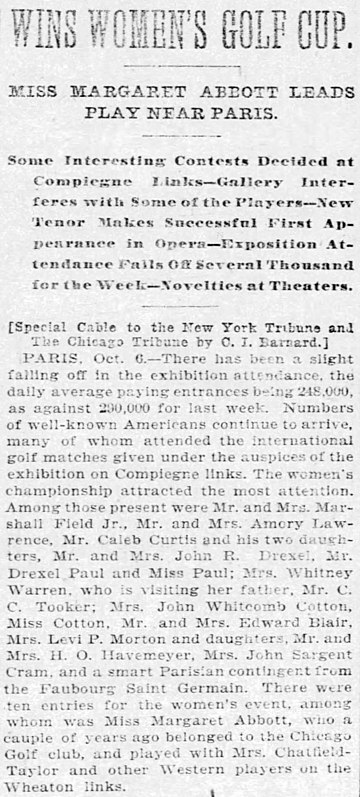
Margaret Abbott was an American amateur golfer at a time when “ladies” didn’t really play competitive sports. She was born in 1878 in India where her parents had moved because her father had business there. Her mother was equally accomplished, becoming a newspaper reporter and literary editor for many newspapers in the United States. And Margaret herself lived a privileged, full, and varied life before dying in the 1950s. She studied in the United States and abroad, but it was while her family lived in Chicago that Margaret first began to take golf seriously.

And she was naturally athletic. A couple of local amateur golfers (true gentlemen of the time refrained from being crass professionals, don’t you know) from the club where her parents were members took Margaret under their wings and taught her all they knew about the game. Under their tutelage, Margaret’s golf game rapidly advanced far beyond others her gender and years. She won several tournaments in and around Chicago and beyond and developed a reputation for being a fierce competitor.

Then, in 1899, Margaret and her mother traveled (by themselves! Amazing!) to Paris for the pair of them to study art. Margaret’s mother also used the time to pen a travel book for American women who had the same desire, entitled A Woman’s Paris: A Handbook for Everyday Living in the French Capital. The two women had a wonderful time, enjoying all that the fin de siècle era Parisian culture had to offer.

It was while the pair were in France in the summer of 1900 that they noticed a newspaper article stating that, in association with all that was going on in Paris that year, a golf tournament was open for any and all entrants. And there was indeed a great number of events happening in Paris that summer. The Paris World Fair was held that year. The French capital city hosted the second incarnation of the modern Olympics that summer as well. The city was filled with tourists from across the globe. And then here was this golf tournament. Now, Margaret’s mother was no slouch at golf, either, and the mother-daughter team decided to enter the tournament.

And Margaret won. By two strokes. And Margaret’s mother finished the tournament a respectable seventh. And, for her win, Margaret was awarded a beautiful porcelain bowl that had gilded embellishments around it. The story of this American girl winning the Paris golf tournament made the US papers, but the story was quickly forgotten.

Margaret got married eventually upon her return to the United States. She raised a family. She played some golf, but an old knee injury made her give up the sport. Almost thirty years after her death, her son, Philip, received a phone call from a professor at the University of Florida, a woman named Dr. Paula Welch. Dr. Welch asked Philip about his mother, about her life and then about what she told him of the tournament she won in Paris three-quarters of a century earlier.

Philip was surprised. His mother really hadn’t spoken much about it, he said sheepishly. I mean, he said, it was only another tournament, and she competed in many during that time. According to Philip, Dr. Welch was silent on the other end of the phone line for a moment. In fact, he wasn’t sure if the professor were still there. Finally, Dr. Welch spoke, and what she said stunned Margaret’s son.

“You mean your mother didn’t tell you that she was the first American woman to have won a gold medal in the Olympics?” she asked.

On an International Soccer Match

The 2022 FIFA World Cup soccer (football for the rest of the world besides the US) tournament in Qatar has been the source of controversy for several reasons. Staging such an international extravaganza in the middle of a war in Ukraine, with Covid-19 still being a major health crisis, and with charges of bribery and malfeasance on the part of FIFA as well as the abuse of foreign workers by Qatar…well, you get the idea.

1914 was a similar time to hold an international soccer match. The turmoil in the world at that time was palpable. Yet, England and Germany, two rival nations, faced off in a friendly match outside of any tournament. In fact, it wasn’t only one friendly, but, rather, a series of games played across one wonderful and improbable day. The event was so historic that the British supermarket chain, Sainsbury’s, later made a short film about that day. The story of how all that came about is still a bit murky, however.

One major obstacle to overcome was a basic lack of trust. The two nations had no reason to believe that the other one would honor the agreement to play, even. Such was the fear each nation had of the other at that time. Officials from both countries even tried to stop the games, but it was the players themselves on both sides who insisted that the series should be played. There was no stopping them, apparently. These men wanted to play the games no matter what the higher-ups said.

And played they were.

One interesting aspect of these particular matches was that the participants were all amateurs. FIFA, which had been created a decade earlier, had sanctioned matches between England and Germany, and, indeed, the national teams from the two countries had met on the pitch four times in the previous six years in FIFA-sanctioned games. England had won 3 of them, and one of them ended in a draw. However, these games were neither FIFA-approved nor played by the nations’ national squads. Besides, the games had no referees and no real goals.

You see, it was Christmas Eve, in France, in that first December of World War I. And along a 20-mile long stretch of no-man’s land between the English and German trenches, soldiers from both sides came out of their foxholes and lines and met in the middle of all that death to play a kid’s game during what has since been called The Christmas Truce.

May there be peace on Earth.

On A Monstrosity

Paris often hosted world fairs in the 19th century. The French prided themselves for being on the cutting edge of engineering, the arts, education, and technology. The world fairs in Paris showcased all these and more to an eager world. The 1889 world‘s fair was no exception.

This time, the event was held in honor of the 100th anniversary of the fall of the Bastille, the seminal event in what would become the French Revolution. France held a nationwide contest for designers to create pavilions and buildings and art that would celebrate this historic event and showcase French ingenuity to the rest of Europe and the world.
A civil engineer named Gustave entered his design for the architecture exhibition. At first blush, Gustave seemed to be out of his depth, somewhat—at least that’s what most people thought. He had built his professional reputation on erecting railroad bridges. True, he had built some railroad stations around the world, but they were not remarkable.
But, in many ways, Gustave was a good representative of France as an international power at that point in the national history. His bridges and buildings were found all over the world; Chile, Vietnam, Venezuela, Romania, Brazil, Spain, Portugal, Peru, and even parts of Africa all had seen Gustave’s works erected. Many of France’s colonies had railroads that ran across bridges built by Gustave.
Gustave found, to his own delight and to some other, more prominent builders’ dismay, that his proposal was awarded the contract, and work began on his project. He only used 200 men to complete his structure, and he pre-fabricated much of the work in his shop. Then, he had it shipped down the Seine River on barges to the worlds fair construction site. One historian recently said that the work was put together much like a modern 3-D puzzle.
When the structure was finished, the public and professional reception came pouring in. And, almost to a person, people hated it. “It’s an embarrassment,“ seemed to be on the mild end of the spectrum, while comments such as “Even the Americans would not build such a thing as gauche as this” occupied more of the middle of the road reviews. Decorum prohibits this blogger from detailing the reviews from some of the more nasty critics of that time.
“Well,” some people reasoned, “this national embarrassment, this public monstrosity, will only be around for a few years, and then it will be torn down. Thank God!“
Yet, Gustave was not to be daunted. He felt that history would treat his creation kindly.
And so it has.
For, you see, Gustave‘s last name was Eiffel. His tower is now probably the foremost symbol of the illustrious French nation