
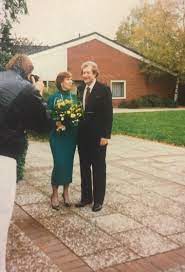
Dennis Whiles met Jean Clarke at a YMCA dance near Norden, California, in the early 60s. Jean liked that Dennis was a good dancer, well-spoken (Jean said he sounded like he was always giving elocution lessons), a smart man, and a hard worker. Norden is a ski resort area in the “elbow” of California that borders Nevada. Dennis worked the winters there as a ski instructor (he was a natural on the slopes, it was said) and as a construction worker in the summers. Jean also admired the way Dennis interacted with the two children she’d had from a previous marriage. The pair decided to get hitched in 1964.
There was one thing that bothered Jean about Dennis, and that was that her new hubby was rather tight-lipped about his past and his childhood. What she was able to cobble together was that he had been raised in an orphanage. He said that the story he’d heard was that his mother and father had been killed in a car crash, and he was left. He told Jean that he was as mystified about his past as she was.
However, Jean wasn’t convinced. There were several “lost years” in the story Dennis told. For example, what did he do from the time he left the orphanage in the late 1930s until the early ’60s–a roughly 25 year gap in his timeline? What did he do in the war? Where did he live? Dennis wasn’t forthcoming about those details. He mostly shrugged off questions like those.
And then there was the issue of the passport. Dennis had a social security card and a drivers license, but he had no birth certificate. Without that, the man couldn’t get documentation that would allow the couple to travel overseas. They lived in Hawai’i for a time, but Jean wanted to go to Europe, and there was no way Dennis could join her. And he claimed to not know where or when for sure he was born. All of his was incredibly sketchy to Jean.
Finally, after 20 years of marriage, she’d had enough. She confronted Dennis. She told him that he was a good man and a good dad and a decent husband, but she was done. Then, she gave him an ultimatum: Either tell her the truth about his past, or she would leave him. Dennis hung his head. “I will tell you,” he promised, “but you can’t overreact.” Jean let out a full breath of air. “I promise,” she said. “I just want to know the truth; I have to know the truth.”
And so, Dennis Whiles told her his true story.
It began for him in 1945, at the end of World War 2. You see, Dennis Whiles wasn’t his real name, it was the name he took while crossing the United States after leaving the Army. It was the name of a man he’d worked for a while. And he’d been incarcerated in New Mexico for much of the war, too, he admitted. He told his wife that if she’d’ve paid any attention to the wanted posters at the local post office, that she might’ve seen his photo because he was on the FBI’s Most Wanted list for years.
Jean was shocked. She couldn’t put the man in front of her with the person described in the story. She was quiet for a moment, and then she asked, “So, who are you, really?”
“My name is George,” he said slipping into an accent. “George Gaertner. I was born in Germany, escaped from a German POW camp in New Mexico at the war’s end, and I never looked back.”

 The Rest of the Story