
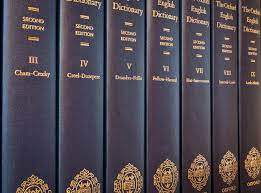
Sir James Augustus Henry Murray is remembered in history as being the primary force and chief editor of what has become the most important and influential dictionary in the world: The Oxford English Dictionary. From 1879 until his death in 1915, Sir James led the panel of contributors and editors in compiling what is today the 22,000 page, 20 volume dictionary. One major thing that sets the OED above all over dictionaries is its painstaking research into not only the origins of the words in the text, but also they provided the history of the words over time–how they changed and were used as English itself morphed and grew.
However, to gather all this work took not only years of toil but also dozens of researchers and contributors. In fact, there weren’t enough of these people to complete the work as Sir James soon realized. So, in an unusual move, he put a call out to the general public to help the academics by contributing quotes about the words from published sources throughout the history of written English. The contributions would have to provide the work cited and the publication information so that the source could be checked, of course, but Sir James knew that this was a much easier task than finding the quotations in the first place.
One of the general public who responded to Sir James’s call for contributions heard about the request from a bookstore. The man’s name was William Minor. Minor was an American who was then residing in the Berkshire village of Crowthorne. He had a large personal library of books in older English. That meant that he could find the types of quotes that Sir James was looking for, quotes that would show how the words had morphed throughout the centuries. For example, the word study used to mean make an attempt at rather than its more common meaning of reading and learning. What Minor would do was to take a piece of paper that resembles a modern 4″ by 6″ card (10cm x 15cm) and then write the word in all capital letters at the top. He would then write the quote on the paper, put the citation and reference information on the back, and then send that entry to Sir James and the compiling and editing committees who were working on the book.
Soon after starting his contributions, Minor was producing several such entries every month. The editors and Sir James were not only grateful, but they were also amazed at the care and clarity of the submissions by this American who, as far as they knew, wasn’t an academician or scholar at all. And Minor produced so many submissions that he became one of if not the most significant public contributor to the etymology and history of the words contained in the dictionary. It reached the point that the editors so relied on Minor’s scholarship that they would send words for him to research, requests that he quickly and happily obliged.
After several years of receiving Minor’s stellar work, Sir James became curious as to who this William Minor was. He resolved to make the trip to Crowthorne to meet the valued contributor. And when Sir James finally reached William Minor, it all made sense–why he had the books, why he had the time, and why he was so eager to offer his help to the creators of the Oxford English Dictionary.
It was because James Minor was residing in the mental asylum of Broadmoor Hospital having been found guilty of murder by reason of insanity.
 The Rest of the Story