On a Beautiful Village

Clovelly. The name of this English village itself contains the word “lovely,” and that’s a perfect description for this quaint fishing settlement on the north coast of the lower left (west) leg of England, almost directly north of Plymouth. If you’ve ever seen a puzzle box that features those brightly painted small fishing boats resting in a quiet little harbor with neatly kept character English houses lining the seafront behind them, well, then, you’ve probably seen Clovelly. There are several interesting things about the village that makes it unique in England and, in many ways, the world.

Take, for instance, that the village is built on a steep hill that ends at the waterfront. The streets of the town are still made of cobblestones–many of them the original ones. Slightly fewer than 500 souls live in the village’s 80 houses today. The population of Clovelly love the village. Most say they wouldn’t live anywhere else even if given the chance. Not that everything is easy in the village, because it’s not. For example, to take, well, anything up or down the hill, the villager can’t rely on cars because cars aren’t allowed in Clovelly. No, to take groceries, mail, supplies, or even a refrigerator up the hill from the harbor, the village has relied on sledges–almost every house has at least one–and these sledges are often pulled by donkeys. Now, this isn’t a description of life a few hundred years ago, but it is the reality of life for the Clovellites today. So, no cars are allowed. And, by the way, visitors to the village must pay the equivalent of $10 to enter. You’d think that would keep tourists away, but you’d be wrong. Clovelly is one of the most popular villages to visit in England, and it’s been labelled the prettiest village in Devon. Social media type have even given Clovelly the title of England’s Most Instagrammable Village.

Shortly after taking England in 1066, William the Conqueror “relieved” the Saxon lord who owned the village of his title, and William gave the village to his wife as a gift. Since then, only three families have owned the land that William originally took. That was in the day when the local lord owned all the land and only allowed the workers or peasants to live and work on it. Today, the most recent family (for the past few hundred years) who have lived in the lord’s house have been the Hamlyn Family. But it was the Cary Family who, in the 1600s, spent considerable money at that time to create a breakwater just off the coast to make a harbor. And harbor protected and sustained a fishing fleet that the village has maintained and used consistently make its livelihood from the sea. While fishing is still a mainstay of the population in Clovelly, now, of course, the main trade is tourism.

And then, there’s the houses and shops of the village itself. The Hamlyns will gladly pay for the residents to repair their habitations, but there’s a catch to the family footing the repair bill. The house must be kept to original specifications and, if possible, as close to the original materials as possible. That means the only exterior materials must be either stone (the newer dwellings) or cob (the older houses). Obviously, modern conveniences are in Clovelly, but people can’t make radical changes to the buildings. That’s because, in part, that the entire village is listed as a historic site. The result is that the whole place, according to one source, is like stepping into a time machine. You can walk down (or up) the main street and easily imagine you’re back in the 1700s rather than the 2000s.

And the Hamlyns prefer it that way. In fact, they insist. You see, the reason the Hamlyns insist on paying for repairs to the houses in the village is because they own the village. And the houses. And the surrounding land. All of it. Every inch. Clovelly is, today, the most picturesque of the last dozen privately owned villages in England.

And the happy people of Clovelly are fine with that.

On Some Cordial Telegrams

Historians are lucky to have access to letters and telegrams that were sent between people on both sides of the conflict we know as World War I. This year marks the 115th anniversary of the end of that horrendous conflict. Let’s look at some of the language used by two men who exchanged telegrams at the start of the war, one on the Russian side and one on the German side. Please know as you read these messages that the men are first cousins, and they know each other well and remember the other one with great affection. Also, know that the telegrams were sent in English because their family had its origins in the United Kingdom.

Austria-Hungary had declared war on Serbia on July 28, 1914, and the world stood by and watched as the great powers like England, France, German, and Russia decided whether or not to join the conflict and to honor treaties made with the involved parties. The decades leading up to the war had seen these countries (and others) become involved in massive arms production. War seemed inevitable. And that’s the context of these affectionate messages between the cousins.

The first telegram, sent by the German cousin on July 29th, pointed out that they, the two of them, had no quarrel between them. He spoke of “the hearty and tender friendship which binds us both from long ago with firm ties.” To these cousins, it seems, the idea of war appeared remote and almost unthinkable. There had been family gatherings over the years where the entire group had come together in happier times such as weddings, and sadder occasions like funerals–the typical times when families celebrate the future and remember the past. So, the pair of correspondents had a long past together despite living in different countries. They even bore a familial resemblance to the other.

The Russian cousin replied and expressed his “thanks for your telegram conciliatory and friendly.” The telegram exchange continued, the cousins in the rival nations almost incredulous that the war machines of each country would contemplate war against the other. The German’s next message included a reference to one of their common ancestors: “My friendship for you, transmitted to me by my grandfather on his deathbed, has always been sacred to me.”

Yet, as we know, the machines of war marched towards what would become an absolute slaughter. Both Germany and Russia would see major revolutions result from the war, with the removal of both the Kaiser in Germany and the Czar in Russia. And the cousins seemed to sense that any impending war would bring about such disasters upon their respective nations. The Russian said, “It may all end peacefully,” but he expressed doubts at the same time, saying while “peace [is] dear to our hearts…mobilization (of Russia’s vast army) seems inevitable.” The German expressed the same sentiments. He stated that only “immediate and clear and unmistakable” actions from both governments were needed, but he expressed doubts that those actions would be forthcoming.

And the cousins were right. Germany declared war on Russia on August 1, 1914. The resulting war cost over 20,000,000 lives lost and about the same number wounded. The Austrian, German, Russian, and Ottoman empires were broken up. And today, we remember those who fought in this Great War on all sides, a war that, as the cousins expressed, didn’t need to happen if only the leaders of both sides had been better at talking to one another. If only they had the feelings of love and affection that these two cousins felt.

The problem was, these telegrams between the cousins–Kaiser Wilhelm of Germany and Czar Nicholas II of Russia–still didn’t prevent war from happening.

On a Merry Gang

We hear the phrase Toxic Masculinity these days to help us define and understand the concept of a male who believes that men are the dominant gender and should be free to exercise that dominance in any and all situations. Hostility towards women (whether overt or covert), lewd or rude behavior (“No one can tell me what to do!”), and a sense of entitlement all mark the toxically masculine. Not that men have often behaved in this manner throughout history, but the rise in the practice of such behavior in some quarters has been a reaction to what is perceived to be a feminization of men by society at large.

That was certainly the impetus behind the formation of what came to be called The Merry Gang. This group of mostly wealthy young men from prestigious families in England met to bemoan the condition of manhood in their country. They decided to live their lives like they thought the men of medieval England did–not caring for what others thought of their behavior and doing pretty much what they pleased. They took inspiration from King Henry II from the 1100s and said that, when Henry ruled, men were men (whatever that means), and what they felt was the current social convention of men “getting in touch with their feelings” and being considerate and kind was only men becoming more like women. Thus, they sought to return to the “good ol’ days” which, apparently to them, meant behaving like boors and creeps.

Some of the deliberate outrageous behavior of the Merry Gang included exposing themselves to women at any and all opportunity, appearing drunk and obnoxious in public, and bragging loudly for all to hear of their sexual “conquests.” They would walk down busy London streets and touch women as they pleased, making crude remarks as they did so. Now, some might say this sounds like a case of “boys being boys,” but that’s the point, isn’t it? The Merry Gang believed that kindness was equal to femininity and the de-masculinization of men in English society. That weakness, as they saw it, was everything that was wrong with the modern world, and they sought to fight against the rising tide of equality and the idea of men getting in touch with their feelings.

Their leader, an earl named John Wilmot, had the political and financial clout to get any of their group out of trouble with the law if they ever were caught or charged with their outlandish antics. For example, two of the Merry Gang’s members were in a pub, and they were drunk. They decided to go upstairs to the pub’s balcony above a busy London street and get naked. Once they’d done that and drew the attention of the passersby on the street below, the pair began miming lewd, sexual acts for the stunned and shocked crowd. Apparently, according to reports of eyewitnesses, they also took a large bottle of wine and loudly toasted to the health of the new King Charles, a man they saw as one of their own for his own reported sexual exploits. Soon, the constables were called, and the two were jailed. Wilmot not only bailed them out and paid their fines, but he also rewarded both of them handsomely.

To further spread their concept of what a man should be, the Merry Gang gave money to artists and writers and creators who felt the way they did. Sadly, the group found that they had a rather large audience for such “manly” artistic creations, and the artists and creators they supported financially flourished. Most of the public was outraged, and protests erupted against the group, but, predictably, Wilmot and his pals could not have cared less.

But, as these things often do, their antics grew tiresome even if they were still toxic. People grew bored with the group. The group began to age. Some of them drank themselves into alcoholism and early graves. Wilmot quietly stopped financing the artists and withdrew from society. In fact, he died from an STD at age 33, a disease he contracted from a prostitute. I mean, you can’t get more “masculine” than that, eh? The Merry Gang proved that toxicity runs both ways, harming both victims and perpetrators. Thus, the Merry Gang ended up being not so merry.

But, sadly, their toxic mentality is still present today–350 years after Wilmot died in 1680.

On a Delusional Young Woman

She began hearing the voices in her head when she was 13 or so. The girl, a product of rural peasant stock in Domremy, France, seemed to be a most unlikely person to receive messages from the beyond. She had no education. She wasn’t a religious novice. No, all the girl did was help keep the cows her family farmed. Barefoot, she’d take the animals to pasture during the day and bring them home at night, milking them early and late. Oh, and the voices didn’t speak to her all the time. Bright lights often triggered the voices, she said. And bells. When the church bells in the nearby village would ring, announcing church services, she’d experience the voices more clearly than ever.

As the girl began to tell other people in the area about the voices and their messages of heavenly instruction, those people began to listen. The time period was back when people were much more superstitious, and those superstitions were tied to religion. When someone came along professing to have supernatural, other-worldly insight, the people of that day took notice. She gained somewhat of a following, with other peasant folk starting to seek her out to learn what other messages the divine was sending through the young girl.

Her parents, Jacques and Isabelle, told people that their daughter had been odd for some time. She didn’t always have this gift of hearing the voices, they said. No, she also had visions, but she didn’t talk about those much. She would seem to go into a trance and then reveal what she had seen and heard. Oh, and the family reported that she had a terrible temper; her short fuse often resulted in some mild violence if she felt something displeased her sensibilities, especially when her brothers, Jean and Pierre, would offend her somehow.

Based on these details, modern scientists have made some broad guesses as to what possibly could have triggered the girl to have those visions and to hear those voices. Some have suggested that she had a neurological issue or a psychiatric disorder. Some postulate that she was bipolar or had been the victim of a brain injury sometime in her younger life. Others, usually medical historians, point to some disease that could have given her dementia. The truth will probably never be discovered.

At any rate, by the time the girl was 16, she was noticed by higher authorities in the Catholic Church. And those authorities, in a time when France was locked in war with England, saw in this odd, seemingly god-sent young maiden, someone they could use to rally the people to their cause. The war had gone on so long that people began losing hope, and the powers that were decided the girl could be useful. So, incredibly, the authorities used this possibly mentally challenged young girl to their own ends; they capitalized on her notoriety, gave her a symbolic role in the war, and used her until, well, they couldn’t anymore. Eventually, she was captured by the English and killed for being a heretic.

You might think you know her name, but you’d probably not get it right. She called herself Jehanne la Pucelle–Joanne the Maid–at a time when most people still didn’t have last names as we know them today.

Of course the name you know her best by is the one that was never really used by anyone at the time.

Joan of Arc.

On a Hunting Buddy

My friend Greg back in Tennessee said that the difference between hunting and fishing is that no one thinks you’re odd if you fish alone. The idea is that hunting seems to be a sport enjoyed with friends, companions, and buddies. The shared camaraderie of the hunt goes back centuries to prehistory and continues today. One such couple of hunting buddies in England grew up in vastly different circumstances but became best of friends through hunting.

Tom was born to a middle-class and land-holding family on the outskirts of London when that area was still largely pastoral. Because his father owned land, Tom was able to enjoy some privileges most young men of his social level couldn’t. for example, he was able to spend time on the estate of a local lord, a friend of his father, and a man who taught young Tom the intricacies of hunting. At the estate, he learned about falconry, even, and how to run the dogs and corner game. Tom loved it; the outdoors, the thrill of the chase and the hunt, and the attention to detail of dealing with the falcons appealed to his sense of order. At the age of 20, he was sent to college where he studied theology and eventually found work as a clerk for a large cathedral in England. He proved to be an efficient administrator, and he was recommended by the Church to go to work for the government.

It was in this government position that Tom met Hank, a man who was also in government service, and one who shared Tom’s interest in hunting. The two began to hunt together. Hank wasn’t as careful with the details as Tom was, but he was a smart fellow, and Tom enjoyed his mind and his company. And, after the hunts, the two men would often share a drink and share stories. A bond was formed. The pair of hunting pals soon became inseparable, sometimes even forsaking their governmental responsibilities for the sake of the time they spent in the field and over their drink. Henry was from the upper class, and, as such, had the means to go to hunting lodges across England and take Tom with him. And, so, they hunted and drank, and drank and hunted.

Then, Tom was appointed to another position and left his governmental department. And the nature of his relationship with Hank changed, in part because, in Tom’s new role, he was now in charge of a part of what Hank was doing in government. Instead of a friend, Hank now saw Tom as someone who was trying to control his career rather than simply be his hunting chum and best friend. Hank appealed to Tom and their friendship to not be his overseer and remain his friend. Tom, on the other hand, took his new responsibilities seriously. He tried to tell Hank that it wasn’t personal, that his job required that he perform certain tasks that, even if Hank found them to be intrusive, were still part of his job.

The rift between them grew. Hank was now hunting and hanging out with other people, people he would later say were nowhere near the intellect and wit of his old friend. And, one night, while drinking with these new friends, Hank made the remark that he wished Tom could be removed from his position someway, somehow. Some of the drinking buddies swapped looks. They liked Hank and his money. They liked the drinking and the girls they sometimes had in the parties with them. And they wanted to impress Hank.

So, thinking that the drunken, offhanded remark about removing this man meant something else, several knights of the court of King Henry II entered Canterbury Cathedral on December 29, 1170, and killed Archbishop Thomas Becket.

On a Pogrom

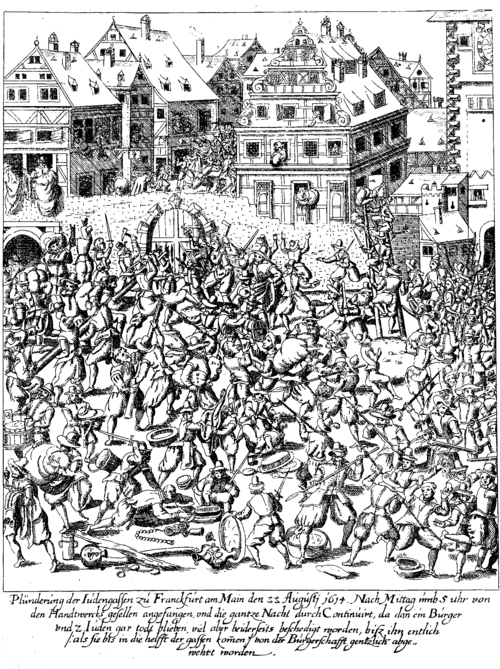
I want to speak about a country where Jews had been persecuted for centuries for being, well, different. Their religion and traditions, their clothing, and their lifestyle; these already marked them in Europe as being the “other” for as long as people could remember. And we know how things go for groups marked as being different. So, when the government of this particular nation ordered that Jews would have to wear a badge signifying their ethnicity and religion, well, in many ways such an order was superfluous. People knew who the Jews were in their community. And, over the years, propaganda spread about Jews being carriers of diseases (but they themselves being immune because they were in league with the Devil, you understand) and being hunters of children for their blood. Jews had been persecuted for being dishonest moneylenders when the Catholic Church condemned them for the charging of interest in lending the money. And so on.

We know that the nation’s history was already littered with accounts of pogroms against Jewish people. In fact, we have records that the houses that had Jewish populations in them were burned in times of plague or famine, because, after all, you have to blame somebody for the bad things that were happening, and who better than the “other” to pin the blame on? Churches preached sermons on blaming Jews for things like floods and earthquakes, saying that these things were happening because God was angry that the Jews had killed Jesus.

But back to this particular period of persecution, specifically how the authorities first marked Jews for persecution. The government, in ordering that the badge be worn, mandated that it be yellow and that it be of specific size and shape. To be a Jew and be caught without wearing the badge in public meant prison or worse. The government decreed that (in fact, promoted the fact that) average citizens could make such accusations. Rewards were offered for turning in Jews who ignored the law. Other laws quickly followed. Of course, one of the first things that the government mandated was that all synagogues were to be immediately shuttered. Then, in an effort to push the Jews out of the economy, extremely heavy taxes were imposed. That shut down several of the smaller businesses immediately. Then, where Jews could travel was limited. What amounted to the establishment of ghettos resulted from laws forcing Jews to live in certain areas of towns. And then, as we know, Jews were systematically rounded up and removed by the authorities.

We should read descriptions like these and redouble our resolve that such events should never happen again. Yet, we see history repeating itself over and over as hatred is allowed to go unchallenged and unchecked. Some people actually deny that these things and others like them ever took place at all. Media even go to great lengths to give credence and platforms for people who actively practice such denial. Many simply say that to deny that these events happened is merely another opinion or even “alternate facts.”

And to think that these events described above occurred in England in the late 1200s makes all of it even more astonishing.

On a London CafĂ©

You can’t spit in Edinburgh these days for a coffee shop. London’s almost the same. Here’s a story about such a place that opened in London a while back. And it’s a typical story of a mix of cultures coming together in the British capital city as is often the case. The man who started this particular cafĂ© was a Greek immigrant named Pasqua Rosee. He came to England to work for a man he’d met in Turkey a few years before. Now, to be fair, Pasqua was planning to work clandestinely. But he still had the drive to open a coffee place in London and make it like the coffee he had growing up–a confluence of Turkish and Greek tastes that he felt would appeal to the sophisticated palates of Londoners.

You see, Pasqua had worked as sort of a butler or servant for a London resident named Dan Edwards when Dan lived and worked overseas. One of the jobs Pasqua had was making coffee every day for Dan. And Dan raved about it. He praised the Greek man, telling him that there wasn’t anything like Pasqua’s coffee in London. So, believing his employer, Pasqua took the chance and bought a ticket to England. He had saved some money, but he knew that his illegal status would preclude him from actually owning the business and, besides, he simply didn’t have the contacts. But Dan had his back. Dan provided the “face” for the legal stuff and let Pasqua’s coffee-roasting and brewing skills do the actual work.

The called the coffee shop, simply, Rosee, after Pasqua’s family.

Dan also helped Pasqua get some baristas to help in the business. One man, Kitt Bowman, was a family friend of Dan’s who decided to invest in the business as well as work there. And the location–which we can all agree can make or break a business–was superb. It was right in the financial district, not too far from the Royal Exchange, and the clientele and market was upscale people who had disposable income. The business was a success soon after opening. The place was packed. People raved over the taste of Pasqua’s coffee. People kept asking him to sell his secret of how he achieved the great tastes of his roast, but he wouldn’t budge. Kitt and Dan were supremely happy. Word of mouth soon made it the most popular coffee place in London.

But, then, the coffee shop’s luck ran out and disaster struck. A fire in a nearby location swept through the adjoining buildings and destroyed the establishment. However, Pasqua wasn’t in the country at the time. It seems that his lack of legality in England had somehow caught up with him, and he was forced to leave the country. Kitt carried on for a time until he grew sick, and then, the fire finally killed Rosee. But the way Pasqua made coffee didn’t die with Rosee. Within a few years, over 500 coffee places had sprung up in London and the surrounding villages using his roasting and brewing methods.

Oh, and that fire that destroyed Rosee? It was the Great Fire of London.

You see, Pasqua Rosee opened London’s very first coffee shop–back in 1652.

On an International Soccer Match

The 2022 FIFA World Cup soccer (football for the rest of the world besides the US) tournament in Qatar has been the source of controversy for several reasons. Staging such an international extravaganza in the middle of a war in Ukraine, with Covid-19 still being a major health crisis, and with charges of bribery and malfeasance on the part of FIFA as well as the abuse of foreign workers by Qatar…well, you get the idea.

1914 was a similar time to hold an international soccer match. The turmoil in the world at that time was palpable. Yet, England and Germany, two rival nations, faced off in a friendly match outside of any tournament. In fact, it wasn’t only one friendly, but, rather, a series of games played across one wonderful and improbable day. The event was so historic that the British supermarket chain, Sainsbury’s, later made a short film about that day. The story of how all that came about is still a bit murky, however.

One major obstacle to overcome was a basic lack of trust. The two nations had no reason to believe that the other one would honor the agreement to play, even. Such was the fear each nation had of the other at that time. Officials from both countries even tried to stop the games, but it was the players themselves on both sides who insisted that the series should be played. There was no stopping them, apparently. These men wanted to play the games no matter what the higher-ups said.

And played they were.

One interesting aspect of these particular matches was that the participants were all amateurs. FIFA, which had been created a decade earlier, had sanctioned matches between England and Germany, and, indeed, the national teams from the two countries had met on the pitch four times in the previous six years in FIFA-sanctioned games. England had won 3 of them, and one of them ended in a draw. However, these games were neither FIFA-approved nor played by the nations’ national squads. Besides, the games had no referees and no real goals.

You see, it was Christmas Eve, in France, in that first December of World War I. And along a 20-mile long stretch of no-man’s land between the English and German trenches, soldiers from both sides came out of their foxholes and lines and met in the middle of all that death to play a kid’s game during what has since been called The Christmas Truce.

May there be peace on Earth.

On a Real Grinch

Ollie hated Christmas. Well, to be fair, Ollie hated any religious celebration outside of Sunday services. In fact, there was quite a lot that Ollie hated.

He worked hard to make sure laws were passed in his country to insure that not only Christmas, but also Easter and other “saint” days were not observed by the Christian church. And Ollie succeeded.

This was a guy who believed in the dictum, “No more fun of any kind.” Besides his war on Christmas, Ollie worked to outlaw such things as theaters (dens of iniquity, he said), bars (do we need to explain why?), and sports (if you have time for leisure, you have time for work). Even swearing could earn you a lashing in the public square.

It wasn’t enough that he believed Christmas should be ignored; he also initiated the day as a day of fasting in repentance for the previous years of what he perceived as gluttony on a feast day. We have to remember that most poor people in towns didn’t eat meat daily, and that meat meals were sometimes had only on “feast” days–like Christmas. To Ollie, this was an unneeded luxury for people. So, he said that fasts should be observed rather than feasts on December 25th.

You might wonder about Ollie’s justification for this concept, and I’m here to help you with that wondering. Ollie pointed out–rightfully–that the Bible doesn’t actually state when Jesus was born. There is no date stated in the Gospels. The date of December 25th is simply a tradition. Also, the Bible never mandated that the date be observed even if we did know what date Jesus was born. Besides, Ollie, said, Christmas is Catholic, and, if he was anything, he was vehemently anti-Catholic. He was anti-anything that didn’t agree with his incredibly narrow interpretation of God.

Now, to be fair, people still celebrated Christmas–they simply did it much more quietly and secretly. The holiday proved simply too popular to stamp out simply by dictate. And you will find people who said that Ollie had nothing to do with the ban on Christmas but, rather, he merely didn’t stop those who wanted such a ban.

Don’t listen to those people. Nothing happened without his approval while he held power.

And anyone who knew him knew that he was sour, dour, and almost never smiled. Ollie was the original Grinch who Stole Christmas. The only thing he wasn’t was green.

You know him, of course, as Oliver Cromwell.