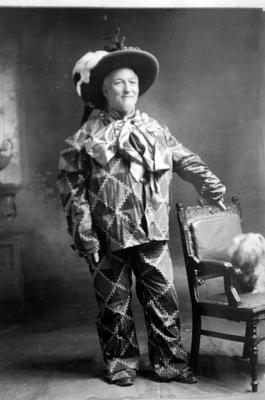
On Playing Dress-Up

Most of us stop playing pretend games where we dress up in a costume by the time we hit puberty (except for the odd Halloween party here and there). Not James Edgar. No, James was famous for playing dress-up well into his 60s. He often donned costumes that made him into George Washington, a sea captain, a member of the first nations tribe, and other historical or interesting characters. James lived in Brockton, Massachusetts, but he was born in Edinburgh, Scotland, in 1843. When he made his way to the United States in the 1870s, James opened a dry good store in that Massachusetts town.

And James made the store a great success. His natural talent for showmanship and publicity drew crowds to the business. And you never knew who would greet you there. One day, James might be dressed as Lincoln; another day, he would be holding the door open for customers garbed as Columbus. The popularity of James and his theatrics also carried over into other businesses on the main thoroughfare of Brockton. People who flocked to James’s store would then go down the block to the diner or up the street to the butcher’s shop. The other shop owners thus embraced the wacky Scotsman and his antics.

James didn’t hoard all his wealth, either. He gained a reputation for being one of the most generous men in town. If a family needed its rent paid, James would do it. If a child had to have an operation, but the parents couldn’t afford it, James would arrange for payment with the doctor. When a young person needed a job, James would find work for that teen in his warehouse or sweeping up the store after hours. And, unusually for that time, James instituted a lay-away plan for people who couldn’t afford to pay for purchases all at once. No one was refused. And he didn’t charge interest, either. These and many other acts of kindness and charity across the years caused the grateful community to name a city park after him shortly after his death in 1909.

However, there was one character James dressed up as that is remembered most of all. That character made indelible impressions on those who encountered James dressed this way. In the 1970s, during an interview about James Edgar, one 90-year old citizen of Brockton recalled that he, “couldn’t believe my eyes. You can’t imagine what it was like. It was a dream come true. I rounded the corner of an aisle of the store, and there he was! And he talked to me!” Such was the impact that this particular outfit had on people. Families came from as far away as Providence, Rhode Island, and New Hampshire, and even the big city of Boston to see James. They lined around the block outside his store. And James, as far as we know, was the first person to dress up like this in public. Oh, of course, today, you see this character everywhere, almost on every street corner during the holiday season. But James was the first.

You see, no one before James Edgar had ever dressed up as Santa Claus.

On Two Failed Medical Careers

Robert wanted his son to be a doctor, a physician, like he was. In fact, he wanted both of his sons, Ras (short for Erasmus) and Charlie to study medicine. So, in the autumn of 1825, Robert sent the pair of young men to the most prestigious medical school in the United Kingdom and, in fact, also Robert’s own alma mater: The University of Edinburgh. The reputation of the school was beyond dispute. Almost all of the modern medical world passed through the medical school in the Scottish capital city. And Robert wished that his sons would have the best education possible–as he himself had.

So, the brothers (Ras was a few years older than Charlie) took some rooms only a few steps away from the medical college on what was then Lothian Street, south of the Royal Mile and near what is today the Scottish National Museum. The rooms, the boys found were bright and airy and not at all stuffy as much of the student rooms in Edinburgh tended to be. At first, all seemed well; the boys loved Edinburgh, and they attended their lectures and classes and conducted themselves like the young, gentlemanly students they were.

However, as I mentioned, Ras was older than Charlie, and he had already been studying medicine at Cambridge in England for some time. By the time the spring of 1826 rolled around, Ras was pretty much finished with the Edinburgh part of his training. It was time for him to go to London to complete his medical education at the anatomy school there. That left Charlie alone in the Scottish city. And it was that spring that Charlie decided he didn’t like the study of medicine. Writing to one of his sisters, he complained that the lectures were boring him to the point of madness. He stopped attending his required beginning anatomy labs. He began hanging out in the natural sciences departments of the university, and he started to learn about botany and what today we would call earth science.

All of this disappointed Charlie’s father. The hopes he had for his son to follow in his footsteps as a physician were fading, fast. Now, it didn’t help that Robert’s youngest son was only 16 when he left home to go to university and then was a still-young 17 when Ras left him alone in Edinburgh. So, it quite possible that homesickness played a part in Charlie’s decision to quit the medical school at Edinburgh after less than two years there. He talked often of going into the clergy as his family had a long history of ministers as well as physicians. Ras, for his part, was a sickly young man most of the time; his delicate constitution proved too fragile for medicine. Thus, it was with great sadness on his father’s part that Ras also quit his medical studies at the precise moment that he was about to finish them. Neither son, then, followed in Robert’s footsteps.

Of course, Charlie wouldn’t become a minister, either. No, the interest he found in the natural sciences at university soon put Charles Darwin aboard the ship The Beagle and on the way to changing how we view our natural world.