
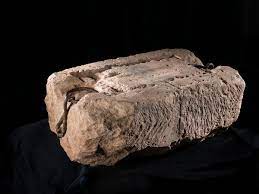
You can call them stone collectors, petrographers, or, if they are people who seek out their formation, geologists, but many people refer to them simply as rock hounds. They love rocks and collecting them, studying them, classifying them, and sometimes simply looking at the rocks in their possession.
Then, there are those in a rare category of rock hound who seek the perfect stone, that one special mineral, the holy grail of their particular desire. Robert Gray was one of this latter category. He had his eyes on one special stone, and he spared no expense in tracking it down and bringing it home. Now, Gray was trained as a stonemason, so his love of rocks came to him as a vocation as well as an avocation. But there was one stone that was special to Robert Gray.
As a mature man, Gray had served in the army during World War 2 and had made good money in his masonry business. In addition, he wielded influence before and after the war as a politician, getting himself elected to the Glasgow, Scotland, City Council. He also served as a board member of the Glasgow Corporation, the organization that ran one of the largest and most efficient public transportation systems in the UK.
It was because of these commitments that Gray couldn’t leave Glasgow and pursue his desire to obtain the stone. So, he did what anyone in his position would do; he hired someone else. He paid four Glasgow University students to go get the stone for him. He provided all expenses and the planning for them to go to London, obtain the stone, and bring it back home to him.
Now, if you’re thinking that it sounds like Robert Gray paid some college kids to go to London and steal the stone he desired, well, frankly, you’d be correct.
In December of 1950, that’s exactly what happened. The foursome went to London and stole the stone. Except, to Robert Gray, the group of thieves weren’t really stealing the stone for him. Rather, they were returning it to its rightful place. You see, Gray didn’t want the stone for himself. He felt that it belonged to all of Scotland. When the students returned with their prize, they brought the stone to Robert Gray’s masonry yard. There, according to some, Gray made a copy of the stone before arranging for it to be returned to London and the care of King George VI.
The stone in question had been the one upon which, for centuries, kings and queens of Scotland and England had sat when they were crowned. And, about a week from now, when King Charles III of the United Kingdom is crowned, he may or may not be sitting on top of the original Stone of Destiny.
That’s because some say Robert Gray hid the original one somewhere in its rightful home of Scotland.
 The Rest of the Story