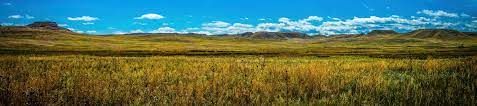
On the Vanished Prairie

The concept of the Great Prairie or Great Plains of fertile grasslands that lie largely between the Mississippi River and the Rocky Mountains has been a mainstay of the American ethos even before the days that Lewis and Clark explored the Louisiana Purchase in the early 1800s. Those two adventurers brought back reports of how beautiful, how bountiful, how pleasant the prairie lands were, and farmers by the wagonloads made their way west to carve out their own private piece of the American Dream one farm at a time.

Except something happened in the less than 100 years from the time the first settler farms began dotting the wide open spaces of the prairies. The grasslands and the fertile soil beneath the grass began rapidly disappearing. Now, certainly, all of the land between the Mississippi and the Rockies isn’t prairie grassland, but the lion’s share of it certainly is, or was. But digging up the grasslands by the farmer’s plows destroyed that fragile ecosystem by and large. Grasslands take time to grow and mature. Those early settlers not only plowed the ground to grow grains but they also dug down into the dirt to use the solid sod to make their homes in the absence of large amounts of woodlands. That’s why many of them are referred to as sod-busters. They were also effective prairie busters. Because, you see, plowing destroys the entire root system of the prairie grasses, and with it, as we have said, the ecosystem.

It’s difficult to understand exactly how diverse the prairie grasslands were. Some botanists say that there were over 350 different species of grass that made up the prairies. This doesn’t even mention the wildlife and the insects, the moths and even the amphibians, that populated the land before it was destroyed. Such incredible variety, such wonderful diversity, would be amazing to recapture if we could restore the grasslands…somehow.

Of course, today, the advent of the modern corporate farm has also replaced the small farmers that first plowed the land more than 150 years ago in the prairies. They made matters worse, if that was possible, by buying up all the land they could, destroying even more valuable natural land. If the land could be somehow procured and set aside, and if somehow the original grass species could be found, then maybe, just maybe, a patch of prairie could be restored with all the flora and fauna that it protected and nourished. If even a square mile of undisturbed, virginal prairie land was to be found somewhere, somehow, it would be considered incredibly precious.

Well, we are in luck. And our undisturbed prairie land is found today in the most unlikely place. You remember those farmers, those sod-busters, who first destroyed the ecosystem? They died, of course. And their deaths, ironically, may just be the key to restoring the prairie ecosystem.

You see, there are sections of undisturbed prairie land, along with the flora and fauna, in the old fenced-in cemeteries that dot the plains today.

On An Exodus Route

The 1930s could be seen as the most pivotable decade of the incredibly violent and paradigm shifting 20th Century. Hitler (and Roosevelt, too) came to power. Japan invaded China. Italy attacked Ethiopia. All of that sets up World War 2 that began in 1939. None of those events begins to look at the absolute disaster that the worldwide Great Depression brought upon everyone.

It’s difficult to fathom 25% unemployment. We can’t imagine not being able to use banks for our economies. A large segment of the population simply not being able to eat is beyond our ken in most of the western world today. Yet, all of that happened in the United States in the 1930s. We have since learned that the Great Depression didn’t begin when the Stock Market crashed in 1929. The grim descent into economic collapse that bottomed out in early 1933 actually started for farmers a few years earlier.

Farmers began to feel extreme economic pressure in the 1920s due to several factors. First, small farmers were finding that they could not keep up with the emerging economy of scale as large, corporation-owned farms began to emerge and started to squeeze prices verses the costs of farming equipment. This forced many small farmers into bankruptcy. Secondly, the middle years of the 1920s saw extreme drought in much of the farm belt mid-west. Finally, outdated farming methods exhausted land and made it useless and unproductive. The result is known as the Dust Bowl, where farmers found that their land literally dried up and blew away.

One of the hardest hit areas was Oklahoma, Texas, Arkansas, and Missouri. So, desperate for food and for ways to provide for their families, many of the farmers there simply abandoned their farms and moved to California. And the route these desperate people took to get to California was along a highway that was one of the first numbered roads in the United States when it was constructed in the early 1920s. It ran from Chicago to Santa Monica, almost 2,500 miles and through seven states.

When John Steinbeck wrote his epic novel, The Grapes of Wrath, he depicted the fate of these Dust Bowl farmers, and he used this same highway as a metaphor for what was happening to the people. He said it represented both despair (the place they were leaving) and hope (their destination), and he likened it to the route the Hebrews took in the Bible from slavery in Egypt to the Promised Land, a journey known as the Exodus. Steinbeck termed the route The Mother Road of America because it birthed a new way of living for these migrants who were so desperate for a start-over. Because they were united by the journey and, thus, the route, Steinbeck pointed out that the journey itself became a unifying experience, an shared moment in history, for these desperate farm families. Think of it as a poor, poverty-driven “on the road” story.

The highway, as you know, is labeled Route 66. Today, it is used by vacationers and tourists, cyclists and RV-ers, people who travel the route for fun and adventure. Most of these travelers probably do not realize that it was the road used by over 300,000 Americans in the 1930s who left behind a dry and barren land for the vision of a green and prosperous Promised Land during our version of the Exodus.