On an Unwelcomed House Guest

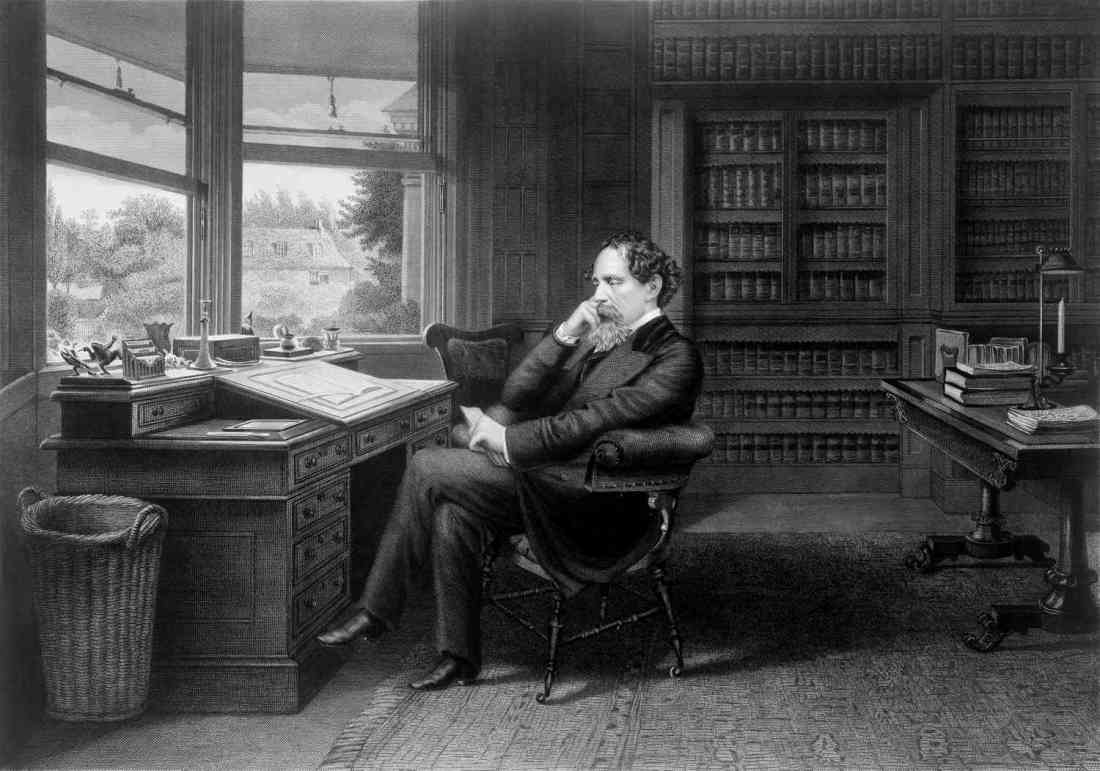
In 1847, a young would-be writer from Denmark visited London. On this trip, he had the fortune to meet the famous British author, Charles Dickens. At the time the two men met, Dickens was already a celebrated author, known for his stories such as Oliver Twist, Nicholas Nickelby, and A Christmas Carol.

Dickens thought the angular young Dane to be eccentric but interesting. After their brief meeting, the young man wrote in his diary, “I was so happy to see and speak to England’s now greatest living writer, whom I love the most.” And, when he returned to his native Denmark at the end of his trip, he wrote a letter to his new acquaintance. “Dear Mr. Dickens,” the letter began, “the next time I am in London, I would wish to come spend some time with you if you would agree.“ Dickens wrote a short note back, acknowledging receipt of the letter and said that yes, sometime in the future, a visit from the young man would be welcome. It seems that Dickens answered more out of a formality and courtesy rather than truly extending an invitation.

Much to Dickens’ surprise, the young man showed up, unannounced, at his house…in 1857. And he brought with him enough luggage to stay for an extended visit. Unfortunately, the guest’s arrival could not have come at a worse time for Dickens. The celebrated author was in the middle of working on a play in London, and his marriage was going through a difficult phase. Nevertheless, Dickens and his family did the best they could to make the odd, thin Dane feel welcome in their home.

Immediately that were problems. It turned out that he did not have a good grasp of English. Dickens noted that his French was even worse. But the language difficulty was the least of the issues. He had a habit of sleeping until almost noon every day. When he finally woke up and came downstairs, he seemed flummoxed that breakfast, which had been cleared away hours before, was not made available to him. He would take long walks in the woods and fields surrounding the Dickens house. When he was with the family, he would get a pair of scissors and made elaborate and oddly strange cut outs from any paper he could find. These amused Dickens’s children at first, but soon they grew tired of the game.

The most bizarre part of the stay was when he requested that Dickens’s oldest son, for whom the young man seems to have grown inordinately fond, be made to shave him every morning. This was something that Dickens would absolutely not allow. Thus, the young man was visibly upset that he was now forced to go into town to be shaved by a barber. Soon, he would spend most of his time in town, shopping or walking the streets. The entire household was soon in an uproar. Everyone in the family and even the servants devised elaborate plans to avoid having to interact with him.

How do you tell an unwelcome houseguest that he has overstayed his welcome? Dickens found a way, and, after five long weeks, the visitor from Denmark left the Dickens household. After he arrived back in Denmark, the man wrote to Dickens and offered an apology and asked Dickens’s forgiveness for any breach of etiquette. Even though he never completely understood why he’d been asked to leave, he must have realized the tumult he brought to the household, and he tried to repair the damage done to the relationship. Dickens didn’t reply. The two never saw or spoke to each other again. And, shortly after the Dane had vacated the household, Charles Dickens pinned a note to the door of bedroom the unwelcomed houseguest had used.

The note said, “Hans Christian Andersen slept in this room for five weeks, but, to the household, it seemed like an eternity.

On a Revolution

The Age of Enlightenment created dramatic societal changes across Europe, changes that are still being felt and interpreted to this day. This period, part and parcel of the late Renaissance, created a rash of authors and thinkers who spoke of logic and philosophy, calling upon the ancient, classical civilizations of Greece and Rome. It saw the rise among a growing middle class of the belief that the power of government should at least include the will of the people, the governed, the people who paid taxes. As a result, revolutions occurred across the western world, revolutions that ranged from the wild and bloody French Revolution (in the late 1700s) to the relatively mild and conservative American Revolution (France also had another revolution in the 1840s as well) Monarchies were toppled. Congresses and Parliaments were set up, old nations died, and new nations were born. Kings and regents slowly began to give up some of their power and relinquish it to the people.

One such revolution happened in the Kingdom of Denmark in 1848. The people of the Scandinavian nation saw the power that the population of other nations were gaining, and they decided it was time to rise up and demand that the Danish monarch share power with them. Denmark had been one of the kingdoms who had a good middle class population who had made money on trade in the North Sea and the Baltic. Denmark sits smack in the middle of one of the most important trade routes in northern Europe. And the king of Denmark at the time was a young-ish 39 year old man named King Frederick VII who had acceded to the throne in January of that year.

Frederick had come into a dicey situation regarding Denmark’s southern border with Germany and German claims of land in that area. In addition, some incremental democratic changes had occurred in Denmark. However, those agreements had been made under the previous monarch. And because of the border situation, man people were afraid that this new king would, in an effort to consolidate his power, renege on the gains that the people had made and rule with an even stronger hand. And Frederick hadn’t made concrete statements as to his intentions regarding the continued loosening of the power of the crown. Thus (and this description is a gross oversimplification), the people of Denmark decided that a public revolution was needed to force the new king’s hand.

In March, 1848, a demonstration made up of over 20,000 Danes marched for several days to the Royal Palace in Copenhagen and demanded that King Fredrick VII give up absolute power and allow a guaranteed Constitutional Monarchy be established. There were some violent street confrontations, but, generally, the demonstrations were calm. What the demonstrators didn’t realize at first was that Frederick had fired all his cabinet ministers who were against the increase in democracy. And, so, hearing the news that Frederick had moved to guarantee an increase in public power, the Danish revolutionaries did an unusually peaceful thing for a band of revolutionaries.

They cheered.

And then they went home.

And that, for the most part, was Denmark’s revolution. The people made demands, and the king acquiesced. Incredibly efficient. Remarkably unbloody. And positively Danish.

Oh, and what the good Danish folk didn’t realize until much later in Danish history was that King Frederick VII really didn’t want to govern. It frankly didn’t interest him, and the work in the government took him away from his other pursuits–drinking, acting, and women among them. So, Denmark’s revolution certainly happened because of the people’s demands, but it also was helped by the complete disinterest of the country’s king to govern.

On Finding a Knife

Osoyro, Norway, lies on the western edge of the Scandinavian nation, on the water, and is one of hundreds of little, picturesque villages that dot the inlets and bays of the coast. It boasts a population of around 1,500 hardy and healthy and happy souls.

Elise is an 8 year old student at the local elementary school. She’s really a typical kid; she loves horses and flowers and her friends. She’s a decent student, and she loves her pets. But something happened to Elise this year in school that doesn’t happen too often these days.

We have all heard the stories about school violence, especially in the United States. Outbreaks of attacks have been increasing in occurrence across the globe, sadly. In nations where guns are as readily available as they are in the US, even knife attacks have seen a rise in many schools. In an effort to combat this rise in violence, some schools have been encouraging kids to report incidences where they witness a classmate with a potential weapon. This preventative measure has met with a mixed reaction. Kids are not eager to be seen as tattle-tales, squealers, or rats. They want to be liked. On the other hand, if one attack is thwarted because some brave child reported a potential threat, then the program is worth it in my eyes.

Anyway, Elise and her friends were on the playground one day (yes, kids go outside for play even in winter in Scandinavian countries). While running and playing with her chums, Elise spotted something reflecting in the low hanging sunshine of the winter’s day. At first she thought it was a piece of glass. She reached down for it…and realized that it had a sharp edge. This, even to her 8 year old eyes, was obviously a weapon.

Elise showed it to her friends. They crowded around her as she held the blade in her hand. It was only slightly larger than her palm, the edge of the weapon still sharp. She looked around at the faces of the circle around her. All of them were looking at her hand. “We should tell teacher,” she said. The circle of friends all agreed. And so, the little group of girls made their way to Ms. Drange, the class teacher.

Ms. Drange was taken aback at first. How could such a thing find its way to the school’s playground? She quizzed Elise gently, knowing the girl enough to know that she herself didn’t bring the item from home or elsewhere. Elise then led Ms. Drange outside to the pile of stones where she first spied the sharp object shining in the winter sun. Ms. Drange assured Elise that she’d done the right thing to turn it in and to make her teacher aware of the situation. She carefully took the sharp object from Elise and wrapped it in a cloth.

The next day, Ms. Drange contacted the authorities. She told them about Elise and how the object came to be discovered. Soon, a team of experts swarmed the village schoolyard. The area was roped off as the specialists began looking for clues as to the origins of the blade. For the children, the day was wonderful because they could see the investigation for themselves. Elise was both a little confused and happy. She was proud to have done the right thing, but she didn’t fully understand what her discovery meant. The local press asked Elise what she felt when she found it. She shyly said, “It was nice.”

Come to find out, Elise did indeed discover a knife that day, but wasn’t a knife that someone was going to use to harm someone these days. The knife’s material didn’t even come from Norway at all; the nearest place it could have been created was Denmark, several hundred miles away. That’s not to say that it wasn’t used some time in the past, however.

In fact, when Elise’s particular and extremely rare flint knife was made, it has been determined that it had most likely been used in a sacrificial ritual.

Some 3,700 years ago.

On an Early Colony

Growing up, my interest in history made me want to become an archaeologist. However, when I realized that 99% of that profession is in the pursuit of the artefact and not the actual finding of it, my innate laziness put the kibosh on that possible career. The opposite was true for a woman named Anne Stine Ingstad. Anne relished the pursuit, the chase, the digging, and the tedious research required by a classic archaeologist.

And Anne was led to excavate a site of one of America’s first colonies of European settlement. We probably all know about Roanoke Island, the first English attempt at settlement and how those colonists mysteriously vanished. Most of us have heard about colonial Jamestown or Williamsburg and those more successful attempt at a permanent English settlement in North America. But the site of the place of early attempt at a colony where Anne dug was a bit more north than what became Virginia.

Anne and her collaborator/husband, Helge, began surveying and carefully uncovering their site on the northeastern coast of North America in 1961 at a site called Grassland Bay. Locals pointed out the small settlement area to Anne by saying they thought the lumps of earth marked an old Native American campsite. However, Anne’s trained eye soon realized that it was a previously unknown and uncatalogued European site. For the next seven years, she and her husband and a growing team of researchers dug the site. What they discovered and uncovered was astounding and re-wrote the colonial history of America.

Over the years, the team was able to uncover and positively identify the remains of sod houses built on timber frames. Inside them, metal needles were found along with fragile bits of fabric, indicating that women were indeed part of the early settlement. They uncovered large, centralized cooking pits, proving that much of the food was prepared for the group rather than for individual houses and families. They found remnants of an iron forge, thus showing that the site didn’t belong to native tribespeople but rather to metal-working Europeans. And they found boathouses and boat-repair shops, indicating that the place was used as a way-station for other ships which passed by. All in all, the excavations carried out by Anne and the team proved beyond doubt that besides the fact that the colony was European, that it was occupied for some decades, and that it was from the early colonial settlement period.

But Anne’s work met some opposition in some corners of the history and archaeology disciplines. Since there was no corroborating narrative about an attempt at a colony at that site, there were skeptics who said that it was a much later site than what Anne and her team had proposed. Rather than a European colony, they argued, that it was merely an outpost of later settlements further down the North American coast.

But Anne then used carbon-dating methods to show that the wood used in the building of the sod huts was older than any of the other European colonial attempts. In fact, the proof Anne had showed that it may have been the oldest European settlement in North America–ever. She thus silenced her critics.

And, today, we recognize that Anne Stine Ingstad uncovered the fact that Vikings settled in Newfoundland, in North America a full 600 years before the English tried to colonize the New World.

On a Genome Project

The study of genetics and the promise of genome science hold out the hope for a future of increased health and quality of life for many. In the meantime, the science has been used for more mundane yet still fascinating purposes. Genealogists have been accessing genetic information for years now, connecting people to ancestors they never knew they had. One such attempt at tracing ancestry in Iceland recently has been interesting and revealing.

The project involves a man named Hans Jonatan, a man of Danish descent who immigrated to Iceland in 1802. I use the term “immigrated” loosely, because Hans apparently hid himself on a ship that left Copenhagen and entered Iceland secretly. He left Denmark after having fought in the Danish Navy, a service in which he distinguished himself. It seems that the prospect of him being sent to the West Indies prompted Hans to make his escape to Iceland. He got a job at a trading post in a village there, and ended up having a wife and a large family. All in all, a good if difficult life.

Fast forward to 2018. Genetic specialists wanted to recreate Hans Jonatan’s genome by only using his descendants’ genetic samples and not using any of the man’s own physical, genetic material. That had never been attempted before. Luckily, Hans Jonatan’s family in Iceland has grown significantly in the past 200 years. Taking samples from several of those family members, scientists were able to reconstruct almost 40% of Jonatan’s mother’s DNA and almost 20% of his.

You might be wondering how this was possible. How could the genetic makeup of someone be recreated simply by, in a way, reverse engineering the man’s DNA? Well, first of all, the fact that Iceland is a remote island nation certainly helps. The place is perfectly set up to isolate a person’s genetic history. And then there’s the other, even more important marker, especially concerning Hans Jonatan’s mother.

You see, while Jonatan’s father was Danish, his mother certainly was not. She was a slave from Africa, brought to the Danish colony of St. Croix, where she met Jonatan’s father. The genome project found that she was from West African tribes. That fact is also why it was so much easier to identify the DNA markers in the attempt to re-create Hans Jonatan’s genes. And the fact that his mother was a slave is why why Hans was being sent back to the West Indies after his naval service.

And, it’s why he escaped to Iceland. Yes, by stowing away and making it to Iceland, he became the first black man to ever live there. And now, over 900 of his direct descendants live there, too.

On a Weird Pair of Pants

Iceland is a weird place. First of all, many people don’t have last names–seriously. They take the first name of their fathers and add -son or -daughter (-son/-dottir). So, you’ll have a different last name than your dad (if his dad didn’t have his same first name). So, yeah. They eat strange things, get all their energy from the earth (not a bad thing!), and let’s not even begin to talk about the language and grammar. But the Icelandic folklore is perhaps the most odd thing about this interesting and odd nation of fewer than 375,000 people.

The isolation of the place helped to foster a rich if sometimes oddly twisted culture of strange practices and stories. The Christianity that the island nation practiced a few hundred years ago had not quite shed some of its Danish pre-Christian rituals, and even witchcraft was known to be practiced. For example, if prayer couldn’t heal you or your loved one from whatever ailment you or they had, you would turn to the local practitioner of folk medicine or traditional healing rituals for help. This practice also applied to such things as casting spells on ones enemies to seek revenge or asking for a spell or talisman to help you get lucky and/or fall into some money. And if you think that this is weird, remember that they were killing witches over in Salem, Massachusetts many years after this time period.

That’s where the pants come in. Icelandic folklore has a story that if you wore the pants of your enemy (or friend, even) after their death, you would get all the money that they would have gotten had they been alive. You’d put on the pants, and then you would have to place a coin in the crotch of the pants. The coin would have to have been somehow stolen or surreptitiously taken from the man’s widow without her knowledge. Having done this, the pants would then fill with money as long as you didn’t remove the first coin. And when you died, you would have to pass the pants on to your closest male relative so the endless supply of money would continue for the next generation. If you don’t believe me, it’s all chronicled in the Icelandic Museum of Sorcery and Witchcraft–for real.

And when I say that you had to wear the pants of the person after they were dead, I mean exactly that. The pants, you see, had to be made from the actual person–the skin of the dead person–that you would flay from the waist down, take the skin, dry it, and then make the skin into pants. By wearing them, the folklore said you were, in effect, becoming that person, and that would therefore allow you to fall heir to all their money.

The Icelandic word for these “death pants” is Nabrok.

Told you it was a weird place.

On a Nordic Legend

Scandinavia is an area filled with lore and legends. The Danish, Swedish, and Norwegian languages–and, by extension, the Icelandic language as well–boast a varied and fascinating mythology. Many of the stories from Scandinavian legends have been created from actual historical characters. These real people have had their lives changed, magnified, and transmogrified over time by singers, painters, and writers for reasons that range from the political to simply for fun.

One such legend that most likely has historical origins is the story of a Scandinavian lord named Amloda or Amleth (depending on the language used). In Old Norse, the name might have meant trickster, prankster, or even fool. Scholars aren’t sure if this was the lord’s name or if it more described his personality. Similar words/names such as amhlair can be found in old Gaelic and can mean stupid or mad–as in crazy.

12th Century Latin versions of Old Norse poems from two centuries earlier are among the first to mention this man. In these early stories, the lord was reported to be the grandson of the governor of Jutland. He was seen for some unknown reason to be a threat to the king, and his life was threatened. The story goes on to say that it was his madness or foolishness that ultimately saved him from the king’s paranoia. If he was this silly, this stupid-crazy, how much of a threat could he really be? This may be why scholars are confused about the name–was it actually the young man’s name or was it merely a description of his personality?

At any rate, the tale continues and includes murders, a love interest, faithful and faithless men and women, and all the swordplay that should be included in any good medieval legend. After he survives the jealousy of the king, the story ends with the lord marrying a nice princess and then dying heroically in battle. Was any of it true? Did this young lord actually live? Scholars believe so. The story is found across several cultures in Scandinavia, far too many for the tale to not have had its origins in truth.

By the 1500s, the popular story had made its way to France and then to England. A writer in Elizabethan times in England knew about this story, and he decided to use it as an inspiration for a new play he was working on. It’s a story that the world today knows well.

William Shakespeare’s Hamlet.