
On a Really Bad Nurse

Several nurses are in my family and among my close friends, both male and female. I know them to be loving and caring people, people who would help anyone regardless of any background the person may have. The nurse in the book/film, One Flew Over the Cuckoo’s Nest, Nurse Ratched, has come to stand for the epitome of the opposite type, an evil nurse, someone who is not really in the healing, caregiving business. No, Ratched was a manipulative person who reveled in using her position to control those in her care. She felt her patients were beneath her. This story is of one such nurse, but she is not a fictional character.

This particular nurse suffered from the delusion that she saw visions and received special instructions from another, non-physical plane of existence. And that voice or those voices told her that she was right and everyone–everyone–was wrong. That alone should have disqualified her in most hospitals. But add to this that she felt that the voices told her that white folks were superior to any other race. As such, she gave preference to that segment of society over other groups.

But it gets worse. Rather than simply be willing to nurse anyone who was sick, this woman decided that the old dictum that, “Cleanliness is next to Godliness” should be actively pursued. However, this nurse took it to a metaphorical extreme; she felt that if someone was unclean by reason of skin color or religion–not necessarily unsanitary, you see–that the person didn’t deserve her help. This is a racism that is absolutely deplorable in any profession, but is rings especially harsh in nursing.

Take her work at face value. When working with the government of New Zealand, this nurse purposely and with malice advised the health organization to provide a lower level of heath care to Māori patients than those of European descent. Read that again–a nurse in the not too distant past advised a government to show preferential health care to one ethnicity over another. Understandably, the New Zealand Nurses Organization (NZNO) soundly condemned her stance. Racism and exclusion, they correctly pointed out, have no place not only in nursing but also not in society at large.

And, surprisingly, she did not care for women doctors. No, this nurse was Old School. She said that women should be nurses and men should be doctors. The women she knew who were doctors were, in her words, “no better than third-rate men.” Not sure whom she was insulting there, but you get the point. Women’s place, she felt, was not being in charge of care but merely assisting in the care of the patient. Women, she insisted, were much too flighty to be trusted with doctor-y things. And, while some might say that she was merely a product of her time, that shouldn’t be used as an excuse to perpetuate the racism and misogyny she practiced throughout her long life. Simply because she believed these horrid things as did many of her time still does not make them right.

Yet, much of the western world at least seems bent on making Florence Nightingale the epitome of what a nurse should be.

On the Elephant in the Room

If you follow this space, you know by now that Edinburgh is one of my favorite places in the world. At the heart of this beautiful and historic city sits Edinburgh Castle, perched atop a large rock stopper on a dormant volcano. That prominence lords over the city, and all life radiates from its epicenter. Over the centuries, the castle has been host to kings, queens, foreign dignitaries, and even captives and prisoners. This tale is about one of those prisoners.

In the early 1800s, Britain was ramping up its systematic colonization of what is now Sri Lanka and was then Ceylon. While the British wrestled control over the territory from the Dutch, the people there were loyal to their local king, a man whom the British eventually replace. Land, economic, and infrastructure reform soon followed. The rich soil of the island provided resources for Britain for decades as a plantation system was imposed.

When the 78th Highlander Regiment returned from their posting in Ceylon, they arrived in Edinburgh with a prisoner in their custody. He was placed in confinement in Edinburgh Castle as it was seen to be the most secure facility to hold him. Now, several mysteries surround this prisoner. To begin with, no history records his name. We don’t know his age. We are not even sure why he was being held; we don’t know why the regiment brought him to Edinburgh in the first place.

Here’s what we do know for sure. This Ceylonese native had a personal jailer. And, because the victors usually write the histories, we even know the jailer’s name: Private McIntosh–can you get more Scottish than that? And we know that the regiment regarded their prisoner as a sort of regimental mascot. When the regiment was on parade in the large courtyard in front of the castle, they put this poor guy at the front of the marching soldiers and made him march with them. And, to further add insult to injury, the soldiers often thought it funny to ply the captive with beer until he could not stand.

We also know that, after a few years in jail, the prisoner died in the castle. He never saw his native land again. Today, you can see wonderful things in Edinburgh Castle. The Stone of Destiny is there. The Scottish Crown Jewels call it home. Wonderful art and architecture can be viewed all around. And, in a small corner sit the feet of this former prisoner. Yes, his feet are on display there.

At this point, you might be wondering what the elephant in the room is that is referred to in the title. Well, the title refers to the fact that the prisoner who lived for a time in Edinburgh Castle was actually an elephant.

On a Broken Promise

If you happen to ever travel through London Heathrow Airport, you’ll literally see the world pass by you. People from all corners of the globe go through that international hub, and that traffic of world-wide guests is magnified by the fact that the British Empire used to be the world’s largest. With colonies on every continent of the world at one time (yes, even Europe–check out Gibraltar), it’s no wonder you can see a veritable United Nations pass through Heathrow.

In the 1800s, Britain still had a tight control over a sizeable amount of land in Africa. One of the colonies in Africa was what would become Rhodesia, now the independent nation of Zimbabwe. And in the late 1890s, the local people rose up to fight against the colonial power. Today, that largely forgotten and terribly violent war is known in the UK as the Second Matabele War. The name implies that there was a first Matabele War, and, of course, there was. Wars against colonial oppressors were fairly common across not only Africa but also Asia and other parts of the world where European, American, an other colonizing powers worked to subjugate people for monetary gain.

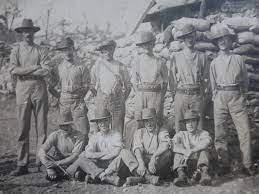
Into this Second Matabele War came a British officer whose wife would call him Robin, and, therefore, so shall we. Robin had risen from the rank of lieutenant and sometime scout/spy to becoming a major in the British Army by the time he arrived in Africa to help relieve the besieged British garrison in Bulawayo. In his short time there, Robin managed to work out an agreement with one of the leaders of the uprising for him to surrender peacefully. In return, Robin promised, the man would not be punished if he cooperated. So, acting on Robin’s word, the man surrendered–and was promptly arrested.

The man turned out to be not only a miliary leader of the local people, but he also carried the distinction of being somewhat of a holy man as well. His name was Uwini. When Uwini was arrested, he was accused of taking part in the killing of some British settlers in the area. The facts of the situation were disputed, but that didn’t seem to stop a military court from finding Uwini guilty of murder. They sentenced him to be executed by firing squad.

As one of the officers over the court martial board that sentenced Uwini, Robin had the verdict come across his desk. He had the option to commute the sentence, and, given that he had promised no harm would come to the man if he did surrender himself., probably should have commuted it. However, Robin did not do so. He signed off on the execution, and Uwnin was taken to the edge of a nearby jungle and executed for the killing of the settlers.

Well, even the British military knew this stank. They brought Robin before a military court of inquiry into his actions. However, the military court cleared him. After the verdict of innocence was announced, even the civil authorities in Bulawayo demanded an investigation and trial. This never happened, however, and the issue was dropped. Robin would later say at length that he had been completely exonerated of any wrongdoing. But people who knew him said that the incident dogged him inside.

Robin would go on to become a colonel and, finally, a general in the British Army. But that’s not why you know him. This man, who had his integrity (understandably) questioned, would go on to become an example to millions of how to live ones life with character, forthrightness, moral fortitude, and clean living.

Interestingly, Robin would later write that if a young person says, “On my honor it is so,” that means it exactly that, “just as if he had taken a most solemn oath.” In fact, this concept was so important to him, that Robert “Robin” Baden-Powell made this the first law of the Boy Scouts.

On a Troublemaker

The headmaster paced silently before the line of schoolboys, his hands clasped behind his back as he strode back and forth.

Finally, he stopped in the middle of the line before one rather thin boy with an oval face.

“Was it you? You’re behind all this, aren’t you, you troublemaker?” he asked accusingly, looking down at the lad.

The young student did not answer and stared back up at the white schoolmaster.

The boy had been given the name Rolihlahla by his family; it does indeed mean “troublemaker,” and the boy certainly grew up to embody that moniker. Born into a royal family in Africa, his father was a polytheist and a polygamist. His mother, the third of his father’s wives, had converted from the religions of her ancestors to Methodism. It was his mother who raised him, along with two sisters. She insisted that the children attend a Methodist school in a nearby village, and it was at this school that 9-year-old Rolihlahla’s proclivity for mischievousness began to manifest itself.

In this case, the trouble Rolihlahla caused was organizing a protest against, of all things, the poor quality of food at his school. His little protest saw the students refuse to eat anything until the food improved.

“Don’t you realize that we feed you well—better! than other schools?” the headmaster said, narrowing his eyes at the boy. What followed this rhetorical question was a long lecture by the headmaster about the good things that the colonizers had brought to Africa: Medicine, education, wealth, science, technology.

What was left out of the speech was that the colonizers also brought oppression and economic slavery, racism and greed.

And Rolihlahla had begun to feel a strong pull towards seeking justice where he saw injustice. That, too, was something the colonizers brought. They seemed to preach about liberty but not allow it, justice but deny it, expression but suppress it.

The boy was only implementing the lessons his “betters” were teaching him.

This protest against the food must be quashed, the headmaster said emphatically. Still, the boy remained silent.

“Well?” the headmaster said.

Finally, he spoke.

“Yes. I organized it. I put the others up to it. The food is of poor quality, and the students should eat what the teachers and staff eat.”

The headmaster pursed his lips in a triumphant smile.

“And, what’s more,” the boy continued, “I am correct.”

The headmaster’s smile vanished. “I am very sorry you feel that way,” he began. He dismissed the other boys, and then addressed the troublemaker.

“You are expelled. I will write a letter to your family. You are dismissed.”

Now it was the troublemaker’s turn to smile slightly.

“You find this matter amusing?” the headmaster asked.

“No, sir,” the boy answered. “I find it unjust.”

For Nelson Mandela, this first lesson on injustice would never be forgotten.