

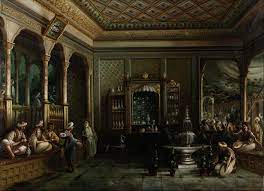
You can’t spit in Edinburgh these days for a coffee shop. London’s almost the same. Here’s a story about such a place that opened in London a while back. And it’s a typical story of a mix of cultures coming together in the British capital city as is often the case. The man who started this particular café was a Greek immigrant named Pasqua Rosee. He came to England to work for a man he’d met in Turkey a few years before. Now, to be fair, Pasqua was planning to work clandestinely. But he still had the drive to open a coffee place in London and make it like the coffee he had growing up–a confluence of Turkish and Greek tastes that he felt would appeal to the sophisticated palates of Londoners.
You see, Pasqua had worked as sort of a butler or servant for a London resident named Dan Edwards when Dan lived and worked overseas. One of the jobs Pasqua had was making coffee every day for Dan. And Dan raved about it. He praised the Greek man, telling him that there wasn’t anything like Pasqua’s coffee in London. So, believing his employer, Pasqua took the chance and bought a ticket to England. He had saved some money, but he knew that his illegal status would preclude him from actually owning the business and, besides, he simply didn’t have the contacts. But Dan had his back. Dan provided the “face” for the legal stuff and let Pasqua’s coffee-roasting and brewing skills do the actual work.
The called the coffee shop, simply, Rosee, after Pasqua’s family.
Dan also helped Pasqua get some baristas to help in the business. One man, Kitt Bowman, was a family friend of Dan’s who decided to invest in the business as well as work there. And the location–which we can all agree can make or break a business–was superb. It was right in the financial district, not too far from the Royal Exchange, and the clientele and market was upscale people who had disposable income. The business was a success soon after opening. The place was packed. People raved over the taste of Pasqua’s coffee. People kept asking him to sell his secret of how he achieved the great tastes of his roast, but he wouldn’t budge. Kitt and Dan were supremely happy. Word of mouth soon made it the most popular coffee place in London.
But, then, the coffee shop’s luck ran out and disaster struck. A fire in a nearby location swept through the adjoining buildings and destroyed the establishment. However, Pasqua wasn’t in the country at the time. It seems that his lack of legality in England had somehow caught up with him, and he was forced to leave the country. Kitt carried on for a time until he grew sick, and then, the fire finally killed Rosee. But the way Pasqua made coffee didn’t die with Rosee. Within a few years, over 500 coffee places had sprung up in London and the surrounding villages using his roasting and brewing methods.
Oh, and that fire that destroyed Rosee? It was the Great Fire of London.
You see, Pasqua Rosee opened London’s very first coffee shop–back in 1652.
 The Rest of the Story