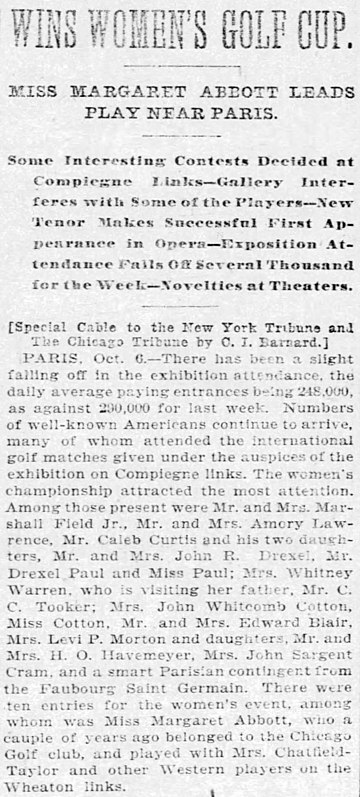
On a Tourney Win

Margaret Abbott was an American amateur golfer at a time when “ladies” didn’t really play competitive sports. She was born in 1878 in India where her parents had moved because her father had business there. Her mother was equally accomplished, becoming a newspaper reporter and literary editor for many newspapers in the United States. And Margaret herself lived a privileged, full, and varied life before dying in the 1950s. She studied in the United States and abroad, but it was while her family lived in Chicago that Margaret first began to take golf seriously.

And she was naturally athletic. A couple of local amateur golfers (true gentlemen of the time refrained from being crass professionals, don’t you know) from the club where her parents were members took Margaret under their wings and taught her all they knew about the game. Under their tutelage, Margaret’s golf game rapidly advanced far beyond others her gender and years. She won several tournaments in and around Chicago and beyond and developed a reputation for being a fierce competitor.

Then, in 1899, Margaret and her mother traveled (by themselves! Amazing!) to Paris for the pair of them to study art. Margaret’s mother also used the time to pen a travel book for American women who had the same desire, entitled A Woman’s Paris: A Handbook for Everyday Living in the French Capital. The two women had a wonderful time, enjoying all that the fin de siècle era Parisian culture had to offer.

It was while the pair were in France in the summer of 1900 that they noticed a newspaper article stating that, in association with all that was going on in Paris that year, a golf tournament was open for any and all entrants. And there was indeed a great number of events happening in Paris that summer. The Paris World Fair was held that year. The French capital city hosted the second incarnation of the modern Olympics that summer as well. The city was filled with tourists from across the globe. And then here was this golf tournament. Now, Margaret’s mother was no slouch at golf, either, and the mother-daughter team decided to enter the tournament.

And Margaret won. By two strokes. And Margaret’s mother finished the tournament a respectable seventh. And, for her win, Margaret was awarded a beautiful porcelain bowl that had gilded embellishments around it. The story of this American girl winning the Paris golf tournament made the US papers, but the story was quickly forgotten.

Margaret got married eventually upon her return to the United States. She raised a family. She played some golf, but an old knee injury made her give up the sport. Almost thirty years after her death, her son, Philip, received a phone call from a professor at the University of Florida, a woman named Dr. Paula Welch. Dr. Welch asked Philip about his mother, about her life and then about what she told him of the tournament she won in Paris three-quarters of a century earlier.

Philip was surprised. His mother really hadn’t spoken much about it, he said sheepishly. I mean, he said, it was only another tournament, and she competed in many during that time. According to Philip, Dr. Welch was silent on the other end of the phone line for a moment. In fact, he wasn’t sure if the professor were still there. Finally, Dr. Welch spoke, and what she said stunned Margaret’s son.

“You mean your mother didn’t tell you that she was the first American woman to have won a gold medal in the Olympics?” she asked.

On a Store Promotion

Robert May worked for the Montgomery Ward company as an ad man who wrote promotional material for the chain. For those of you who don’t know, “Monkey Ward” was a chain of department stores somewhat akin to Target today. Anyway, the store brass asked May to produce a story they could pass out to customers, something that would be light and entertaining and that would give the clientele a positive feeling about the company. If May could somehow tie the story into one of the holiday seasons–so much the better.

So, May began to brainstorm ideas. Easter had an appeal, and he toyed with that for a bit, but May knew that if he wanted to really tap into holiday time, his story would have to something to do with Christmas. It was the late 1930s, and May and the rest of the United States were only then beginning to emerge from the economic bombshell that was the Great Depression. Sales were increasing nationwide, people were starting to work again, and promotional items like May was asked to create were becoming more and more popular.

Well, when Robert May submitted his first story idea, his boss hated it. “Can’t you think of something better?” the boss asked. May went home that day severely depressed. He liked his story, and, when he read it to his wife, she concurred. It was a child’s tale about an animal who had been an outcast. You see, in many ways, that was Robert May’s story as well.

Born to a Jewish family on Long Island, May had first-hand experience on what it was like to be different. He managed to survive high school and win a place at Dartmouth College. His major, perhaps surprisingly, was psychology. He grew particularly interested in the psychological theories of Alfred Adler, a man who had proposed that much of human motivation stemmed from the strong desire to overcome perceived inferiority.

May had achieved success working for various department stores after his graduation from Dartmouth. He worked for Rich’s in Atlanta, Gimbel’s and Macy’s in New York City, and, finally, he and his wife moved to Chicago where he worked for Montgomery Ward. However, in almost every place he had worked, May encountered some form of prejudice because of his background, even though he was not a particularly observant practitioner of Judaism.

Adding to May’s life situation was that, in 1939, his wife, Evelyn, was diagnosed with cancer. Life had not turned out the way he had hoped. He later said that he found himself in his mid-30s, heavily in debt due to the mounting hospital bills for Evelyn, and, instead of writing the Great American Novel, he was instead writing advertising for cheap clothing and now, a promotional pamphlet for the holidays.

Turns out that May’s boss was wrong. The story was a huge success. Almost three million copies were handed out to Ward customers, and the stores couldn’t keep the little booklet in stock. World War 2 paper rationing slowed the distribution of the story somewhat, but, after the war, the holiday tale became even more popular. May even got his brother-in-law, a singer/songwriter named Johnny Marks, to pen a version of the story for a song. A huge singing and motion picture star, Gene Autry, “The Singing Cowboy,” cut the record, and it, too, became a huge success. The story has taken on a life of its own.

Couldn’t have happened to a better guy than Robert May, everyone said. If anyone deserved the success after so much adversity in his life, it was he.

Yes, and we can reasonably say that Robert May’s creation, Rudolph the Red Nosed Reindeer, would heartily agree.