On Idle Gossip

Is there anything more delicious or more dangerous that gossip? A rumor that takes wings and soars over our ears, passing from one throat to the other, each telling of the tale making the story only slightly more luscious and salacious and opprobrious. We’ve all played the whisper game in school, where a simple sentence is told to the person next to you, who passes it on to the next, and so on, so that at the end, the sentence rarely bares any resemblance to the original message.

Rose Oettinger found a way to make idle gossip pay, and pay well. But she didn’t start out that way. Rose was born in Illinois in 1881, and she wanted to be a serious journalist at a time when most middle class women rarely worked outside the home. She wrote for her local newspaper for a time after her schooling, given stories by the editor about weddings and societal events. From there, she learned how to write scenarios for silent films in the ‘teens and early ’20s. She also published a book detailing how to write for the movies. It was a modest success. Ruth then got a plumb job writing about film for a Chicago paper. She loved that work. But then, the newspaper tycoon, William Randolph Hearst, bought the paper and fired Rose because he didn’t think film warranted news coverage.

Out of a job, Rose moved to New York and continued writing about film for a paper there. Part of her job included conducting interviews of up-and-coming movie starlets and young stars, as film journalists today have to do as well. And Rose was good at ferreting out those interesting tidbits of information that the public wanted to know about their new favorite film actors. She said it helped that she was from a small town, and that gave her an advantage over her city-raised competitors. She knew what small-town America was wanting to know, and she gave it to them.

One of those starlets Rose interviewed was a lovely girl named Marion. Like Rose, Marion came from fairly humble origins. She had been a chorus girl on Broadway for a time before her big break came and she was able to star in a feature film. Sadly, most film critics panned Marion’s performance, a mark that could have been a career killer for a new starlet. But Rose liked Marion from the get-go, and the two became good friends as a result of the interview Rose conducted. When she wrote her article about Marion’s film, Rose told people to give the girl a chance, that she saw great things for Marion’s future. Because of that glowing interview, the film producer who had backed Marion’s film became a cheerleader for Rose’s writing career. That patronage led to Rose being given a job writing about film for a newspaper in Hollywood at the rate of almost $2000 per week in today’s money.

Then, in 1924, Rose was invited on a short trip down the southern California coast on a private yacht, the Oneida. Onboard that boat on that trip were some famous people, including the legendary Charlie Chaplin, famous (at the time) producer/director Thomas Ince, and Rose’s actress friend, Marion. Something happened on that boat, but we aren’t sure what it was exactly. The result was that Thomas Ince was dead. What many people believe is that the owner of the boat, a wealthy businessman and Rose’s boss, shot Ince in a jealous rage. You see, what we know for sure is that the boat’s owner was in love with the much younger Marion. It has been speculated that the wealthy older man flew into a jealous rage when he thought Chaplin was flirting with Marion, and he shot at the silent film star but hit Ince instead. The inquest that followed said that Ince died from heart failure, but his body was cremated before a full inquiry could be made.

Whatever happened, Rose and the others on board never said. What resulted is that shortly after the trip, Rose was given a hefty raise and a life-time unbreakable contract if she would write gossipy stories about Hollywood’s stars. Rose agreed. Of course, you don’t know her as Rose Oettinger (if you know her at all). No, she wrote under her first name and her married name.

Oh, and that wealthy man who was in love with Marion? He was the same newspaper tycoon (and one of America’s most powerful men), William Randolph Hearst, who had fired Rose years before. He and Marion stayed together for the next three decades.

And, until she died, gossip columnist Louella Parsons never disclosed what really happened aboard the Oneida during that trip.
On a Bad Imitation

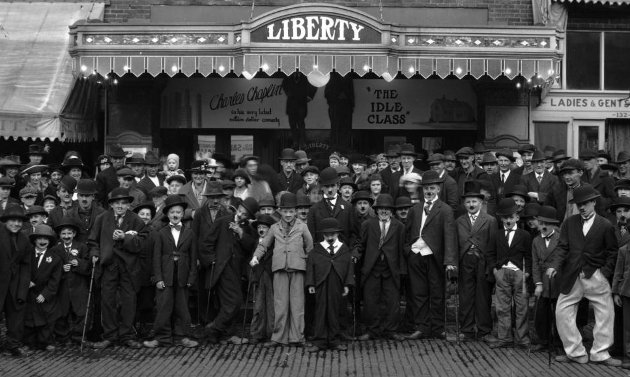
Some historians claim that a woman named Sarah Bernhardt, was the first “modern” celebrity. The French actress used popular magazines and her relationships to famous painters and writers and musicians to publicize her stage career in the 1800s. As a result, people world-wide knew who she was, thus becoming the first international star. But the world has never seen the popularity of the (mostly silent) film star, Charlie Chaplin. Everywhere he went, even when he wasn’t in his usual costume as the character “The Little Tramp,” the talented actor and director was mobbed. He was so famous in the 1910s and ’20s that cities and organizations would often hold Charlie Chaplin Look-Alike contests, contests that offered cash prizes to the person who could best imitate the character’s signature splay-footed walk. Even a young Bob Hope, later to become a famous comedian in his own right, entered one such contest during that time.

One such competition was held near San Francisco in the late 1910s as part of a county fair and a new movie theater promotion. Several dozen competitors donned their little under-the-nose bristle mustaches, put on ill-fitting hats and too-big shoes, found ragged pairs of trousers, grabbed reedy canes, and made their way to the fairgrounds. As the crowd gathered to watch the competitors, one of their number, a young man named Spencer, watched with amusement. “Those clowns,” he said to his small group of friends who had joined him at the fair that day as they watched the look-alikes start to parade across the fairground’s stage, “they don’t have the walk right.” You see, Spencer considered himself somewhat of a Chaplin expert, having seen everything that the comedian had put out on the screen.

Spencer’s chums began to goad him good naturedly. One of them dared him to get up on the stage and show them how to imitate the Chaplin walk if he knew it so well. Spencer grinned at his friend. “You’re on,” he said. “Here,” he added, taking off his jacket, “hold this and watch!” And, with that, the competition had another entrant. Spencer made his way to the side of the stage where one of the organizers was trying to corral the several would-be Chaplins in line before they demonstrated their imitations on stage.

“Say,” Spencer said to the harried worker, “d’ya think I could join the competition?” The staffer didn’t care. He just wanted to get through the warm afternoon as quickly as possible. “Sure, what do I care?” he said handing Spencer a number and a safety pin. “Just put this on your shirt and go to the back of the line.” And, flashing a large grin and a thumbs-up to his group of friends, Spencer went to the end of the queue to wait his turn. Eventually, as the last entrant, Spencer–without any Chaplinesque costume at all–made his duck-walking way across the stage. A few people clapped, mainly Spencer’s friends, and a few in the crowd booed.

The organizers used a set of three local minor dignitaries as their judges, and the judges also used crowd approval as a criteria in selecting the five finalists for the competition that day. And, when the votes were tabulated and every competitor was judged, it turned out that Spencer didn’t make the cut. He and the other unsuccessful entrants were thanked by the emcee and they were dismissed. Spencer made his way back to his little coterie of friends. They laughed at his failure, telling him that maybe he wasn’t as good of a Chaplin fan as he thought he was if he couldn’t even do the Chaplin walk correctly. Spencer was incredulous. In his frustration, he didn’t want to stick around to see who won the contest, and, with his friends still laughing at his expense, the group made their way on down the fair’s midway.

Now, of course, no one remembers who won that look-alike competition that day.

However, we do remember the contest.

For, you see, it was the day that Charles Spencer Chaplin couldn’t even win a competition imitating himself.

On a Visit with Charlie

It’s difficult for a person in today’s world to understand how immensely popular Charlie Chaplin was during his heyday as a silent film star and director. Chaplin was mobbed everywhere he went. People could not get enough of stories about Charlie. Photos of his most famous character, the Little Tramp, filled magazines and newspapers.

Sometimes Charlie found it difficult to make his movies, even when he would be filming or directing on a studio lot. People, famous or not, would often stop by and demand that Charlie take a moment to speak to them and maybe have a photograph or two taken with him. As you can imagine, this became very annoying and disruptive to Charlie as an artist. Yet, when someone showed up on set, Charlie rarely turned him or her away. Such was the case in 1919, when a young woman showed up to meet him on the set of his movie, Sunnyside.

Usually, Charlie would tell the cast and crew to take a short break while he made small talk and posed for the obligatory photographs. But, on this day, something was different. Rather than taking just a few moments and then getting right back to work, Charlie seemed  immediately and absolutely captivated with the young woman. It seemed odd. She was certainly no beauty.

You probably know that Charlie had a deserved reputation as being a man who had an eye for beautiful women, and one could almost understand him taking a little extra time if the woman were especially attractive, but this was so obviously not the case. This woman was awkward. Her movements were stilted. Yet, Charlie ended up spending several hours talking to her. And, again oddly, during their whole time together, the woman said absolutely nothing to Charlie—not one word.

That actually suited Charlie quite well. It was said about him that he was someone, “who tries to avoid people who talk too much, which gets on his nerves.” Perhaps that’s why Charlie became friends with a artist in California named Granville Redmond. Redmond was a deaf mute, but he and Charlie got along famously. Charlie said that he learned from Redmond that subtle movements and actions carry great weight if they were done properly. Redmond also taught Charlie sign language, and Charlie helped promote Redmond’s art career.  But, at the heart of their friendship, the fact that the two men could communicate without speaking seemed to be important to Charlie.

And that may be why he spent so much time with the woman that day. For, like Redman, this woman was also a deaf-mute. In fact, she was also blind.

The great silent comedian did all the talking that day because he had spent the hours with a young woman named Helen Keller.