
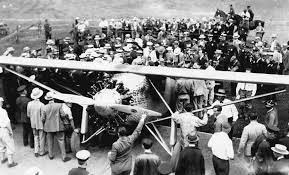
The race to be the first to cross the Atlantic between New York to Paris in either direction via an airplane began heating up in the mid-1920s. A cash prize of almost $400,000 was offered to the first who could make that trip without stopping for fuel or supplies or sleep. The prize was first made available in 1919, immediately after the war, but the long journey was so daunting that by 1927, no one had claimed it. The journey of over 3600 miles scared off almost all but the most fearless pilots.
And to accomplish such a feat took a large team—not only the pilots. The pilots were vital, of course, but there were teams of designers, engineers, efficiency experts, professionals in things like weight distribution and safety who had to be consulted and considered. For example, flying for hours over open water like the Atlantic meant that having to account for the real possibility of having to ditch in the ocean. What would that mean? How much lifesaving provision would be needed? So, the task took longer because of the vital logistics and the number of people surrounding it.
One such attempt at the journey left its origin on May 8, 1927. The pilot was well known and celebrated for his fearlessness and skill. The route is the same one that planes fly today; it’s called the Great Circle Route, and, instead of a direct line, it flies north in a semi-circle because, on a globe, that is shorter than flying around the larger part of the sphere. In the weeks and days leading up to the attempt, interviews with the pilot insured that the public, who were eager for such stories, knew every detail of the aircraft and the logistics that went into the courageous attempt to cross the Atlantic non-stop.
The take-off of the attempt took place amid throngs of well-wishers and cheering. Some other aircraft even accompanied the craft as far as the coast as a farewell escort, of sorts. After that, there were only a few sightings of the plane. One priest in Ireland swore he saw the plane. A British sub, also, said that its crew made a visual confirmation of the flight. After that, the craft was on its own over the deep, blue Atlantic for the next several hours.
And as the hours drew on, crowds of fans and media gathered at the arrival airport to welcome the plane that made history because they were sure such a well-planned flight could not help but be successful. As they waited for the landing and the celebration, rumors ran through the crowd. The flight was seen over the coast, or it had been spotted circling above the city, or it was due any moment. But, as the hours passed, it became evident what had happened. The aircraft carried enough fuel for 42 hours of flight—which should have been plenty of time to make the journey. Two days after take-off with no landing, however, told the story.
One of the largest air/sea search operations up to that point was dispatched to look for the plane. Nothing has ever been found of the aircraft or of its French pilot, Charles Nungesser, and his navigator, Francois Coli. Only twelve days after those two left Le Bourget Field in Paris to fly to New York, Charles Lindbergh, flying his Spirit of Saint Louis alone, left New York and arrived at Le Bourget 33 ½ hours later to a hero’s welcome.
 The Rest of the Story