
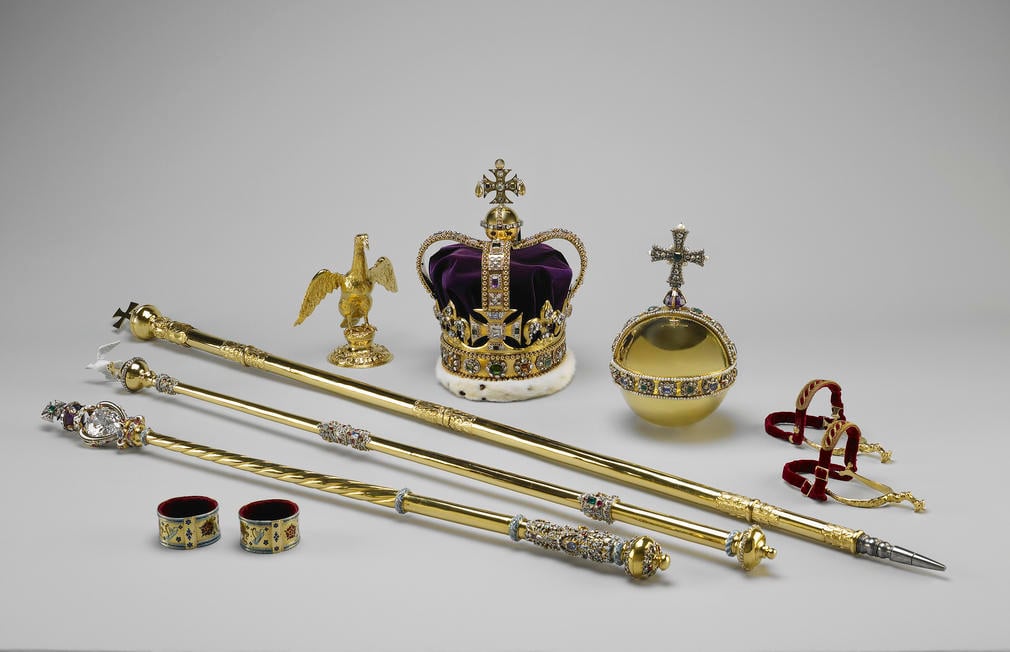
The coronation of a new monarch in the United Kingdom put me in mind of one of my favorite movies as a child. The film was called The Jokers, and it was about two bored, upper class English brothers in London who decide to steal the Crown Jewels as a prank. For me, a kid from the southern United States, that such a place as “Swinging London” as depicted in this 1967 film existed at all boggled my mind. Added to my interest was that the film showed many of the grand historical sights (and sites) in and about London.
The Crown Jewels are not simply the crown that the monarch wears, or the scepter, or the orb. No, there are many other things that make up this selection of precious things, a group of items called, “a unique collection of sacred and ceremonial objects.” Over 100 items, in fact. 23,000 gemstones adorn the various items. We can’t really put a price or value on these things simply because of their intrinsic and symbolic value to the people of the United Kingdom. They mostly either represent the power and responsibilities of the role of monarch or they are used in the coronations.
One of them, however, stands so distinct and so unique compared to these other bejeweled and “precious things.” In fact, it is the oldest of all the objects so precious and revered by the nation. Records say it was made in the 12th Century for the king. It’s not particularly flashy or overly bejeweled or large like the rest of the objects, and you won’t actually get to see it during the coronation, but it’s used in the ceremony.
Let’s go back a bit. In the 1640s, England stopped being a monarchy. Oliver Cromwell defeated Charles I in a bloody civil war and had him beheaded, and he drove Charles’s son into exile. For roughly a decade, England had no king. The new government, eager to erase the trappings of the monarchy, destroyed or melted down or sold the Crown Jewels. The sale of the jewels attracted a large crowd, even though most of the people in attendance couldn’t afford the items. A man who had been a groom of the wardrobe for the now-deceased Charles I, a man named Mr. Kynnersly, bought this item in question for 16 shillings. In his mind, it would give him something to remember his former employer by.
Fast forward a few years. In 1660, Cromwell and his Commonwealth experiment were gone, and England welcomed back Charles II to restore the monarchy. The problem was that all of those crowns and other trappings of the office were gone. So, they had to be remade. And those are the items that are today stored in the Tower of London when not being used for official functions. And, when Charles II was being crowned, that’s when Mr. Kynnersly stepped forward and presented to the new monarch the only item that survived the Cromwell destruction of the Crown Jewels. So, when you view a coronation, know that all those objects-the crown, the orb, the scepter, the capes, everything-has been recreated since 1660.
Except for one.
It’s the spoon used to anoint the monarch with oil.

 The Rest of the Story