On a Delusional Young Woman

She began hearing the voices in her head when she was 13 or so. The girl, a product of rural peasant stock in Domremy, France, seemed to be a most unlikely person to receive messages from the beyond. She had no education. She wasn’t a religious novice. No, all the girl did was help keep the cows her family farmed. Barefoot, she’d take the animals to pasture during the day and bring them home at night, milking them early and late. Oh, and the voices didn’t speak to her all the time. Bright lights often triggered the voices, she said. And bells. When the church bells in the nearby village would ring, announcing church services, she’d experience the voices more clearly than ever.

As the girl began to tell other people in the area about the voices and their messages of heavenly instruction, those people began to listen. The time period was back when people were much more superstitious, and those superstitions were tied to religion. When someone came along professing to have supernatural, other-worldly insight, the people of that day took notice. She gained somewhat of a following, with other peasant folk starting to seek her out to learn what other messages the divine was sending through the young girl.

Her parents, Jacques and Isabelle, told people that their daughter had been odd for some time. She didn’t always have this gift of hearing the voices, they said. No, she also had visions, but she didn’t talk about those much. She would seem to go into a trance and then reveal what she had seen and heard. Oh, and the family reported that she had a terrible temper; her short fuse often resulted in some mild violence if she felt something displeased her sensibilities, especially when her brothers, Jean and Pierre, would offend her somehow.

Based on these details, modern scientists have made some broad guesses as to what possibly could have triggered the girl to have those visions and to hear those voices. Some have suggested that she had a neurological issue or a psychiatric disorder. Some postulate that she was bipolar or had been the victim of a brain injury sometime in her younger life. Others, usually medical historians, point to some disease that could have given her dementia. The truth will probably never be discovered.

At any rate, by the time the girl was 16, she was noticed by higher authorities in the Catholic Church. And those authorities, in a time when France was locked in war with England, saw in this odd, seemingly god-sent young maiden, someone they could use to rally the people to their cause. The war had gone on so long that people began losing hope, and the powers that were decided the girl could be useful. So, incredibly, the authorities used this possibly mentally challenged young girl to their own ends; they capitalized on her notoriety, gave her a symbolic role in the war, and used her until, well, they couldn’t anymore. Eventually, she was captured by the English and killed for being a heretic.

You might think you know her name, but you’d probably not get it right. She called herself Jehanne la Pucelle–Joanne the Maid–at a time when most people still didn’t have last names as we know them today.

Of course the name you know her best by is the one that was never really used by anyone at the time.

Joan of Arc.

On a Banned Item

It’s rare that a day goes by when the news isn’t reporting on some group or another protesting about this practice or that book or the other item over there being something that is causing the ruin of modern society. That fear isn’t new. The status quo hates change by definition, and anything that is perceived to be a threat to what most people are used to is often castigated as the “other.” Take the banning of an item in the Middle Ages, for instance.

In Europe of almost 1000 years ago, of course, the Catholic Church was the predominant influence on what was acceptable to society and what wasn’t. And anything that was considered by the Church to be unacceptable was labeled–no surprise–evil. That’s what happened in this case. In fact, the item in question was labeled as “notorious” and “sensuous”–two words that spell Satanic in the minds of most Christians of that time.

But that wasn’t all. This particular item was considered to be so heinous that its use was said to make the user homosexual. Those of us today who snicker when we hear some religious person speak of something “turning our children gay” should know that this type of mindset is, again, not new. In fact, the Church decreed that the use of this item ranked right up there on the list of high sins, right alongside such despicable things as gluttony, the selling of church positions, and even marriage by priests.

I’ll even give you the name of this item. The people of that day referred to it as Pigache. I can tell you that, and you’ll still probably have no idea what it was. The word comes from the middle French word for a long-toothed hoe, but that etymology is more of a descriptor than a definition. And Pigache were banned across much of Europe for several decades because of this association with sin and the Evil One.

We today find it difficult to relate to a time when the things you could use were considered not only illegal but also morally wrong. The Middle Ages were a time when even your thoughts, if you expressed them, could condemn you to prison or worse. That is why we should remember those times in history when mankind used tradition and superstition to coerce others into acting in a way that really amounted to freedom of choice and expression.

And you’ve seen Pigache before in artwork from the Middle Ages. Pigache are, in fact, so innocuous that you’ve not given them a second thought, yet, at that time, they invoked fear and dread because of the illogical fear of those in power. In the 1950s and since, the Pigache has been used by several groups including Rockers, Teddy Boys, and even more modern haute couture designers on runways across the globe. No one today things anything about it. Most people today know that things like Pigache have nothing to do with the content of your character.

After all, there’s nothing wrong with a pair of long-toed shoes, is there?

On an Alternative Method of Healing

The Catholic Church of the medieval period pretty much controlled every aspect of the lives of their parishioners. Everyone from king to peasant had to go through the Church literally for life’s events from cradle to grave and everything in between. From baptism to confirmation to confession to marriage to last rights and burial on Church grounds–if you didn’t go through the Church for these things they weren’t considered legitimate.

But it happened quite often that when the church couldn’t provide a certain service, the people would be left to seek alternative ways of doing what they wished to do. Let’s say you wanted a certain boy or girl to fall in love with you. The Church wouldn’t have any remedy for that situation. Or take the case of healing the sick. Now, it was absolutely the practice in some areas of Christendom that the Church would set up hospitals and provide medical care for sick people, especially during times of plagues and other pandemics. But if you wanted the healing of, say, a headache, the best the Church could do for you is pray. And prayer can only do so much, mostly as a placebo.

And that’s where a certain class of people arose in the middle ages to meet the needs of people who found that the Catholic Church didn’t actually have the ability to solve or handle all the problems of their parishioners. And we’ve discussed this before, and recently, that when someone or some group tries to take the place of an already established entity or power (or even if there is the perception of such), then those in power will strike out against the usurper. And that’s what happened here.

You see, there was no such thing as a doctor as we today would recognize, at least in Western and Central Europe. Oh, a handful of medical schools opened across the continent, but they were often run by the Church, and they were most often in large cities that were springing up especially after the Crusades. But these medical schools did nothing for the people who lived in smaller towns and villages and certainly they were not helpful to those in the countryside across Europe.

And so people began turning to the people who would at least try to help them with their headaches and skin rashes and venereal diseases and whooping coughs and other physical maladies. Oh, and, sometimes, people sought help for other things, things like their love lives and their melancholy or their nightmares. And, sure enough, when these people who offered help grew too popular or too successful or too prominent, the local priest or the local Church organization would rise up to put them down and restore the normal progression of things such as relying on the Church for the solutions to all of life’s problems. In doing so, they literally demonized those people who were only trying to help others. And people kept going back to the healers.

Now, you and I would call a person like that a doctor and reward them.

The Catholic Church called them witches and burned them.

On a Painting Contract

There are usually two camps when it comes to paying for contract work. Some people argue that it’s always better to pay the contractor up front, but others contend that the work should be completed before payment is tendered. Then, there’s a growing third group, and this bunch sets benchmarks for work completed with payment to be given as the benchmarks are met and the work approved. I like this one the best, because it seems like a win-win with neither side in a position to take advantage of the other.

This last benchmark-type contract was the arrangement Julio made to have some painting done. He hired a man named Mike for the job. Mike and his crew came highly recommended. As Mike completed different tasks for Julio, the work was to be inspected and payment made before Mike would begin the next bit of painting. But there’s something that you should know about both Julio and Mike–each man had a terrible temper. Julio was known to berate people who worked for him. He was obscene and showed off his vast vocabulary of curse words daily, sometimes rattling off a litany of vulgarities simply to see how others would react. For a man with quite a lot of money, he had a lower-class sense of humor and coarseness about him. In addition, he was unfaithful in his sexual relationships, fathering children by several different women. Now, on the surface, this has nothing to do with paying a contractor what you owe him, but it gives you an idea of the kind of man Julio was before we get to his business agreement with Mike.

And Mike, for his part, was no prize, either. His temper was shown not to underlings or workers like Julio’s was, but, rather, for people he worked for who stiffed him on payment. He was known to threaten violence against anyone who didn’t pay him the money he knew was owed him for his work. Some rumors were out that that Mike had killed a man at one time for non-payment. No, for his own workers, Mike was generous to a fault, often paying them out of his own pocked when the people he worked for didn’t meet their promised obligations. Add to this the fact that Mike wanted the job done right. He was often late on his work because he was known for starting over. Call it OCD or whatever you wish, but the man was a perfectionist. Julio wanted the job done right, but he wanted the job done. He didn’t want to wait for Mike’s perfectionist streak to repaint and repaint and repaint.

And, so, when Mike and Julio agreed to a large benchmark painting job, you knew fireworks were bound to happen somewhere along the way.

The first benchmark was met, and Mike was paid. The second one, was met and Mike was paid. The third one was…late. Mike was repainting, and Julio yelled at him that this was a breach of the contract, that the benchmark having not been met meant that the deal was off. But Julio was pleased with what Mike and his crew had done. So, he promised to pay Mike, but still he withheld payment. So, Mike and his bunch took their buckets and brushes and ladders and left the job unfinished. Julio, realizing that he wasn’t going to find a better man than Mike to do this job, finally acquiesced and convinced the man to return to the work. And there were other hiccups along the way.

In all, it took Mike from May to September to finish the $600,000 paint job–September five years later.

But you have to admit, the painting of the Sistine Chapel by Michelangelo for Pope Julius II was worth the time and trouble.

On a Pilgrimage

Paul’s dream his whole life was to visit Jerusalem. He grew up a good Catholic boy in Italy, born in the countryside about 130 years ago to upper middle class parents who had some landholdings. One of his brothers became an attorney, another became a politician. Paul wasn’t sure what he wanted to be as he grew up, so he received a general education from the local school. He finally found a home in a publishing wing of the Catholic Church. He also taught in Catholic schools and eventually became a secretary to a Cardinal.

But he was devoted to the Church and to God. The Holy Land, especially the city of Jerusalem, always called to him. For most of his life, work and his responsibilities kept getting in his way of making the pilgrimage to the place. Finally, at age 67, Paul decided that it was now or never. He boarded a jet in Rome and flew to Amman, Jordan. Now, in 1964, when Paul made his pilgrimage, that was the normal tourist route into Israel because Jordan controlled those areas where Paul wished to visit. In other words, the borders of all those countries have changed dramatically since then. At any rate, Paul made his way with a large group of other pilgrims across the Jordan River and entered Jerusalem for the first time, fulfilling his life-long dream.

And it was magical for him. He knew enough history to realize that what he was seeing wasn’t the way it was almost 2000 years earlier, but that didn’t matter to him. It was his connection with the earth in that spot, the spiritual connection he felt with the place rather than the buildings or stones or streets. He knew in his heart that he was seeing the same space if not the same city that his beloved Jesus had once seen, seeing the sky from the same spot on the globe as Jesus had done, and breathing the air where Jesus had once breathed.

And that was more than enough for him.

To show his thanks to the land and the people for allowing him to realize his greatest desire, Paul brought gifts that he left at the different shrines. He lit candles in the churches. He prayed in the chapels. And, even though he was older, he barely slept while he was there because of his excitement. He didn’t want to waste time sleeping, he told friends later.

And, while he had accumulated wealth during his life and work, Paul chose to wear simple clothing during the pilgrimage. He wanted to honor the simple man he admired so much. And, because he believed that Jesus spoke about peace and love, he made sure to leave olive branches at every stop he and his other pilgrims made.

You may wonder why Paul’s pilgrimage merits your attention here and now. Surely, Christian, Muslim, Buddhist, Hindu, and billions of other religious people make pilgrimages all the time. And you’d be right. Except Paul’s pilgrimage was the first of its kind.

You see, Paul’s pilgrimage in 1964–Pope Paul VI–marked the first time a Catholic Pope had ever visited Jerusalem.

On an Benevolent Racist

We’ve looked at the topic of racism in other posts in this blog series, but this particular post is about a racist that most people didn’t realize was a racist when she was alive. To begin with, this woman felt that those of the so-called “inferior” races should accept the lot that God gave them in life. And, if there’s one thing that is difficult to fathom, it’s someone who uses religion and/or God to justify their hate.

This woman ran a large organization that was built, ostensibly, to help the poor receive medical care. The opposite was in fact true. Most people who came to the organization run by this woman received little to no help at all. And, to make matters worse, the woman publicly didn’t care that her group failed to fulfill its stated mission. Again, it was due to the fact that she was of the “correct” race–white–and those whom the organization was designed to help, well, weren’t white.

“The world,” she said once, “is better off because they (the non-white people) suffer.

Sheesh.

You see, the problem wasn’t that the organization lacked funding. The opposite was true. They were simply drowning in funds. The woman was an astute and crafty fundraiser. Yet, the facilities of her organization (and there were over 100 of them) were poorly equipped and the staff–my God, the staff!–were worse than useless. Most were without any kind of certification or qualification in helping poor people with their medical issues. Again, the reason for the these conditions was that the woman simply didn’t seem to care about those whom she was supposedly there to help. Their plight was what God wanted for them, sure, but it was what they were supposed to receive, what they were destined to receive, simply because they were not worthy of the quality of care the so-called superior races deserved.

Who was this medical Cruella de Ville? Well, I can tell you she was born in Albania, a nation that is not exactly the wealthiest nation in Europe. She was more of a cultural racist in a way. Christianity was the true religion, she felt, and she insisted that many of the people who applied for help in her organization first convert to her religion before receiving help.

And it gets worse. This woman sought out audiences with dictators around the world, men like Haiti’s Duvalier and her native Albania’s communist strong man, Hoxha.

Ultimately, the reason she decided to “help” those less fortunate than she was that she truly felt that help for the non-whites should come from their “betters.”

Can you believe the gall of this woman?

And to think that Mother Teresa of Calcutta became a saint in only 5 years.

On the Priest of St. John’s

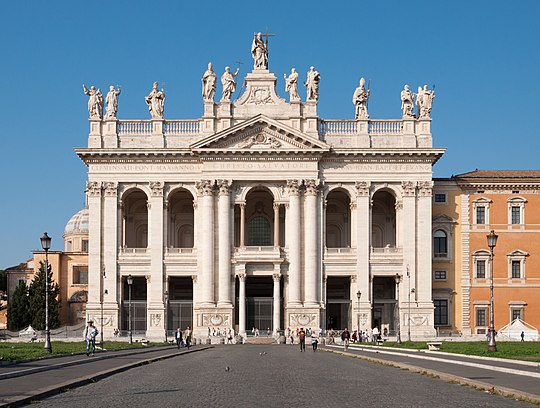
Ah, Rome! The Eternal City. I’ve been there twice but only went to the Vatican and the Vatican Museum one of those times. It’s an amazing city for art, architecture, and history. You can’t spit for a ruin, or a church, or a ruined church. And to walk out of the Rome subway system and see the majesty of the Colosseum rise before you…it’s magic. But I want to talk about a church building and the priest of that church that does not lie within the borders of the Vatican City.

While we all know about St. Peter’s, the church I want to introduce most of you to is called St. John Lateran. It’s named for two of the Johns from the Bible–John the Baptist and John the “beloved” Apostle of Jesus. It’s located almost 3 miles of the Vatican, and, having been consecrated in the 300s, it boasts of being the oldest public Christian church still in existence in Rome and the oldest in Western Christianity (those Eastern Orthodoxers have older ones).

The priest of St. John’s at the moment has been the head of that church for the past 10 years, and he is quite an amazing fellow as those fellows go. He’s an older guy (83) who was born Mario Bergoglio. He became a Jesuit in the late 1950s and taught in seminary before becoming an ordained priest in the late 1960s. What makes him special, at least in my mind, is that for a guy who comes from such a traditional Catholic background, he’s pretty progressive when it comes to seeing his work as being one of service to others.

Let’s not debate the abuses of religion in general and Catholicism specifically in this format. Allow me to tell you what I really admire about this simple priest of St. John’s church. Here’s an example of what I mean. During August, most of Europe goes on holiday–everybody. That includes people who work in the Catholic church. That sounds reasonable until you consider that a lot of beggars come to Rome in the summers to make money off the tourists who flock there. Those people who are mostly homeless rely on the largesse of the Catholic Church for food often and even for a place to shower or to stay the night in a shelter. What Father Bergoglio did was tell his staff that they had to take their August vacations in shifts so as to not shut down the mechanisms that helped the homeless population of Rome. In other words, he argued that the Church couldn’t simply walk away and leave people without resources for a whole month. In my mind, that’s pretty noble of him. In fact, Bergoglio himself still takes some shifts in the soup kitchens during the month, even at his age. It’s the rare priest or minister who practices what he preaches.

Here’s another example. As the priest of St. John’s, Bergoglio has as one of his perks a luxurious apartment where he could live–if he so chose. However, he does not live there. Instead, he chooses to live in the much smaller and much simpler guest house. His argument is that all he needs is a bed.

These and other stances have gotten him into trouble with the hierarchy of the Catholic Church. He is against capital punishment. He is for a more tolerant stance regarding same-sex relationships. He has spoken out against the excesses of capitalism and has advocated for laws addressing climate change. You can see that these stances might ruffle some feathers in the Vatican, and, indeed, they have. The Catholic Church has maintained its power for hundreds of years by being traditional and unchanging, and here is one of its most high-profile priests speaking like a modern radical practically.

You might think the Pope would step in and address some of these actions and positions taken by Bergoglio. Would it surprise you to learn that the Pope actually hasn’t spoken out against what the priest of St. John’s Lateran says and does?

You shouldn’t be surprised. Pope Francis isn’t the priest of St. Peter’s Basilica, after all.

And Francis is the name Cardinal Jorge Mario Bergoglio chose when he was made Pope and became the priest of St. John’s ten years ago.

On a Heresy

The issue with using religion as a base to write and enforce laws is that religion is man-made and subjective. Your religious beliefs, even if they are different from mine, are no more or less right or good. And the same is true for my religious beliefs. Two people can look at the same thing or idea or work of “scripture,” express our individual interpretations about it, and suddenly my orthodoxy becomes your heresy. And so laws based on these opinions–and that’s all that they are–are not only wrong on their faces, but they also go against basic human freedoms of liberty, justice, and equality (none of which are so-called Biblical principles, by the way).

And all of that that takes us to a case of heresy that was brought against a man in the 17th Century. At this time in what is now Italy, the Catholic Church held political as well as religious power. They prosecuted and persecuted people who did not follow the letter of the Catholic ordinances and beliefs to their interpretation of religious perfection. In this particular situation, a man simply did not agree with the church that the earth was the center of the universe, that all objects circled around our globe.

Nicolaus Copernicus, the Polish astronomer and thinker, had posited a different idea, that the earth revolved around the sun instead of the Catholic model of the opposite. Now, Copernicus wasn’t the first to hold this belief; Greek astronomers and others had made the same claims centuries earlier including the concept that the earth rotated on its axis. Islamic astronomers confirmed these Greek ideas. However, it was the Copernicus proposal that this man had espoused, and it’s what the Catholic church prosecuted him for. One major reason for their prosecution at this time was because Copernicus had published his findings a century before; he drew the known planets in correct order radiating out from the heliocentric system. Many people began listening to the theory, and the Catholic Church saw this as a threat to their ways of belief and their control over what people believed.

So, they put this poor man on trial for agreeing with Copernicus. During his cross examination by the Church’s prosecutor, the man walked back his belief out of a sense that he knew the punishment for his “crime” could be severe. He said that, after careful consideration, that rather than a “belief” in the heliocentric idea, he wanted merely to use that concept as merely a starting point for scientific discussion.

We must remember that this period saw the Catholic Church under attack from the surging Protestant movement. Printing presses published ideas that countered the Church. The Renaissance and the early beginnings of the Age of Enlightenment further challenged the orthodox and monolithic Catholic faith and power. That is why trials such as this one, while seemingly over a trivial matter, were so important to the Catholic hierarchy. While this doesn’t excuse the severe abuses the Catholic Church committed during this period of the rise of heterodoxy in Europe, it does help to explain it. Sadly, similar behavior is occurring across the globe as extremists in all nations are demanding that laws be passed that match their beliefs and not that protect basic freedom of thought and belief.

The argument of the man that he didn’t actually believe Copernicus but only wanted to use his ideas as discussion points did not sway the Catholic court. They found him guilty of crimes against the Church and against God. His sentence was to be under house arrest for the remainder of his life. And that’s what happened to him.

It would take the Catholic Church 300 years before it admitted it was wrong and exonerated Galileo for his “crime.”