
The doctor said to the large, wealthy gentleman, “That thing is a bad-acting tenant, and I would have him evicted immediately.” It was the surgeon’s way of telling the man that the cancer that had been discovered on the roof of his mouth required surgery. The gentleman smiled at the doctor’s small joke, but the point was made. Surgery was scheduled.
Now, this was 1893, and a cancer diagnosis then was pretty much a death sentence. We forget how far cancer treatment has progressed in past 130 years since then. But at that time, well, all a surgeon could do was cut away until he felt the cancer was removed, and then everyone simply hoped for the best. Post operative treatment such as any type of radiation or chemotherapy was decades in the future at that point. But the gentleman trusted his doctor, and knew that the surgery was his best, and only, chance at surviving the bad “tenant.”
The patient was in relatively good health for someone of his size and age. In his late 50s, he stood almost six feet tall and weighed nearly 300 pounds and was remarkably active for his condition. He was what some today might call “fit-fat,” in that the weight he carried hadn’t reached the point that he was incapacitated by it. No, he worked for hours daily, walked often, and enjoyed life. However, he was an inveterate cigar smoker. And the cancer had come from. And the cancer–well, left unchecked, the man would be dead sooner than later. He was sicker than he realized.
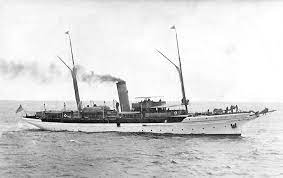
Now, this man was important to Wall Street, a man whose influence had power over the rises and falls of the stock market. To announce that he had cancer could affect the markets at a time when the United States was entering an economic downturn. Newspaper reports of the man’s cancer could send stocks tumbling. And if he were admitted to a hospital, someone might recognize him and spill the beans. So, this upcoming cancer surgery would have to be done in secret. And, so, a wealthy friend of the gentleman offered him and his doctor the use of a yacht, the Oneida, as a place for the surgery. The boat would be offshore of the man’s summer home at Cape Cod, Massachusetts. The story was put out that the gentleman wanted to relax and do some fishing for a few days.
A team of six surgeons performed the delicate operation despite the moving boat and the rocking waves. It took them only 90 minutes to remove most of the roof of the man’s mouth, much of his upper left jaw, and several teeth. And they pulled all of that through his mouth rather than create an incision on his face. The thought was that no one would know about the surgery to look at him–other than a tooth extraction. The skilled surgical team even managed to salvage his distinguished mustache.
The operation was a success. The surgeons removed all the cancer. The gentleman would live another 15 years, but for the rest of his life, he wore an artificial rubber plate inserted where the roof of his mouth used to be.
But, if you looked at President Grover Cleveland, you’d never know it.

 The Rest of the Story