On an Established Firm

The Kongo Gumi Construction Company in Japan is an old established firm, well known throughout the country, although you’ve probably never heard of it. The firm has made its reputation as the foremost company in the construction and repair of the country’s many Buddhist temples and shrines. And one of the major characteristics of the company is that, in an age when many construction companies use modern building techniques and products, Kongo Gumi sticks to the traditional Japanese methods of temple building.

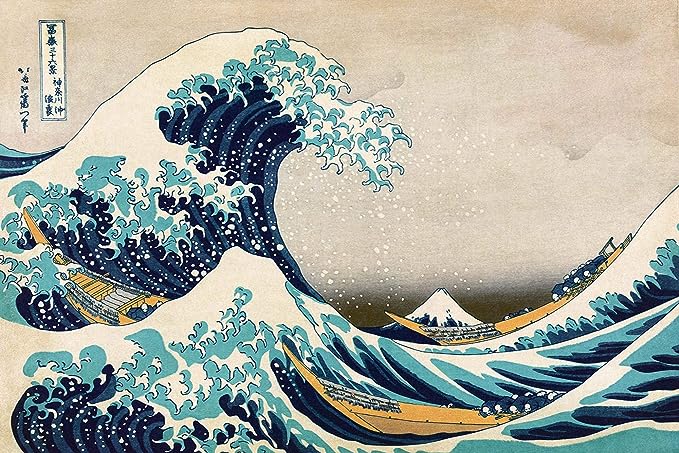
That’s important in a land where tradition is still widely practiced and respected, although it is under attack in many quarters of society. The “old paths” still carry a great deal of weight in Japan, despite the rapid incursion of a more modern sensibility and practice. There’s a famous and beautiful Japanese art print showing a tsunami wave about to rain destruction upon some Japanese boats. In the distance, Mt. Fujiyama is dwarfed by the wave. The print’s subject isn’t actually the wave or the boats but rather the symbol of the modern world crashing down on the traditional Japanese lifestyles and ways.

Thus, a cultural war of sorts has been ongoing in Japan for some decades now between the new ways and the old. And Kongo Gumi was one of the old firms that still clung to the old ways, stubbornly and tenaciously so. Sadly, their share of the construction market is shrinking as clients look for ways to save money in building, even in the building of temples. Concrete and modern methods have increasingly replaced the way Kongo Gumi has practiced their craft for a long time.

There’s an irony here as well. It seems that this old established firm was actually the one who pioneered the use of concrete in the building of temples. However, Kongo Gumi never used the material on such a scale that you’d notice it from the temple exteriors. But other and much newer construction companies have used concrete almost to the exclusion of all other construction materials. And, as the population becomes more and more “modern,” people care less and less about how a temple is constructed. As a result, the market share that Kongo Gumi held dwindled and dwindled over the years. Finally, in 2006, the company went bankrupt. It was purchased by a large conglomerate, and the traditional processes used by the firm were kept by the large company for specialist projects like temple repair or small temple construction for clients seeking that old style of building.

And that’s a sad thing in one sense. True, time marches on. Life is change. But there is something to be said, I think, about embracing the change while still remembering and appreciating the way things were done in the past. The future may depend on finding a balance between the two.

Still, it’s a shame that a company like Kong Gumi is not what it was. Especially considering that it is an old established Japanese firm, especially since it was the world’s oldest firm, established in 578 A.D.
On a Complex Occupation

Imagine stumbling upon a large complex of buildings, so vast and so beautiful, that words to describe it would fail you. Imagine architecture so complex and intricate that it surpassed anything you’d ever seen in your lifetime. Well, such a place exists in this world today. It’s visited by thousands each year, and all of the visitors come away from the encounter stunned and awed.

One of the first men from Europe to bear witness to such a place wrote of it saying, “The pen cannot describe what it is like; there is nothing like it in the world.” Another early European visitor said that something so vast and exquisite could only come from the hand of someone like Alexander the Great, or, he argued, perhaps the Romans could have conjured such grandeur but no one else.

Wrong on both counts.

Some Europeans saw it as something like an ethereal palace compound that was built for some special, holy king. Others insisted that the place was a palace constructed especially for one of the gods himself. In the early 1860s, a French explorer and naturalist said it was grander than anything designed by Europe’s greatest architects, decorated by painters and artists greater than Michelangelo, and that the entire place made all of the buildings in the rest of the world appear to be “barbaric.”

It was, and is, none of these things.

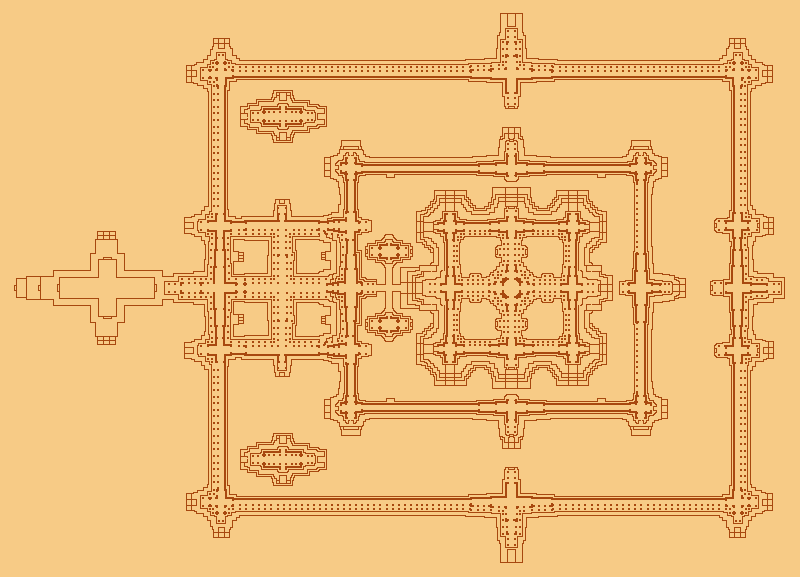
What we know for certain is that this complex was constructed using about 7,000,000 sandstone blocks. the largest of which weighs almost two tons. More stone was used in this place for construction than in all of the pyramids combined, while the area of the complex is larger than the area of modern-day Paris, France. What’s more, almost every square inch of this monstrous place features intricate carvings. It rises in parts to over 200 feet above its base, and, incredibly, records indicate that this amazing complex took place over 28 years to complete. We also know that it was constructed using rudimentary tools in the early 1100s A.D.

Yet, no one lived there. There’s not a trace of houses or household artifacts or anything used in daily living. And that is by design. The Europeans were largely clueless as to the complex complex’s purpose, the meanings of its decorations, and the intent of its planners. They didn’t realize that it was built first as a Hindu and then eventually turned into a Buddhist temple complex.

But Angkor Wat so captivated the French imagination that, under the pretext of saving the temple complex and its artistic treasures, the French government launched a military campaign that led to the occupation of Cambodia and Vietnam and the eventual establishment of French Indo-China.

On an Intuitive Child

The man sat in the dingy, smoky, kitchen room of the simple and uncluttered house. He called the small boy to him. The boy bowed quickly, straightened, looked at the man in the eyes, and said, “Sir, may I have those?” and pointed to a strand of prayer beads the man held in his hand. The man was surprised. “Well,” he began, if you know who I am, then you may have these, yes.” The child answered, “Yes, I know,” and told the man who he was. This received a smile from the man. “Then you know whose prayer beads these were,” the man said. Again, the child told the man the correct answer, and the man gave the child the beads. He received in return a polite thanks from the boy.

Then the man took a package from beneath the table and unwrapped it. Inside were several objects, some personal, some of the small household variety, a few tchotchkes. The man spread the items across the table, taking the time to space each item apart at an equal distance.

“Now,” the man said, motioning for the boy to step closer and examine the items, “which of these things also belonged to him?” The boy bit his lower lip and narrowed his eyes as he looked across the table at the arranged things. The man ran his hands over the table. The man then explained what he wanted the boy to do. He would stop, touch an object, and the boy would tell him “yes” or “no.”

As the exercise began the mother of the child watched from the doorway to the kitchen. She was shocked. She heard her small son speaking in a dialect that she did not understand and one in which she had no idea how he could possibly know.

As the little test came to an end, the man allowed himself a small smile. The boy had chosen correctly in every case. “What is your name, child?” the man asked. “Lhamo,” the boy answered. The man looked up at the mother. “Age?” he asked her. The boy’s mom, still recovering from the shock of hearing her son use words she didn’t understand, crossed her arms across her chest. “He’s only 2 years,” she answered. The man nodded. He had all the information he needed.

“What are those things?” the mother asked. The boy looked from the man to his mother and back to the man. “They belonged to the Dalai Lama,” the man explained, “at least the ones your son identified did.”

“What does that mean?” the mother asked.

The man said, “It means that your son is the next one.”