
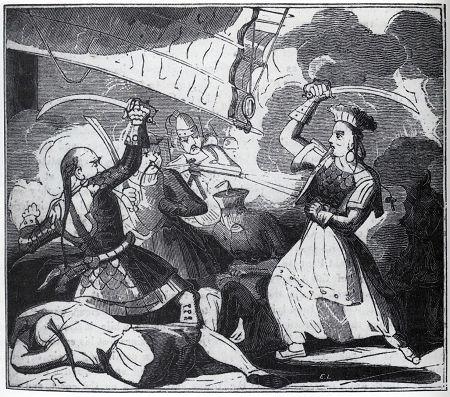
Action films often depict criminal masterminds who control vast armies of minions who carry out their dastardly deeds before succumbing to the pursuit and prosecution of heroes or the police. Believe it or not, that type of thing has historically been more common than you might realize. One such international criminal was known as Zheng Yi Sao, and this criminal operated in the early 1800s in the seas off the coast of China. Yes, Zheng was a pirate but not just any pirate. Zheng was in charge of the largest fleet of pirate ships and a pirate army that totaled over 50,000 men at its most powerful.
Zheng acquired a small group of ships through marriage. From that start, the pirate parlayed the fleet into what it became–the scourge of the China seas. Sailing as far south as the coast of Vietnam and as far north as Korea, no ship or port was safe from the power and prowess of Zheng the pirate. When finding a rival pirate ship or fleet, Zheng would give the pirates the choice of death or joining the growing number of the pirate navy and army. Well, you can imagine that almost all of those other pirates made the decision to join rather than die. So, through cunning and bravery, Zheng spend years pillaging and stealing great amounts of wealth from any ship or city that got in the way.
The pirate conglomerate became known as the Red Flag Fleet because that’s the color of the banner they sailed under. Zheng also created a Pirate Code, a set of laws that the members of the fleet had to abide by. These rules called for specific conduct in war and peace, and the code was closely followed by all who sailed under the fleet’s red banner. One interesting rule was that no women would be purposely harmed by anyone in the fleet. Harming a woman was punishable by death.
The Chinese government sent an armada to stop Zheng and the Red Flag Fleet, but, easily outsmarting the Chinese admiral in charge of the government’s navy, Zheng lured the government ships into a trap and destroyed them. Then, to confuse the government officials, Zheng split the fleet into three parts. Each part was sent on pirate raids in different directions, with Zheng taking direct command of one of the three prongs. The government was overwhelmed. They didn’t know which of the three groups was actually Zheng, and they were tricked into doing nothing. Was this another trick? Which prong–if any–was the one led by Zheng? The government was helpless. And, at this point, they asked for help from the international community.
Portugal, by this time in history, controlled the Chinese port of Macao. And China, desperate to stop Zheng’s piracy, asked Portugal’s fleet for help. A combined Sino-Portuguese fleet managed to trap several of Zheng’s ships in a harbor for a time, but the pirates managed to fight their way out. The Portuguese were impressed by the pirates’ bravery and ability. And they felt challenged by the pirates’ victory over their ships. So, they, in turn, asked the British Navy for help in corralling the Red Flag Fleet. Britain was delighted to help, and that proved to be the beginning of the end of Zheng’s power. You see, the British had the best-equipped ships in the world at that time. The powerful but small Carronade, a Scottish cannon, was the standard armament on the British ships, and it could wreak havoc on the thinly wooden-clad Chinese ships. Zheng knew that the gig was up.
Using an envoy, Zheng sent a message to the Chinese government. The pirate fleet would be disbanded, all ships and crews would be put under the command of the authorities if–if–Zheng could keep all the pirate loot gained up to that point and would be given a complete amnesty. And that’s basically what happened. The Red Flag Fleet, largely undefeated in battle, was disbanded with a simple agreement. Zheng took the money from the years of piracy and moved to Guangdong, China. There, the former pirate made even more money running a large gambling house and brothel. Zheng died wealthy and happy at the age of 69.
And, in the years before that death, people from all over the world would come to Zheng’s casino and whore house for a chance to meet the world’s most famous female criminal mastermind.
 The Rest of the Story