On a Deadly Flood

England has been flooded lately. This late fall and the last week of the year 2023 saw record rainfalls in a nation known for being, well, wet. Only this week, the beginning of the tunnel connecting Britain to Europe by train was flooded out, and I have had floods from these rains cause the cancellation of some train travel due to inundated railroad tracks. Sometimes, the flooding causes deaths, but Britain has been exceptionally lucky in this area.

Boston, in 1919, saw a localized flood that killed over 20 people and severely injured dozens.

In this case, however, the cause of the 1919 Boston flood wasn’t rain. Instead, the flood was caused by a reservoir bursting. The Purity Company made products that required large storage tanks for manufacturing. In this particular case, Purity’s holding tanks were over 50 feet tall (15m) and had a circumference of 90 feet. I’ll save you the trouble of doing the math to tell you that the capacity of the tank was 2,3 million gallons or 8,700 cubic meters. The facility was located in the north end of Boston, quite near and convenient to the docks. However, when the tank ruptured and the flood happened, the crowded buildings in the neighborhood funneled the flood through the narrow local streets at a speed of over 35mph (55km/hr). That’s why so much destruction was caused and so many people were either killed or wounded.

Today, science can explain what happened that January day over 100 years ago. As temperatures rose to above freezing and more liquid was added to the tank, the warmer liquid that was added to the tank that day caused the existing liquid in the tank to expand, and that caused the almost explosive rupture of the tank. People who later gave their eyewitness testimony to both the police inquiry and to the local papers described a low, almost growling rumble that first produced what sounded like machine gunfire as the rivets of the metal tank started shooting off the sides. Then, those who were there spoke of a thunderous, explosive burst as the tank tore itself apart from the pressure of the rising temperatures.

As a result, a wave over 20 feet tall swooped through the canyons between the buildings. Everything in the path of this mini-tsunami was wiped out–people, wagons, storefronts, horses–everything. Even some smaller buildings were swept off their moorings. A streetcar was toppled in the wave. And, after the initial wave hit, the rescue efforts were thwarted by the 3+ feet of standing liquid that kept first responders from the scene. Several people who survived the initial flooding died because they became trapped by the liquid and drowned in it. Some of the first help to arrive came from a local naval training ground. The cadets there rushed in as quickly as they could and assisted those trapped by the flood. These cadets were the heroes of the day for many.

The oldest victim that day was 78, a messenger who came out of retirement to work part-time. The youngest was a 10 year old schoolgirl. The Purity Company was found responsible for the flood, and they had to pay out millions in compensation. The flood destroyed much of the factory, of course, and today, nice ballfields occupy the site where the storage tank once stood. In between two of the play areas, a nice plaque remembers the day of the flood and memorializes those killed and wounded by it.

Oh, by the way, local legend says that the smell from the flood stayed in Boston well into the summer. Even the harbor’s color was changed by the flood. You see, apparently, it’s simply quite difficult to remove both the color and the smell of that much molasses.

On a Same Sex Relationship

Historically in the United States, same sex relationships have been against the law from a legal standpoint, sin from a religious standpoint, and an unspeakable offense and/or a mental derangement in the social realm. Yet, all of that never stopped same sex couples from existing and even flourishing throughout American History.

Now, of course, these were not relationships that were generally out in the open; there was no flaunting of sexual orientation because of the backlash such behavior would cause in the law, church, and society at large. And people created euphemisms for men who lived with men and women who lived with women. If two women were life-partners, many times that was referred to as a Boston Marriage. Wellesley College near Boston was where women of the upper middle and upper class would go to receive an education. Being women of some means, these Wellesley students weren’t as dependent on men for their livelihoods and preferred the company of other women. So, they would cohabitate, and that’s where the sobriquet sprang from. Now, to be fair, some of those Boston Marriages were not sexual in nature, but the living arrangement certainly went against the norm for that time period. For men, the euphemisms were a bit more subtle. Up until the past few decades, if a gay man died, his obituary would often list a “friend” or say that he was “a life-long bachelor” or “he never married,” and those in the know would be able to read between the lines.

Let’s take the case of a devoted couple who lived not too far outside of Baltimore, Maryland, about 175 years ago. Let’s call them Aunt Fancy and Miss Nancy, because that’s what people who knew them called them. The pair lived together for some years, and they would be seen at social functions together, even at gatherings where it was understood that the spouse or significant other was supposed to make an appearance. They also managed to work in an occupation that would normally not be acceptable for people with same sex attraction–the government. And that work often separated the two. The letters we have found (most were destroyed by their embarrassed family members after the couple died) that the pair exchanged were long and expressed, passionately, how the other one was terribly, terribly missed.

It’s rather interesting that Nancy and Fancy would’ve gotten together in the first place. Nancy was from Pennsylvania originally, while Fancy hailed from the Cotton Belt of Alabama. It was amazing that they ever got together at all. Nancy had even been engaged once, but the wedding was called off when the fiancĂ© died suddenly–much to Nancy’s relief, a later letter would admit. And, like the examples of other couples as in the Boston Marriages, they both came from money. But their personalities were different; Fancy was, well, fancy; a quiet and refined gentility oozed from every pore and hair. Nancy was loud and boisterous and enjoyed a bit of a drink every now and then where frivolity would ensue. Yet, the relationship worked for many years. Writing to a relative while waiting for Fancy’s return, Nancy confessed, “I am now solitary & alone, having no companion in the house with me. I have gone a wooing to several gentlemen, but have not succeeded with any one of them.”

Sadly, Fancy died in 1853 of tuberculosis. Nancy would follow 15 years later. Oh, and their names? Those were the names that they were called in derision, first given to them by none other than Andrew Jackson. While we don’t know for sure if the nature of the relationship between the two was sexual, we do know that some of their contemporaries and political foes and even friends certainly thought so. You see, you know Aunt Fancy as William Rufus King, who was the Vice-President under Franklin Pierce, and you know Miss Nancy as President James Buchanan himself.

On a Hat Maker

Thomas Corbett was born in England in the 1830s and, with his family, emigrated to the United States when he was 8 years old. The family moved to Troy, New York, and young Thomas apprenticed to a hat maker in the village. It would be a job he’d hold off and on throughout his life. When he became of age, Thomas found a woman he fancied, and the pair got married. But his wife and her baby died in childbirth, and that sent Thomas over the edge.

Thomas cursed God and decided to spend the next few years as a homeless drunk for the most part. One night, he found himself in Boston, Massachusetts, and got rip-roaring drunk as usual. It was during his intoxication that he crossed paths with a minister who was standing outside of a local bar and preaching to all those who came out of the establishment, drunk to the gills. Something the minister said resonated with the young grieving widower, and he gave up drinking on the spot. As fervent as he was as a drunk, Thomas became equally as resolute as a Christian. In fact, he even changed his name to represent the “new birth” he felt he’d received upon his baptism; he became Boston Corbett.

Now, we should note at this point that this young man was somewhat unstable mentally. He had exhibited odd behavior even before he experienced his remarkable conversion, but he became increasingly odd afterward. He would stop people on the street and pray for them–people who were complete strangers. He would verbally berate anyone whom he heard using what he considered to be swear words. And he had a habit of stopping traffic in the street and preaching to all within earshot. All of these behaviors caused those around him to question his sanity.

When the Civil War broke out, Corbett enlisted in the Union Army. There, he soon got into trouble for refusing to follow orders he felt were against God’s law (such as marching or fighting on the Sabbath). He faced disciplinary action on many occasions, including one court martial. After one battle in Virginia, Corbett was captured by the Confederates. He was sent to the infamous Andersonville Prison Camp in Georgia, staying there until released in a prisoner swap. When he eventually rejoined his unit, he found himself near Washington D.C. as the war ended.

Like all of the other soldiers in the army, Corbett was incensed that the man he saw as God’s avenging instrument, Abraham Lincoln, was gunned down by the Confederate sympathizer, John Wilkes Booth, a few days after the war ended. Corbett and his company were part of the group who pursued the fugitive Booth. When Booth was found hiding in a barn a few days later, it was Boston Corbett who shot Booth as he hid–shooting the man who was supposed to have been captured alive. You see, Corbett didn’t listen to the orders of men, no; he had a Higher calling.

And the event made him a hero.

After his service, Boston Corbett returned to hat making. He suffered increasing bouts of strange behavior for the remainder of his life. It is supposed that he died in fire in Minnesota a few years later after being a lay preacher for many years in addition to making hats.

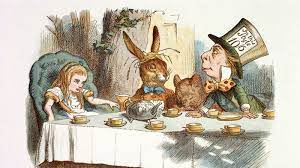
What we know now is that Thomas “Boston” Corbett was crazy, but there was a reason for his being that way. You see, at that time, the fur used in making hats such as the tall, beaver pelt hats of the day, was treated with a compound that included mercury. Years of inhaling that poison affected Corbett’s brain and caused his madness.

And it’s why we say that someone is “as mad as a hatter,” because, for Boston Corbett, the avenger of Abraham Lincoln, that was his job.