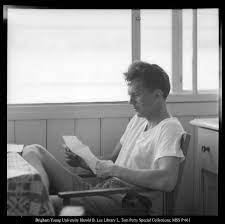
On a Young Hobo

Hobo is one of those words of which we have no clear etymology. However, the word is in our vernacular and has been since the 19th Century. During the Great Depression in the United States, the roads and railways were clogged with young men (and a few women) who were traveling around looking for work, food, direction. With almost 25% unemployment, it’s no wonder why. My uncle Bubba (his name was Melville Carr Baker; that’s why everyone called him Bubba) told his tales of riding the rails in the 1930s from town to town.

Another young man who did this was one Arnold Samuelson. From Scandinavian stock in the American Middle West, Arnold had finished his college work and was, like most men aged 22, uncertain about his future. That’s when he decided to stick his thumb out on the highway and travel the United States, to see what there was of the amazingly large nation. Eventually, Arnold found himself sitting on top of a boxcar as it made its way down the bridges from Miami into Key West, Florida, the southernmost point in the nation on the East Coast. When he arrived in Key West, it was almost summer, the time when people at that time left Florida to escape the heat and mosquitos.

That first night in Key West, Arnold slept on the dock; the sea breeze kept the bugs at bay. But the next night, a couple of local policemen said he couldn’t sleep in public and offered to put him in their holding cell for the night. One rule of being a hobo, at least according to Uncle Bubba, was that you never said “no” to the police. So, Arnold went with them. That started several days of walking around the town during the light and sleeping in the mosquito-filled jail cell at night.

On one of his walks about the town, Arnold found himself in front of a large, older, typical Key West house. He knocked on the door, and a burly, shirtless, mustachioed man came out and confronted him. Arnold stammered hello, and the man asked him, brusquely, “Waddaya want?” Arnold sketched out his tale to the man, and he could see that, the more he explained his situation, the more relaxed the man became. “So, you just want to chew the fat?” the man said with a smile. Arnold nodded. The man said that he was busy, to come back the next morning and they would sit on the porch of the man’s house and have a proper talk. Arnold agreed. That began several days of Arnold waking up in the jail, scratching his new bug bites, then coming to the man’s house and having deep, meaningful conversations about life, love, art, and Arnold’s favorite topic, writing. The man was quite knowledgeable about many topics and filled with good advice and helpful life-tips for the young hobo.

“If I wished to learn about writing and about life,” Arnold asked him one day, “what books should I read?” The man got up and got a piece of paper and a pencil. He made a list of books for Arnold to get and peruse. “Those’ll teach you about what you need to know,” he told Arnold. One day, the man gave Arnold the news that he had to take his boat up the coast. He asked Arnold to do him a favor. “Say,” he said, “would you want to come along? You can live on the boat and watch out for it when I’m not on it.” Arnold eagerly agreed. He couldn’t believe his good fortune. He ran back to the police station and grabbed his tattered bag, thanked the cops, and ran back to the man’s house. That was the beginning of a whole year of sailing on the Caribbean with the man and his fishing buddies and other assorted guests. The man paid him a dollar a day, and Arnold was deliriously happy.

Arnold never did become a famous writer, but he did publish an interesting book about his experience there.

It’s called, With Hemingway: A Year in Key West and Cuba.

On a Heroine

Louise Julien died at a much-too-early 38 years old of tuberculosis on the British island of Jersey. She went there in 1853 for her health after leaving France by way of Belgium, but by the time she reached Jersey, the illness was too far gone in her weakened body. Louise had been born in Paris, the illegitimate child of a seamstress and a minor Portuguese nobleman. Louise came into the world at a time of great upheaval in the history of France. Napoleon had only recently been removed and exiled, his attempts at European domination finally thwarted. France had to get used to a new government, and the changes brought about by the French Revolution and Bonaparte’s reign were still being processed by the culture and society.

From a young age, Louise was different than other girls. Strong-willed and almost foolishly brave, she eventually married a tailor but chose to go by the last name Julien rather than her husband’s name. She made money singing in workingmen’s clubs, becoming rather popular in those circles. And that experience helped her develop a sense that workers were, by and large, still at a disadvantage in French society despite the changes the revolution had brought. In addition, she made a reputation as a poet.

In 1848, France experienced another revolution, as workers rose up and demanded more rights and accommodation in the public weal. It began in Paris, and Louise was at the forefront of the movement. The Second French Republic was proclaimed as a result, and some major changes were made in society. But then, Napoleon III, the nephew of the former emperor, staged a coup and declared himself the new French Emperor. Again, Louise took to the streets in protest, urging her comrades to march against the illegal takeover by public demonstrations. The will of the people must be heard, Louise said, and the only way those in power would hear the people’s voice would be through mass demonstrations. In a skirmish with government troops, Louise was injured and then arrested by the new government for being a dangerous revolutionary. It was in prison that she contracted the tuberculosis that eventually took her life on Jersey.

At her funeral in Jersey, the famous author, Victor Hugo, and the poet of the Second Revolution, Joseph Déjacque, gave eulogies over her coffin. Hugo’s speech in particular was so moving that Parisian newspapers reprinted it, and the story of Louise’s heroic efforts on behalf of the revolution and French workers was retold for generations afterward. But that’s not why most people remember her today.

No, we remember her for Hugo’s memorialization of her, at least indirectly. You see, when it came time some years later for Victor Hugo to put pen to paper and write the great novel of the French Revolution of 1848, he used Louise as the inspiration for one of literature’s most enduring characters. He was looking for a character who, like Louise Julien, lifted herself from humble beginnings and attempted to make her world a better place. Thus, you know Louise Julien best as the character Cosette, the girl adopted by Jean Valjean, in Hugo’s landmark story, Les Misérables.

On Three Jealous Lovers

Oh! beware, my lord, of jealousy; it is the green-eyed monster which doth mock the meat it feeds on.-Othello, Act 3, Scene 3, by William Shakespeare

Shakespeare knew that jealous was powerful and hungry and often incredibly dangerous. We feel jealousy’s threat with the Bard’s warning to “beware.” And history is filled with stories of jilted lovers and of people who have almost literally lost their minds over love. More recent news stories tell us that nothing has changed much over the millennia. Here are three of the more odd and drastic examples of the green-eyed monster rearing its ugly head.

Take the story in 2013 of a man in Saudi Arabia who loved and married the woman of his dreams. Social media’s prevalence has given the public many more opportunities to find out about people cheating on their significant others. This man discovered what he thought was evidence of proof of his wife’s infidelity online. That’s when this Saudi man, as we say, “lost it.” He confronted his wife over the post online that showed her kissing the cheek of a rather handsome fellow. How dare she, he said, when had been completely faithful to him. Of course, the wife protested. In fact, she literally laughed off her husband’s accusations at first. How could he be so ridiculous, she asked. She didn’t deny the post and didn’t deny the kiss. However, she said it was obvious that the kiss meant nothing to her other than a sign of friendly affection. He was not to be daunted. He filed for divorce, citing the online photo as evidence. Even though the photo didn’t prove anything, the court granted the man a divorce. And, while the divorce was final, even the court also had to laugh at the man’s irrational jealousy. The ex-wife wasn’t sorry about the divorce, either. She felt that the man’s irrationality should have been something she saw earlier in the relationship. You see, the photo definitely showed the kiss. But the object of the wife’s kiss was a beautiful Arabian horse.

In 2012, Lowell Turpin of Tennessee flew into a rage over a photo on his wife’s computer. Lowell didn’t have the best judgement in the first place, and he had a history of violence and jealousy towards his wife. If any man spoke to his wife, even a cashier or checkout person, Lowell would threaten the man with revenge. The photo Lowell found on his wife’s laptop was of an attractive man, a bit older than she was, with a chiseled jawline and a full head of hair with a touch of gray at the temples. And he had a winning smile to boot. Right on cue, Lowell flew into a rage and snatched the laptop from his wife’s hands. “You slut!” he kept screaming, over and over. He threw the computer against the wall, shattering the machine into dozens of pieces. “Tell me who he is!” His brow-beaten wife, right before she called the police and had Lowell arrested, obliged him. “That man,” she explained calmly, “is Mitt Romney.”

The last tale is one you probably remember from the news at the time. Lisa Nowak lost her mind in 2005, at least temporarily. She left her husband for another man, a co-worker, a few years before. To Lisa, the new guy became her obsession. An old adage says that if he’ll do it with you, he’ll do it to you, and, in this case, it was true. The man she left her husband for left her for another woman. And that’s when Lisa lost it. She drove almost 1000 miles to confront the woman she’d lost her lover to. Tracking and stalking the woman to the airport in Orlando, Florida, Lisa first accosted and harassed the woman before pepper spraying her through her open car window. When she was arrested, Lisa’s car revealed that she had been shadowing the woman and the former boyfriend for some time. In her defense, Lisa claimed a temporary breakdown, but the obsessive behavior was shown to have gone on longer than “temporarily.” Thus, Lisa Nowak became the first active-duty astronaut to be charged with a felony and dismissed from NASA and received a less-than-honorable discharge from the US Navy.

We often associate colors with moods and emotions. Cowardice is yellow. Sadness is blue. Anger is red. But the green of envy, the monster of jealousy, can be the most irrational at times as these three stories prove.

On a Future Library

Scandinavians are deliberate.

They tend to see themselves as part and parcel of what was, is, and will be, in a view that examines life on a continuum. Taking the best from the past and with an eye towards the future, they seem to always be making plans that have an impact on the present world and also on the generations to come. So, it’s not surprising that its the Norwegians who are planning on a library for the future. Here’s the idea.

Beginning in 2014, a public trust organization, in collaboration with the city of Oslo, Norway’s capital city, started collecting the a book of the year as chosen by a select committee. The project is almost as much art project as it is library. But the organization wishes to preserve modern literature for the future. They will collect a book a year for the next 100 years.

The Future Library Project, or Framtidsbiblioteket in Norwegian, has several disparate parts happening at the same time to bring this library to fruition. It will actually be a large room built inside a new library that was recently constructed in Oslo. A large swath of Norwegian forest was harvested for the wood used to build this special room that will house the future library. That choice of medium for the room is intentional, of course, because, after all, books are made out of paper that comes from wood.

Oh, and the books chosen? They are unpublished as of now. The authors submitted manuscripts to the organization, but the public hasn’t seen them yet. Some of the writers whose works will be a part of the future library include Han Kang, Margaret Atwood, and Karl Ove Knausgård. We know the names of the books, of course, but not the content. At least, not yet. And, since 2014, we have only 9 books of the eventual 100. When each chosen author presents the book to the organization, they meet in the place where the Norwegian forest where the trees were harvested to build the library room to partake in the handing over ceremony. This ceremony will be done only 91 other times.

Are you starting to see how all this is interconnected, how the collective community is being incorporated to produce this library for tomorrow? Everything has been thought out, everything has been planned–for the now and for the future. And, speaking of the future, let’s jump 91 years from now, to 2114, when the library is finally ready. Let’s listen in on a description of the library given by a docent to a group of visitors in the year 2114.

“There are now 100 books available to be read in this library, 100 books stretching back to the 21st Century. They have never been read by the public. In fact, they have only recently been printed. However, you can purchase copies of these books if you wish. In fact, people were buying these books back in 2014 before they were available. Again, with an eye towards the future, people back then bought the books for their grand children and great grandchildren to read in this, the future. And the pages of the books are made of special paper. The room you’re in was made 100 years ago of trees felled for this reason. In their place in the forest, new trees were planted that are now 100 years old. Those trees, those trees planted back in 2014, they are the ones now being harvested to use as paper for the 100 books you see before you.”

I told you Scandinavians are deliberate.