On a Polite Man

March 4, 1889, was a cold and rainy day in Washington, D.C. The newly elected Benjamin Harrison was due to be sworn in that day as the 23rd President of the United States. Harrison, a Republican, had been elected in an incredibly close and sometimes bitter election, defeating the Democratic incumbent, Grover Cleveland. In fact, Harrison had lost the popular vote the previous November, and he won the electoral college vote because he had narrowly won the state of New York despite Cleveland’s workings with the Tammany Hall political machine there.

No matter. Harrison was the man of the moment, and he felt the hand of destiny upon him. He was the grandson of a previous resident of the White House, one William Henry Harrison, known as “Old Tippecanoe” for his victories in wars against first nations more than half a century before. And he had been a senator from his adopted state of Indiana and served that state well in the US Senate. Also, Harrison had seen a great deal of action in the American Civil War, working with General William T. Sherman to split the Confederacy in half in the war’s last full year. So, all of that background led him to the inaugural day, and the rainstorm that beset the capital that day.

Interestingly, Harrison’s grandfather has the distinction of serving as president for only one month. It was during his ancestor’s inauguration during a winter storm that Old Tippecanoe had spoken for over an hour, and, as a result, he caught pneumonia that eventually led to his death and the rise of his Vice-President John Tyler to the office. Benjamin Harrison was well aware of his grandfather’s legacy, and his planned remarks were purposefully short. He wanted to touch on several key issues, however, in his speech. After such a contentious election, he felt that the occasion called for extending an olive branch to the Democrats and to the southern states that still stung from the defeat in the war that was still fresh in many minds down there.

In many ways, the election was a choice between personalities, as many elections are. Cleveland had raised some eyebrows during his term by marrying a young girl barely out of college for whom he had been appointed a guardian after her father had died. Harrison, on the other hand, was seen as a steady, solid, traditional candidate in sharp contrast to that type of “unseemly” behavior. Much muck had been thrown during the campaign over Cleveland’s unusual marital choice, and that had also caused some harsh feelings between the two campaigns.

But Harrison wanted to rise above all that electioneering. After the oath of office, and as he stood to read his prepared speech in the pouring rain, it quickly became obvious that there was no way Harrison could read what was quickly becoming a smeary sheaf of papers in his hand. It was then that a man emerged from the crowd on the platform behind Harrison, a man who quickly stepped up and held his umbrella over the head of the new president and kept it there while he finished his inauguration address.

When Harrison finished, he looked up to see who the kind man was who had allowed himself to get soaked so that the new Chief Executive could read his remarks on that historic occasion.

Harrison smiled and nodded when he realized that the polite man who had held the umbrella was none other than Grover Cleveland.
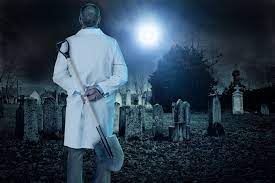
On a Stolen Corpse

This story comes to us from our friend, Brian Kannard. Brian wrote a pretty interesting book a few years ago: Skullduggery: 45 True Tales of Disturbing the Dead. In this book, as the title suggests, you can find stories about corpses that were dug up, disturbed, held for ransom, and otherwise disrespected. The tales concern the famous and the not so famous.

One of Brian’s tales that has stuck with me concerns the grave robbery that took place in Ohio back in the late 1870s. Now, you have to remember that, back then, medical schools did not have a system for receiving cadavers for their students to use to learn about human anatomy. They turned, macabrely, to corpse snatchers. These nefarious characters made their living by digging up freshly buried bodies and selling them to the medical schools.

At the funeral of a man named John, the family realized that one of John’s nephew’s graves had been disturbed. The nephew had been buried a few days prior to John’s burial, and the family was horrified to learn that the younger man’s body was missing. One of John’s sons, also named John, told his brothers, Ben and Carter, that they should place large stones on top of their departed’s grave to insure that no one could steal the deceased John’s body. Then, John and another cousin traveled to Cincinnati, Ohio, to go to the medical school to look for the body of their cousin there.

At the Ohio Medical College in Cincinnati, John spoke to the janitor who answered John’s questions in a non-committal way. Of course, the school paid for an accepted cadavers, but the man didn’t want to admit that he knew the bodies had been stolen when they purchased them. John noticed that the dumbwaiter door in one of the operating rooms was open and that the rope was taught. “What’s on the end of that rope? Pull it up!” John demanded. The janitor demurred. So, John took it upon himself to work the pulley and bring up the very heavy object on the other end.

The body on the end of the rope was covered with a canvas sheet. John and his cousin removed the rope and brought the body onto one of the examining tables in the operating room. He pulled the sheet back and expected to see the face of his recently dead cousin.

“Oh, my God!” John said. “It’s Father!”

Somehow, in the past 24 hours, grave robbers had exhumed the body of John’s father and brought it to Cincinnati. The janitor was arrested on suspicion of purchasing and/or handling a stolen body. However, it was impossible to prove that the man was the one who arranged for the purchase or even received possession of the body, so the charges were eventually dropped. Interestingly, one of the doctors at the medical school had served directly under another of John’s sons, Ben, in the American Civil War.

Well, the public was outraged. The dead man was well known in the country, and a broad-based campaign was waged to make grave robbing a major felony. Several states in the mid-west passed such legislation in he ensuing months and years, and a system of receiving the bodies of indigent persons and voluntary donation of cadavers for use in medical study was established. By the way, the cousin’s body was later found in the medical school of the University of Michigan. But it was the theft of the body of John Scott Harrison that caused those laws to be passed.

So, who was he?

Well, it’s not really John that you know. However, you know John’s father, William Henry Harrison, the 9th President of the United States, and you know John’s son, Ben–Benjamin Harrison, the 23rd President of the United States.