
Have you ever looked closely at a dollar bill? I mean, really closely? You’ll see bits of cotton fibers in the bill. Hold it up to the light. See the watermarks? And some bills today also have an electronic strip inside them. All of these elements were designed to help fight the scourge of a stable currency: The Counterfeiter.
As an example, in one of the more recent years that we have records for, counterfeiting in the United States alone cost businesses over $200,000,000,000. You can see that these measures, while difficult to replicate and fake, don’t really stop the bad guys from stealing from the US economy. But imagine what it would be like if these measures weren’t in place at all.
And that takes us back to the founding of the US and even before. When paper money was used in the British Colonies, it was incredibly easy for someone with simple means–like a printing press–to print out their own money, almost like having a copy machine today and simply making copies of hundred dollar bills. Each colony could print their own currencies based on the British pound, but, because of the difference in the relative economies of the colonies, a Massachusetts pound would be worth a different amount than that of, say, a Virginia pound. And there were really none of the more modern countermeasures for counterfeiting. A signature on a bill would probably be the only thing most colonial paper pounds would have as a way to verify it as a genuine bill. Thus, such colonial pounds were easily faked.
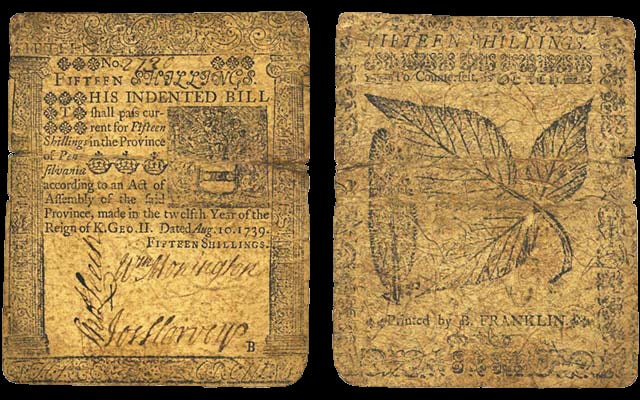
Enter an enterprising man from Pennsylvania who had the great idea to add some of the earliest anti-counterfeiting measures to pounds produced in that colony. He began with paper weight. Counterfeiters work cheaply, and if the quality of the paper used for the banknotes were heavier, so much the better. But he took it several steps farther. Watermarks were introduced that would be difficult to replicate. He introduced the idea of threads into the notes much like we have today. And he found a way to emboss the notes with the veins of leaves and flower stems–almost impossible to copy if that’s what you wish to do. And his expertise extended to the use of a special type of ink that was made by a special process by which animal bones were burned to create a unique graphite.
All of these processes made the Pennsylvania pound notes the envy of the colonies. It helped stabilize the economy of the colony at the outset of the American Revolution. The British tried to ruin the American economy by producing fake bank notes during the war, and they succeeded in doing major harm to many of the other colonies, but not so much in Pennsylvania. Because the other colonies’ currencies were easily faked, the fledgling United States distrusted paper money until the era of the Civil War, more than 80 years later, relying instead on coinage.
But if the nation had only followed the anti-counterfeiting measures created by this Pennsylvanian, they might have switched to paper money much sooner. In fact, these innovations are one reason why Ben Franklin is on the $100 bill today.

 The Rest of the Story