
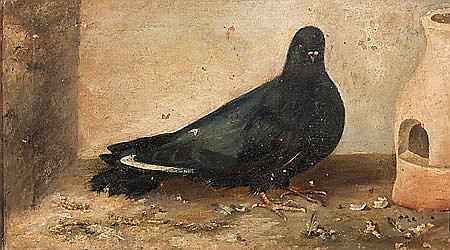
Jose Ruiz y Blasco is not an artist you would’ve heard about. Yet, you do know some things about him. We will get to that in a moment. For now, know that he was born in Spain, in Malaga, in 1838. His family was middle class, and that comfort allowed Jose to study art and become a teacher and artist himself. Everyone called him Pepe. He taught for many years in schools and also gave private lessons. He felt that within everyone, especially young people, artists were alive. The key, Pepe said, was to remain an artist your entire life. His own painting were usually of landscapes, and he loved doing pictures of doves and pigeons in the town streets and parks.
Pepe tried, he really did. He wanted to make a living from creating artworks, not simply teaching others about how to do that. Finally, he had a chance to exhibit some of his work in a public showing in Malaga. But the critics were not impressed. Oh, Pepe’s works were technically fine, but they lacked feeling, the critics said. The paintings had no passion, no fire of inspiration to them. Pepe was crushed. After working for a period in a Malaga art museum, he decided that a change of scenery was in order. First, he moved to another nearby town, where he also worked at a museum. But then, the opportunity arose to teach at a prestigious art school in Spain. So, he moved to Barcelona, but the work there only reinforced the idea that he could only make a living teaching other, more promising students how to paint.
And then there was Pepe’s personal life. He married when he was middle aged, and his wife, Maria, who was from a part Italian family, was fully 18 years younger than he. They had three children, a son and then two daughters. The youngest girl, Conchita, died of diphtheria when she was only 7. However, his marriage seemed to be a contented one. But, sometimes, his frustration with not being able to be a success as an artist spilled over into his family relations. He fought especially hard with his son.
Then, something happened to Pepe that made him stop painting all together. It seems that Pepe’s life completely changed when he saw the work of another artist, an artist he himself had helped to teach. The work of this young man stunned Pepe to his core. He couldn’t believe that someone so young could paint with the passion and fire that he himself lacked. Call it inspiration, call it genius, call it whatever you wish, but the fact remains that Pepe saw this young man’s work and was stunned. He raised his hand to God and swore he would never paint again.
You see, the young man who impressed Pepe so, the pupil who outshone his teacher, was none other than Pepe’s own son. That son decided to become an artist, too, but he chose to be known by his mother’s last name, that Italian name that her family bore.
Picasso.
 The Rest of the Story