On an Unusual Pacifist

Conrad Haas should not have been a pacifist. Given his position in the Austrian Army’s artillery corps, Haas spent most of his adult life figuring out how to best use gun and cannon fire to kill large numbers of troops. And, during the time that Haas lived, artillery killed more soldiers than any other type of weapon did.

Haas was born in Vienna and raised in a middle-class family. He studied artillery in college, and became an army officer in charge of munitions for the entire Austrian Army soon. When it came to artillery, Haas was somewhat of a savant. He not only could calculate distance and elevation of the weapons to fire accurately, but he also knew how to best conserve fire and make it effective when it counted most in battle. Such skill soon made him known throughout Europe, and he was invited to Romania to teach in an army artillery school there.

Now, you’d think that a person who knew about how to effectively cause death and destruction through artillery wouldn’t have many qualms about his job, but Haas did. In fact, he began to see that his job was that of a sort of artillery grim reaper, a person who sowed disaster and mayhem. And that made him become a pacifist while he was still in the employ of the military.

He began to tinker with the artillery and the calculations needed to shoot projectiles long distances. And this led him to try to see another possible application for artillery than that of death. What Haas came up with was revolutionary for his time. In addition, he began writing treatises about disbanding and disarming the military. “Mankind should pursue peace and not war,” he wrote. “The day will come when the powder will stay dry, the leaders will keep their money, and the young men will not die.” You can imagine that these types of writings made him some powerful enemies.

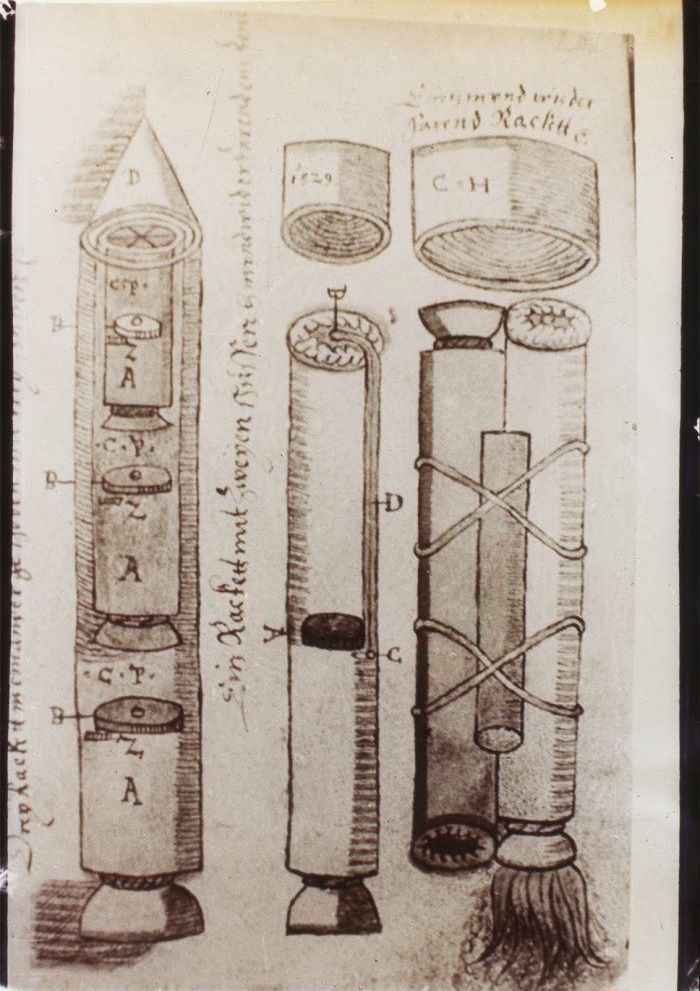
And those enemies would have done something about this artillery officer cum peacenik if what Haas proposed to do with artillery didn’t interest them so. You see, it was Conrad Haas who first came up with idea of launching not an artillery projectile, but, rather, a rocket into space. His concept was a three-stage rocket made up of a combination of solid and liquid fuels that would help the rocket break the earth’s gravity and cause the projectile to soar into the upper atmosphere.

He also came up with what is called a delta-shaped fin (the types we see on rockets today) and even a cone-shaped exhaust that would focus the power more directly and in a less diffused manner. And we can imagine that armies certainly liked the military capabilities that Haas’s ideas brought. So, his pacifism was ignored.

Of course, when Haas thought of all this, the practical application for such technology was years away.

After all, it was the 1550s.

On a Religious Patient

Dr. Bloch knew the woman would receive the bad news with fortitude. He knew her deeply religious belief would not even allow her to question what she felt was God’s will for her life. Sure enough, when Block told Klara about her bad prognosis, that the breast cancer was going to kill her sooner than later, Klara took the news with complete resignation and acceptance.

Six children and her husband had been Klara’s life. However, tragedy had already struck the family deeply. The husband had died some years earlier, and only two of the six children would live to see adulthood. Yet, through it all, Klara’s faith remained strong. She saw her suffering–the losing of the spouse, the loss of her other children to disease and then, finally, the cruel blow of the terminal cancer–as making her suffer like her beloved Jesus had suffered. During all her sickness, when she could, she never forsook attending the Catholic church in Linz, Austria, where she and the children had moved after her husband’s death.

They had moved to a small apartment where they could manage to survive on the small government pension the husband’s death had provided. Dr. Bloch assured the family that the cost for the cancer treatment would not be more than they could bear. This was a great relief to Klara and the family. Surgery was scheduled for a double mastectomy. Sadly, the surgeon found that the cancer had metastasized far beyond what his scalpel could reach. Klara’s oldest surviving son, only a teenager, begged the doctor to try something, anything, to save his beloved mother. So, Dr. Bloch suggested a new type of treatment as a last resort. This treatment, an early form of chemotherapy, called for direct contact of the chemicals with the infected tissue.

The pain caused by the therapy was almost unbearable. Yet, through it all, Klara’s unfailing faith kept her from grief. God’s will, she told her son, was the most important thing. This attitude of Klara’s would have an impact on him to the point that he eventually gave up on any faith at all. What kind of God would allow such a wonderful, loving mother to suffer as she did? Bloch noted the close, almost psychic bond the mother and son shared, and he watched as the son grieved so deeply as anyone he had ever witnessed when his mother finally succumbed to the cancer.

Dr. Eduard Bloch had a long career in Austria. Years later, and being Jewish, he watched with understandable concern as Adolf Hitler annexed Austria in 1938. He knew the Nazi pre-occupation with what Hitler called “the Jewish Problem” in the greater German Reich. And, so, he made plans to try to emigrate to the United States to escape the oncoming Holocaust. He sent a request to Berlin to be allowed to join his daughter who had gone to New York City some years earlier. Surprisingly, not only did Hitler allow Bloch to go, but he also ordered his private secretary, Martin Bormann, to take personal charge of the paperwork. Bloch went to New York and lived for the remainder of his life there. But he never forgot the deeply religious woman who faced her cancer fight so bravely. And he never forgot the son who grieved so deeply for his mother.

It was the same Adolf Hitler.