On a Mistaken Murder

There’s no doubt that Christer Pettersson lived a difficult life filled with the results of mental issues. Born to a middle class Swedish family in a suburb of Stockholm in 1947, Christer had a fairly average childhood. He wanted to be an actor, so he attended a high school that emphasized the performance arts. Unfortunately, and for reasons we still aren’t quite sure about, Christer suffered a head injury. To fast-forward to the end of his sad life, Christer died from a brain injury he suffered as a result of a seizure in 2004. The question is: Did a seizure cause the original brain trauma or did it result from it? We don’t know. What we do know is that this once-promising acting student completely changed personalities after the first head injury. He became sullen, withdrawn, and began taking hard drugs. His family had to separate themselves from him because of his sudden outbursts of anger and sometimes, violence.

Those outbursts became more frequent the older Christer became. In 1970, he stabbed to death another drug user, a man who, like Christer, had taken to living on the streets of the Swedish capital city. The part of the city where these men lived was an area where several film and stage theaters were located. The authorities knew that the area wasn’t safe and that most of the homeless population suffered (and still suffer) from emotional and mental challenges. As a result of his mental issues, Christer received a manslaughter charge and was forced to undergo psychiatric care as a result of the killing. Two years after his conviction, Christer was released. He returned to the theater district and to living on the street. He began a life of petty crimes and burglaries to finance his drug use. The violent episodes continued, and he was in and out of police custody.

Then in 1986, Christer later said he had a dispute with a drug dealer who had cheated him in a drug deal. He vowed revenge and told the man to watch his back. Now, we don’t know if this was the case or not. Christer often imagined that people had wronged him when they didn’t. However, given that the man was a drug dealer and that Christer was a drug user, the likelihood that something bad one way or another had indeed occurred between the two is high. And Christer made good on his promise to get the guy who had wronged him.

He saw the drug dealer and a woman walking on the street at the corner not too far from a movie theater late one night. The couple was holding hands as they walked, and, to hear Christer tell it, this angered him even more for some reason. Taking a gun he had gotten illegally and kept on him for protection on the streets, Christer quickly walked up behind the pair and shot twice. He hit the man in the upper back and only grazed the woman. Christer then jogged off ahead of the couple while bystanders ran to help the victims. Within 30 minutes of the shooting, the man was declared dead. The woman’s injuries were superficial and she made a quick recovery. From some general eyewitness accounts, Christer Pettersson was taken into custody as the prime suspect. However, by that time, there was no gun found on him.

Yet, despite the lack of physical evidence tying him to the murder of the man, Christer was picked out of a ten person lineup by the woman who was also shot. He was convicted of the murder of the man largely based on her testimony. However, upon appeal, the lack of a murder weapon and any physical evidence weighed heavily. Besides, the woman’s ID of Christer in the lineup had been somewhat tainted because the other nine men in the lineup were well-dressed and clean, while Christer was presented as he was picked up from the street–dirty, messy, unshaven, an still a little bit high from having gotten some drugs the night before. As a result, his conviction was reversed on appeal, and he was released.

And, as we saw, Christer died from head trauma suffered when he fell after having a seizure in 2004. Many people still think he was the one who killed that man on the street corner that late night in 1986. We still don’t know for sure, despite some talk that he had confessed to some others that he did the shooting. But it turns out that Christer also said that he was so high that he mistook the man for the drug dealer he had his disagreement with. That means, of course, that the man Christer shot wasn’t the drug dealer at all.

No, the man who was murdered on that street corner that night–maybe by Christer Pettersson–was Olof Palme, the Prime Minister of Sweden.
On the Butterfly Effect

I’ve been thinking about the Butterfly Effect lately–the idea that one small, seemingly insignificant event can trigger other things that lead to a major change in the world. As an amateur/armchair historian, playing the “what if?” game can be both fun and scary. What if Bobby Kennedy hadn’t been shot? No Nixon/Watergate then, no ending in Vietnam like we had it, possibly things like universal healthcare in the US, etc. And so forth.

Take the life of Gaetano Bresci, for instance. You’ve never heard of him, and neither had I, really, until I followed him down an internet rabbit hole search recently. Bresci was an Italian immigrant to the United States in the late 1800s. He settled in Hoboken and then Patterson, New Jersey, and took up with another immigrant, an Irish woman, with whom he had two children. Bresci worked as a silk maker in a mill there, and he became interested in making a better life for himself and his fellow workers. Thus, he began attending meetings of labor unions and workers’ organizations to see what could be done collectively to improve working conditions in the factories that dotted the New Jersey landscape.

But he quickly grew frustrated. The meetings were much talk and little action. “Much ado about nothing,” he remarked, and he began to think of ways that he could have an impact. You see, Bresci had a soft heart in one sense. He saw injustice in the way workers were treated by management–harsh conditions for little pay, no breaks during the day, huge profits for the factory owner on the backs of the workers, etc.–and knew that the system was inherently unfair. But what could he do to change it all? He was only one person, after all. You can understand his frustration.

Then, word came about an event back in his native Italy. It seems that some desperate factory and farm workers in Milan had rioted because they had no food. The Italian government stamped down, hard, on the rioters, and several dozen were killed and over 400 wounded when the military opened fire on their own citizens. This outraged Bresci. He purchased a pistol in New York, kissed his wife and children goodbye, and returned to Italy. He was going to act.

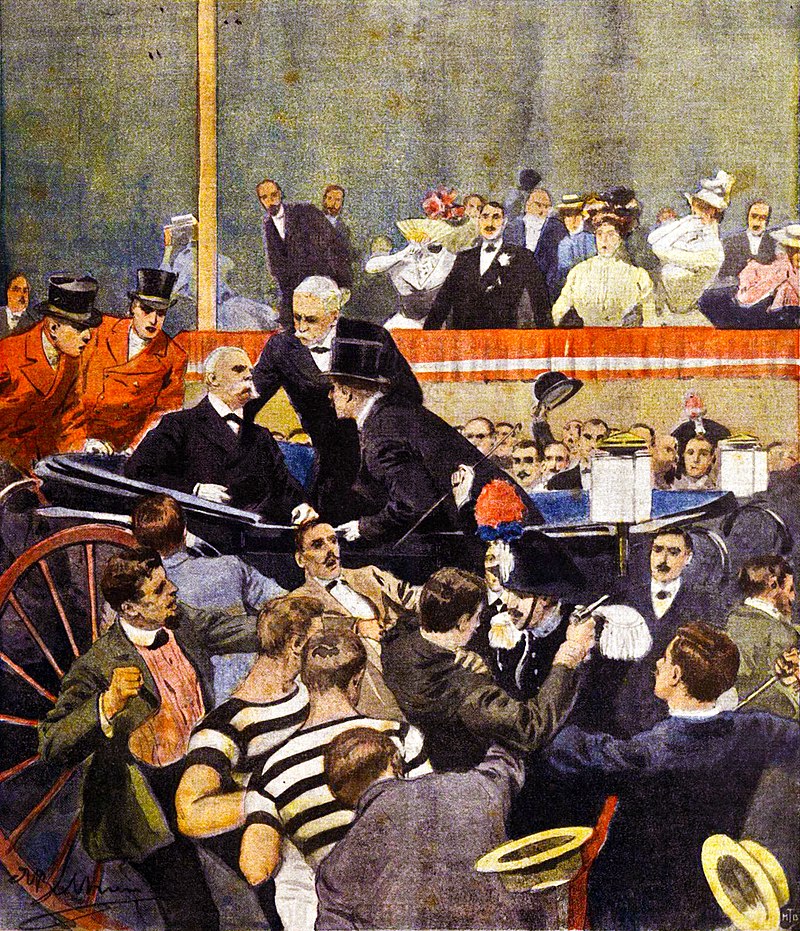
On July 29, 1900, Bresci stepped out of the crowd that surrounded King Umberto of Italy and shot him, dead. He then did not resist arrest, and he calmly stated that he had not killed a person but, rather, he had killed a principle. Well, of course, this “reason” for the assassination was seen as preposterous, and he was sentenced to life in prison. Shortly after being incarcerated, he was found dead in his cell–possibly killed by another, unknown assailant.

Back in the United States, the press hailed his death. Such should be the fate of anarchists and assassins, the newspapers said. But one young man, a Detroit-born fellow of Polish descent born Leon Czolgosz but who called himself Fred Nieman, saw Bresci as a hero. Here, he thought, was someone who was willing to do a wonderful thing to strike back at the people who held power and who exploited the little fellow, the nobodies of the world. Nieman, by the way, was the name chosen by Czolgosz because it means, literally, “nobody.”

So, inspired by the Italian assassin, Nieman took a pistol, wrapped it up in a bandage on his hand, went to the Buffalo World’s Fair in 1901, and shot and killed American President William McKinley. A nobody who killed a somebody.

But let’s Butterfly Effect this. Who became president upon McKinley’s death? Theodore Roosevelt. If McKinley had lived, then there might have been no Progressive Movement as we know it; no election of Taft in 1908; no splitting of the Republican vote in 1912 that led to the election of Woodrow Wilson. And if Wilson isn’t elected, then there’s no entry by the United States into World War I. And possibly no victory of the Allies in that war. And if Germany doesn’t lose, then no rise of Adolf Hitler in the early 1930s.

And no Hitler?

On an Assassination Attempt

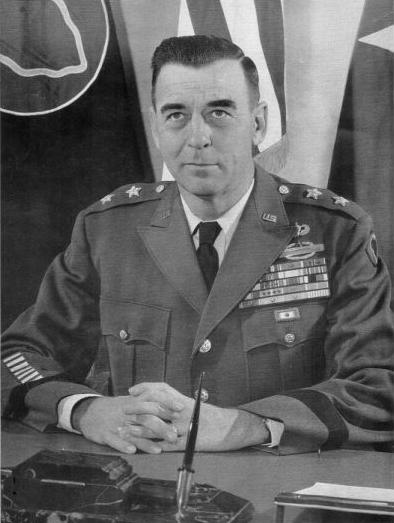
General Edwin Walker was a decorated soldier who was a career soldier up until the time he, well, wasn’t. Walker graduated from West Point. He commanded troops in World War 2. He fought in Korea. Then, after Korea, something either happened to Walker or he felt less need to stay quiet. What happened was that Walker became political and vocally so. Now, there’s nothing wrong with military people having an opinion. The issue arises when they let those opinions determine if and when they obey orders or they use their opinions to coerce people under them to make choices based on those opinions. And that’s what Walker started doing in the 1950s.

You see, General Walker fell into bed with extreme right-wing politics. He was an extreme anti-communist (ok, nothing wrong with anti-communism), but he bought into the idea that much of the US government and military were agents of the Soviet Union. This was the period of the Cold War, and America saw the USSR as its mortal (and moral) enemy. Walker joined forces with people like extreme racists, John Birch Society folks, and other radical right-wing groups.

In the mid-1950s, President Eisenhower gave Walker command of the troops detailed to insure that the segregation of Little Rock Arkansas schools went off without interference from violent racist groups. To say that Walker found the duty distasteful is an understatement. He carried out his orders, but he didn’t like it and said so. He threatened to resign (not retire), which would have meant he was giving up his military pension. But Ike offered to re-assign him, and Walker accepted. But the changing political and social landscape proved too much for him to keep his opinions quiet. When the University of Mississippi was integrated in the early 1960s, Walker decided it was time to resign.

The now former general decided to enter politics as a pro-segregation, anti-communist, pro-Bible/Christian, and anti-, well, anti pretty much everything candidate. And he decided to run for governor of Texas. He gave a speech in which he said that he had been “on the wrong side” during his work in Little Rock, but that now he was “standing for the right,” and he probably didn’t see the irony of his words. And he drew adoring crowds in a state in the south that was still largely living separate existences between the black and white population. Fortunately, his brand of extremism was defeated by the more centrist appeal of John Connelly in the election.

But his anti-communist views were some of the most troubling. He was firmly convinced that Franklin Roosevelt, Harry Truman, and even Dwight Eisenhower were all Russian/communist plants in our government, hell bent on the destruction of the nation he’d sworn to protect and defend. And this anti-communist stance drew the attention of a man who wished Walker dead. One evening, as Walker sat at his desk in his house in a Dallas suburb, a shot rang out. Walker grabbed at his forearm, as splinters from the shot entered his body there.

He leapt up and ran to the window. There, he saw where a bullet had shattered the window sill. It was the splinters of metal from the bullet that had fragmented when it hit the sill that had pierced the former general’s arm. He was lucky to be alive. A few inches to the right and a bit higher, and the shot would’ve pierced his anti-communist brain. And that’s interesting that the shooter was fairly close, on the same level even, as Walker, but still missed the headshot.

Eight months later, Lee Harvey Oswald, who’d failed to kill Edwin Walker, got his headshot with a much more difficult shot into the brain of John Kennedy.