On a Train Ride West

Charlie was a historian of sorts a hundred and fifty years ago. More often, Charlie wrote for newspapers along the upper Eastern Seaboard of the United States. As a young reporter, Charlie covered local stories that pleased the readership of the papers he wrote for. His tales garnered so much attention in the towns and villages in the upper east that the young man decided to compile some of his favorite local stories into book form. The book proved so popular that a big city paper hired the young man in 1877 to write for it because his prose made the local places and events come alive for readers. That’s how Charlie made the transition from reporter to some sort of local historian.

Charlie combined thorough research and good interviews to weave his tales. For example, on a story about some local cloth mills, Charlie gave an overview of the history of not only mills in New England but also of the use of cloth over the past several centuries. Such depth of coverage made him respected and made his writing popular. So, when a group of businessmen wanted someone to provide publicity for an investment they were making in some silver mines out west, they hired Charlie to take a train trip with them to document what was happening both on the trip and in the process of the mining of the silver. It was the investors’ idea that Charlie’s stories would bring in more investment money to their mining venture.

It took the group over four days by rail to reach Colorado, the place where the silver mine was located. Along with the investors, there were some geologists, lawmakers, and some other business types who made the journey as well. And Charlie milled among them all on the train, spending time with them in the dining car, interviewing them in the bar and smoker car, playing cards with them in the poker room, and so forth. And what Charlie learned as he rode the rails with some of the richest men in the nation, well, it was as if the young reporter had been to the best business school in the country. The way Charlie told the story to the papers, and the way the investors used what Charlie wrote, was that the young man wrote a series of “letters back home” as it were, letters that were really news stories that told of what he had learned and saw.

In these letters, later collected into a pamphlet called The Leadville Letters (after the famous silver mine the trip was traveling to), Charlie told of how capitalism had developed, how these men were doing things with their money, things that were changing the face of the nation. Sure, in one way, what Charlie wrote was propaganda, but what he wrote was also true. These men were changing the economy of America, using their investment money to get even more riches that they then turned into things like oil, steel, railroads, and other modern technology that was indeed changing the world itself.

And the trip also changed Charlie. He decided to report on business from that point on. Joining forces with a young college dropout named Ed, the pair opened their own reporting agency that focused on New York’s financial markets. Their reporting was accurate, well-researched, and well-written. And they could neither be bribed nor bought, nor would they allow their reporting to be swayed by market forces. Their daily reporting on the financial markets included a look at several key companies, mostly railroads, some banks, and the Western Union Telegraph Company. Charlie and Ed felt that these businesses were good indicators of how those financial markets were doing. That daily report on those businesses as an economic indicator is well known today. And their success was due in large part to that train trip Charlie took out west a few years earlier.

You see, it was Charlie Dow and Edward Jones who created the Dow-Jones Industrial Average.
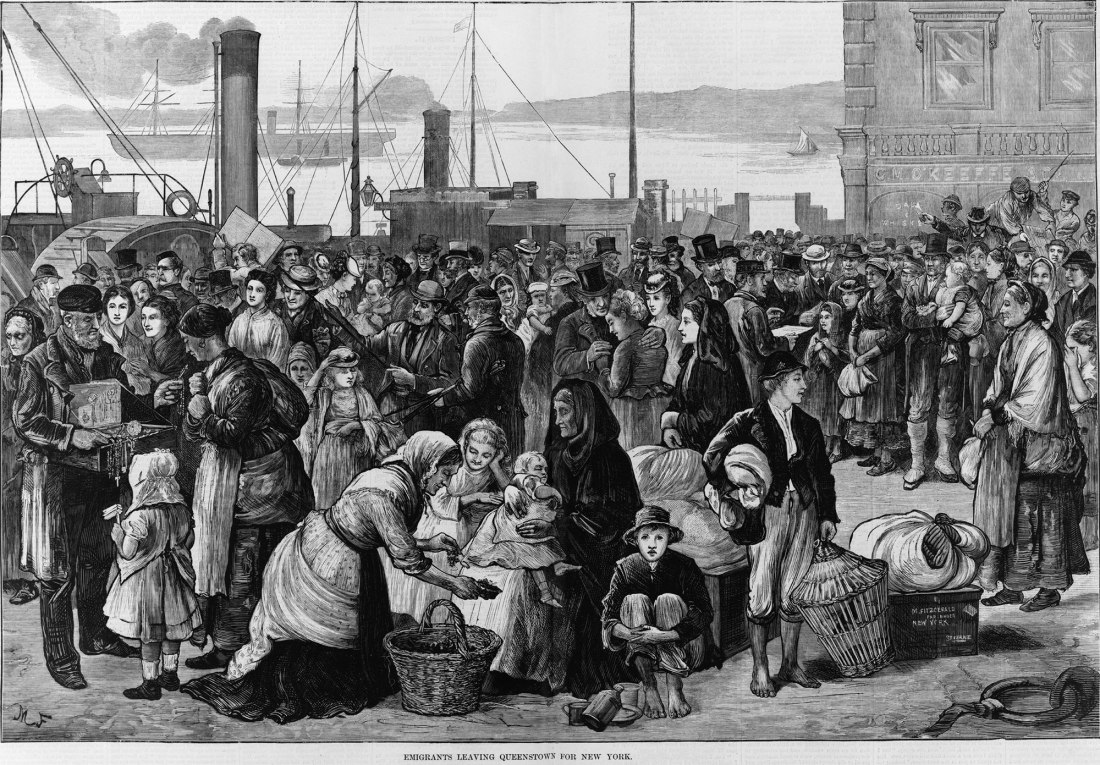
On an Immigrant Family

William became a casualty of the Industrial Revolution. A Scottish damask weaver in his home in Dunfermline, William saw the trade into which he had been born and raised taken from him and replaced by a large mill that was able to produce exponentially more fabric faster, cheaper–but not necessarily better. His oldest son would later remember the day his father came home and told his mother, “Andra, I can get nae mair work.”

Andra tried to sell food out of the house for a time, and she also took in work sewing leather soles to workers’ boots. Nothing improved the family’s situation. Thus, in the cold winter of 1847, the choice was made by the family of 4 (William and Andra had a younger son as well) to sell all their possessions–the looms William worked with and the remaining cloth–and sail for America. There, William reasoned, his skill as a weaver of fine cloth would be appreciated and not supplanted by mass production.

William was wrong.

The proud man tried to work as a weaver in Pennsylvania where two of his sisters had taken up residence after emigrating. The family ended up in a place called Slabtown, a shabby suburb of Pittsburgh, PA, in Allegheny City. They rented a couple of rooms there among other immigrant families. There was no sewer, no running water, and even feral hogs roamed the streets of the neighborhood in what was, effectively, a slum. William reassured the family that his skill as a weaver would produce enough for them to soon leave the lousy surroundings for a better place for the four of them.

However, William found that the Industrial Revolution had found even more fertile ground in the American continent than it had in Scotland. His hand-woven cloth was simply no match for the economy of scale that the textile factories enjoyed. William was thus forced to work as a laborer in a cotton textile mill. His oldest son, at age 13, soon joined him there in an effort to provide for the family.

Of note is that the lad did not share his father’s distain of factory work; in fact, he showed such a keen understanding of how the production process worked that he was soon promoted to be the keeper of the steam engine that made the factory’s machines work at the lofty salary of $2 a week.

That aptitude for machinery and the appreciation for the technology involved in the factory led to another job offer for the young man. He became a messenger boy for the new technology of the telegraph. In a letter back home to his mother’s brother, the young man wrote:

“Although I would like to be back in Dunfermline, it is far better for me that I came here. In Dunfermline I would have been a poor weaver all my days, but here I can surely do something better than that, if I don’t it will be all my own fault, for anyone can get along in this country…”

Anyone except, well, William.

It’s easy to see in this excerpt that William and his son each represented the reality of two vastly separate and different worlds. One of those worlds was William’s world of private, small business owners who worked out of their homes, people who produced hand-worked and crafted products that provided an extremely modest living for a person’s family–but that reality was dying an economic death. William’s son, on the other hand, represented the birth of the Modern World, the world of instant communication, of the application of steam engines to do the work of dozens of people, and of the burgeoning railroad industry that moved people and goods faster than humans had ever moved before. That new world of industry promised wealth beyond any man’s wildest dreams–especially well beyond William’s concept of modest success.

Yes, William’s world was gone. His son’s new, modern, mechanized and industrialized world–in fact, the world for both of his sons–had rendered William’s world obsolete. He died at age 51, less than a decade after coming to America, his dreams of making a success as a small weaver in his newly adopted nation dashed by the forces of the new economy.

His oldest boy, now the man of the family, was 20 when William died. And soon, the entire globe would soon know that oldest boy as one of the titans of this new Industrial Age.

Andrew Carnegie.