On a Monstrosity

When Claude was born, his mother was heard to say, “Oh, my! What a monstrosity! He looks like something nature tried to make but couldn’t quite finish.” Not the most auspicious birth, don’t you agree? And, as he grew, his family despaired of him. His own sister, supposedly a person he was close to as a youngster, said, “I hope you don’t grow up.” You see, there were several things wrong with Claude. He probably had Tourette’s Syndrome at a time when that was not yet able to be diagnosed. We know he foamed at the mouth, had twitches of his face and lips, and he walked with a shuffling limp. As he reached his teens, he developed a terrible stutter that made his family think even less of him. A monstrosity, indeed.

Yet, this monstrosity had a good brain and a fine mind. He learned several languages. He read everything he could get his hands on. His large family, wealthy and influential, kept Claude hidden from public view, but that suited him just fine. It gave him time to learn. And it gave him time to study people–the servants, his caregivers, and his family members. All of that learning and watching and listening would serve him well as he grew up. But that knowledge didn’t stop his family from humiliating him every chance it got. One of his nephews, a young man who was about Claude’s age, liked to throw food at him when he would doze off at dinner. This particular nephew would point and laugh at poor Claude, calling him all sorts of names and playing particularly cruel pranks on his uncle.

When it came time for Claude to assume more responsibilities in the family’s matters and business dealings, his uncle, the man who ran the family, didn’t want to give Claude any job with real danger of him possibly screwing it up. He didn’t trust that the differently-abled young man would be able to handle any real job that required thinking. Again, Claude was quite capable, as he would eventually prove, but no one believed in his abilities. As a result, as the family power grew, Claude was usually overlooked for positions and promotions within the power structure.

So, to pass the time, Claude decided to hell with them. He chose to spend time drinking, gambling, and womanizing. It’s funny, isn’t it, how money will buy you the attention–even for a short time–that your own family won’t give you. And Claude had plenty of attention when he want to bars and brothels because of his family’s money. And, for their part, the family didn’t care. They were sort of glad that the monstrosity wasn’t underfoot so much. And, at the same time, Claude didn’t stop his learning. He began also to write history books, books on culture, and even books on language and literature that proved to be so good, so well researched, that leading academics of the day were impressed with his knowledge and his writing abilities.

Then, as fate or luck would have it, that nephew that had tormented him so as a youth ascended to become the head of the family. Almost all other male relatives had died. Claude himself was in his late 40s by this time, and, since there was no one else, the nephew made Claude his “advisor.” Thus, from monstrosity to being close to the seat of power and prestige, Claude had somehow survived.

Then, after only a few short years as the family head, the nephew was murdered. And guess who assumed the mantle of leadership of the family? Yes, it was good, old, monstrous Claude. And, once he had his hand on the tiller of power, he did exceptionally well. In fact, it turns out that some of his so-called “ailments” as a youth were done for affect. Oh, sure, he had his tics and still had the shuffling gait, but the stutter left him, and he didn’t seem to be the complete idiot the family had though he was for so long.

In fact, history doesn’t think of him as a monstrosity at all. No, it remembers Emperor Tiberius Claudius Caesar as one of the best rulers of the early decades of the Roman Empire.

On a Massive Construction Project

When a city wants a pro sports team, it is often up to the taxpayers to foot the bill for constructing the arena where the city’s team will play. Many of these massive projects have been huge boondoggles in the past, with shoddy construction and illegal kickbacks resulting in a lousy building that has a short span of usefulness. As a result, many cities are almost forced to build new stadiums every decade or so to accommodate the sports franchises.

There was one city, however, that seems to have been on top of its game when it comes to building a sports arena.

First of all, the contract wasn’t put out to bid; the city merely appointed the builders and contractors they wanted (that caused a minor scandal at the time but proved to be wise later). There were four different firms hired to build 1/4 of the facility each. These four companies were almost competing to finish their sections on time and under budget–and those that did received an incentive bonus. The beautiful design of arches and tall columns gave the whole place an idea of lightness and airiness. That perception was interesting considering that, at the time it was built, it was the largest sports arena in the country, with a capacity of over 50,000 (that was a large arena at the time).

The politicians and magistrates in charge of the project were onsite daily. There wasn’t going to be any malfeasance of funds, no shortcuts would be taken on this project. And all that oversight paid off. When the public facility was opened, the city pulled out all the stops at the ribbon cutting. Bands played, parades were held, and several events were scheduled back to back to back over several days so that the public could have plenty of time to see where all their tax money went. And they were thrilled. The overwhelming consensus was that the facility was the best public arena ever built. People raved. And they marveled that it wasn’t only a sports arena. They applauded the builders and the government that oversaw the grand, massive project.

The result was a glorious, almost classical building, one that was used over the years as a multi-purpose stadium. However, as time passed, the city found that the stadium had outlived its purposes. So, it spent some time being used as a city garbage dump. That makes sense in one way, because it was a large, confined space, that would keep the trash out of the public’s view or interaction. And, over time, some people began looting the grand old structure. Luckily, the city realized the facility’s potential and took great pains to try to restore the grand old building.

And it is still in use today, at least occasionally. Today, you can still see it. In fact, millions of tourists flock to Rome today to see the Colosseum.

On a Cesarean

Men have no idea how difficult pregnancy is on both mother and child. The miracle of gestation and the wonderful but incredibly uncomfortable 9 months of the development of the fetus isn’t usually discussed in polite society, but it should be. And that doesn’t even factor in the emotional issues associated with the flood of hormones produced by the pregnant woman. Then, all of that culminates in the indescribable pain associated with the birth itself. Carol Burnett famously described it as pulling your bottom lip over your head. Modern medicine has made the process somewhat more safe and less painful to a degree, but, again, that is only in the modern era. For births in antiquity, every event was fraught with potential disaster to both mother and child.

Take a birth that occurred in Rome approximately 100 years before the Christian Era. At that time, physicians knew relatively little how the process of birth happened. In this case, the pregnancy had been a difficult one on top of the usual issues that come along with becoming pregnant. The doctor on duty for the birth realized that the birth would be difficult as well, possibly endangering the lives of both mother and child.

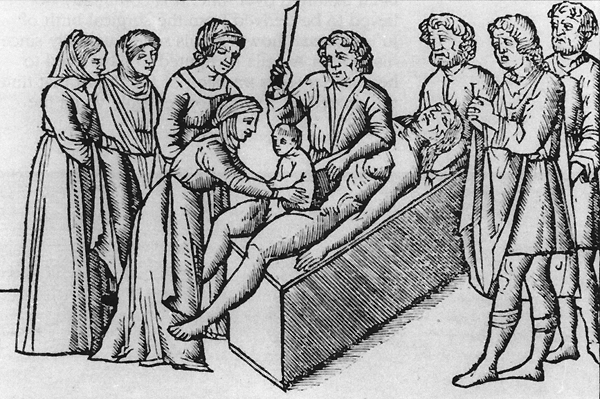
Now, at the time, Cesarean sections were employed only in cases where the mother was dead or dying in an attempt to possibly save the child. Sometimes, the doctors would perform the operation on the deceased mother in order to extract the child if it were dead so it, too, could receive a proper burial. It wouldn’t be until within the past 150 years that C-sections were employed to save the life of the mother rather than only to save the child. There were anecdotal evidence of the rare case when the mother would recover after the child was taken by C-section. These stories were so rare that many historians today doubt their veracity. By the way, the verb “to cut” in Latin is caedere, and cutting out of the child–that’s where the idea of the Cesarean section came from.

I say all that to point out that his particular physician was preparing for the worst. In his mind, if the mother was unable to give birth and began to succumb, he was ready to do what was needed to extract the child–even if the child, too, passed away. Such was the primitive methods and mindset of birth 2100 years ago.

Yet, in this case, despite the difficult pregnancy, the birth was relatively uneventful. In fact, a thoroughly healthy boy was born to a wealthy family, to the mother, Aurelia, and her husband, Gaius. Their family name, by the way, is said to have come from the fact that one of the ancestors of Gaius had indeed been taken from his dead mother surgically.

That’s why this healthy boy, a boy who was not born by C-section after all, was named Julius Caesar.

On Caesar’s Favorite

It is wonderful when a rich and powerful benefactor makes you his favorite. Such was the case in ancient Rome when an emperor bestowed his kindness and largesse on one such favorite named Incitatus. This Incitatus was the recipient of Emperor Gaius Germanicus’s favor and blessing. Caesar gave Incitatus a marble-lined bedroom equipped with expensive purple bed linens. He held great banquets in Incitatus’s honor, invited famous poets, musicians, actors, and senators to dine with them to honor Incitatus.

Caesar also gifted him expensive jewelry, had servants feed him by hand (and the food he gave for Incitatus had gold flakes in it), and also sent people who would bathe Incitatus. We don’t know what Incitatus thought or felt about this unusual attention from Caesar. History is not sure of his origins nor of how he came to catch the eye of Caesar. We know nothing of his parentage, and we can only guess that he came from decent stock or otherwise he would never have come under the gaze of the most powerful man in the world at that time. But, again, all of this is conjecture.

We do know that a female named Penelope shared his house. Penelope, also, received great attention from Caesar. In fact, Caesar liked her so much that he took Penelope on a military campaign with him after Incitatus died. This raised some eyebrows in Roman society to be sure. Some wondered why Caesar seemed to care so much about Incitatus and Penelope to practically adopt the couple.

Another time, Caesar wanted Incitatus to join the Roman Senate, that most august institution of Roman politics and society. The trouble was (and here we have some clue about his background), being a senator cost money in ancient Rome, and it seems Incitatus had none. So, Caesar decreed that the financial contribution requirement for all senators would be eliminated. With that hurdle taken away, it seems that Caesar got his wish and had Incitatus made a senator. That decision, also, aroused much speculation about the favoritism Caesar showed. Some said that Caesar was doing this as a joke to make fun of the senators who thought themselves high and mighty, and that to appoint a senator who had no money would take some of the wind out of their sails. Others said that to do this showed that the emperor was slowly losing his grip on reality and becoming mad.

History also records that it is likely Caesar had Incitatus made a priest as well. That role was also a political move since appointed priests would be in direct service to the emperor. Again, we still have no idea how Incitatus reacted to all this attention. One major reason we don’t know is because Incitatus could not speak Latin or Greek.

In fact, horses don’t speak at all, usually.