On A Double Spy

This past week, I told you how much I love spy stories. This one involves a spy who worked for the American cause during the American Revolution in the 1780s. That period was a good time (relatively speaking–it was fraught with danger, of course) for spying because loyalties were fluid and people changed sides in the war depending often on who was standing nearby. But James was decidedly on the side of the American rebels.

It’s pretty generally accepted that the American public in the 13 British colonies were split into thirds during the conflict. About a third was against the rebellion and wished for the British Empire to stay as the ruler of the colonies. Another third didn’t care either way–the war didn’t affect them one way or another. Finally, approximately the last third of the population was whole-heartedly on the side of independence and actively worked towards that end. And James worked for independence more than most.

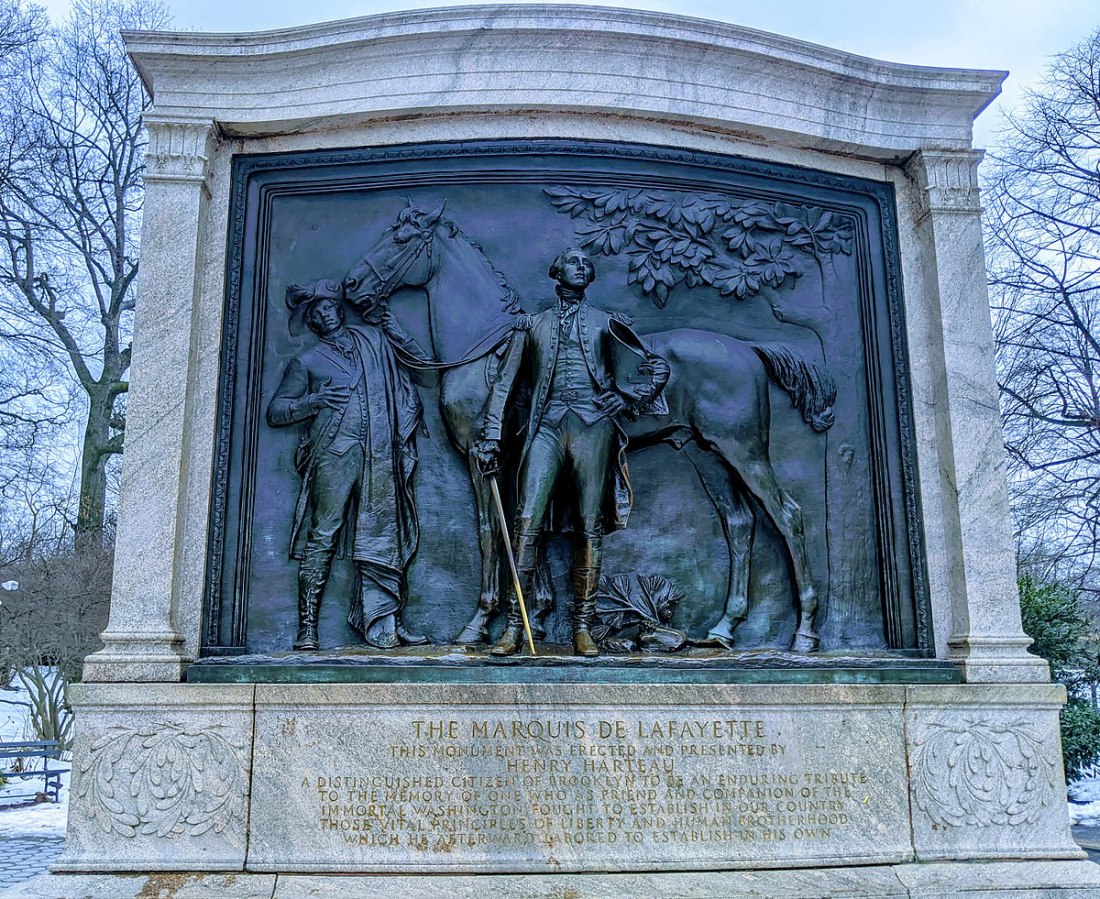
He offered his services as a spy to the rebels, and his offer was accepted. His commander was the French general, the famous Marquis de Lafayette, the man who admired the Americans’ desire for liberty so much that he came to the colonies to help George Washington in the war effort. Lafayette suggested that James secure a position as a “loyalist” in the camp of the American traitor, General Benedict Arnold. Arnold had changed sides in 1780 and then fought for the British. So, Lafayette, with Washington’s approval, sent James to spy on Arnold shortly after the transition from American patriot to British traitor. James gained the trust of the former American leader by pretending to be a spy for the British. The information that James gave Arnold was always solid but was largely useless. However, the intelligence he secretly sent back to the Americans was invaluable regarding British troop size and movements.

Then, as the war began its final stages, Lafayette ordered James to offer his services to General Cornwallis, the British commander in Virginia. There, James secured work as a courier for the British, taking orders and correspondence between British camps. In other words, the British were giving their battle plans directly into the hands of the Americans by entrusting it to James to carry between their lines. The information James gathered enabled the Americans to easily counter Cornwallis’s movements, and it led directly to the American victory over Cornwallis at Yorktown. It was the victory that effectively ended the American Revolution.

After the war, James purchased several acres of land in Virginia and became a fairly prosperous farmer. Despite some issues on whether or not he was in uniform during the war (he was not, obviously), James eventually received a small pension for his service in the war. But, for James, the real satisfaction was knowing that he had fought for the cause of liberty in his own way.

Then, in 1824, the Marquis de Lafayette made a return trip to the United States in honor of the nation’s upcoming 50th birthday. He traveled around all 24 states including Virginia. While in Richmond, Virginia, Lafayette was riding in his carriage through a large group of well-wishers when he saw James’s face in the crowd. The Marquis ordered his driver to stop, and he got out. He rushed into the crowd to excitedly hug James. The two old men were so happy to see each other after so many years and after they both had endured so much for the cause of liberty. However, many in the group surrounding the Marquis’s carriage were less than pleased, however.

You see, James had chosen the last name Lafayette after the man he so admired during the war. And the reason he chose that name was that he had no last name when he had met the Marquis. And the crowd was upset at the embrace because, at that time in Virginia, White men simply did not embrace former slaves like James Lafayette.
On Fighting Counterfeiting

Have you ever looked closely at a dollar bill? I mean, really closely? You’ll see bits of cotton fibers in the bill. Hold it up to the light. See the watermarks? And some bills today also have an electronic strip inside them. All of these elements were designed to help fight the scourge of a stable currency: The Counterfeiter.

As an example, in one of the more recent years that we have records for, counterfeiting in the United States alone cost businesses over $200,000,000,000. You can see that these measures, while difficult to replicate and fake, don’t really stop the bad guys from stealing from the US economy. But imagine what it would be like if these measures weren’t in place at all.

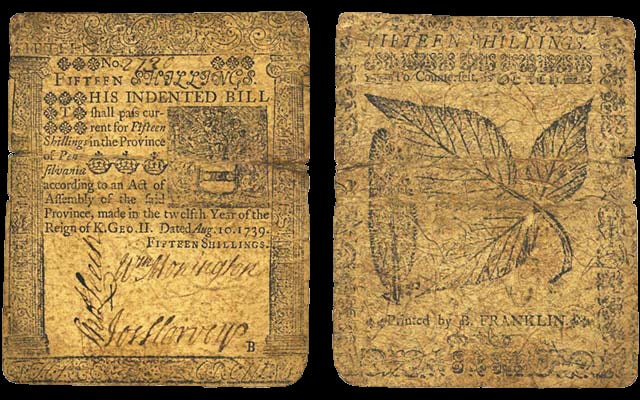
And that takes us back to the founding of the US and even before. When paper money was used in the British Colonies, it was incredibly easy for someone with simple means–like a printing press–to print out their own money, almost like having a copy machine today and simply making copies of hundred dollar bills. Each colony could print their own currencies based on the British pound, but, because of the difference in the relative economies of the colonies, a Massachusetts pound would be worth a different amount than that of, say, a Virginia pound. And there were really none of the more modern countermeasures for counterfeiting. A signature on a bill would probably be the only thing most colonial paper pounds would have as a way to verify it as a genuine bill. Thus, such colonial pounds were easily faked.

Enter an enterprising man from Pennsylvania who had the great idea to add some of the earliest anti-counterfeiting measures to pounds produced in that colony. He began with paper weight. Counterfeiters work cheaply, and if the quality of the paper used for the banknotes were heavier, so much the better. But he took it several steps farther. Watermarks were introduced that would be difficult to replicate. He introduced the idea of threads into the notes much like we have today. And he found a way to emboss the notes with the veins of leaves and flower stems–almost impossible to copy if that’s what you wish to do. And his expertise extended to the use of a special type of ink that was made by a special process by which animal bones were burned to create a unique graphite.

All of these processes made the Pennsylvania pound notes the envy of the colonies. It helped stabilize the economy of the colony at the outset of the American Revolution. The British tried to ruin the American economy by producing fake bank notes during the war, and they succeeded in doing major harm to many of the other colonies, but not so much in Pennsylvania. Because the other colonies’ currencies were easily faked, the fledgling United States distrusted paper money until the era of the Civil War, more than 80 years later, relying instead on coinage.

But if the nation had only followed the anti-counterfeiting measures created by this Pennsylvanian, they might have switched to paper money much sooner. In fact, these innovations are one reason why Ben Franklin is on the $100 bill today.

On a Freedom Fighter

The name Washington is synonymous with the American Revolution and the founding of a nation, as Abraham Lincoln said over 80 years after the fact, “dedicated to the proposition that all men are created equal.” Let’s take a moment and talk about this Washington man who fought for freedom.

His story is familiar to many, I’m sure. In 1776, he joined the fight for his freedom and donned a uniform, a man willing to die if needs be. His nation called to him, and he did not shirk from his duty. Certainly there was a price on his head for taking up arms to fight. However, he was not to be daunted.

Remember that America at that time was British territory. Even during the war itself, about 1/3 of the population still remained loyal to Britain. Historians estimate that another 1/3 was indifferent as to which government ruled them (the colony/state verses the Parliament in London), and that left 1/3 to actively prosecute the revolution like the master of Mt. Vernon did.

The range of fighting that Washington saw went from New York to South Carolina over the years of the war. He endured the same privations as the other soldiers, the same extremes of cold and hot, and the same hardships as any other man in the field. Going through all of that was better, he believed, than living under the yoke of oppression for the rest of his life.

As we all know, the British were finally defeated at Yorktown, and the resulting Treaty of Paris in 1783 cemented the freedom of the American colonies from British rule. But that’s not the end of Washington’s story. What happened next was rather unusual; when the war ended, he didn’t return to Mt. Vernon. No, instead, he boarded a ship in New York bound for Nova Scotia. I bet you didn’t know that, did you? It’s true. And over 3,000 people in his same situation escaped from American territory in the same manner.

You see, Harry Washington, an escaped slave from Mt. Vernon, ran away from Mt. Vernon in 1776, ran away from his owner, George Washington, and took his former master’s last name. He then fought in the Revolutionary War on the side of the British–and for his freedom.

On An Old Man’s Conversations

George really was a man who enjoyed simple things, but he was no simpleton, he. Some of his friends called him “Farmer George” because he liked to dabble in agriculture (even though he lived in the city, mostly) and because of his liking for things like food, family, and laughter. All in all, a good man who married a good woman and had a bunch of kids.

15 to be exact–9 of them sons. The last two boys were born to George when he was an older man. It was these last two sons that George talked to more than the other children that he and his wife had. You see, George had some health issues as he aged as many of us do. He became bedridden, and the younger children around him were all he saw as the older ones were grown and gone by that time. So, George amused himself by talking to the two younger boys, Freddie, the 9th son, and Eight–yes, George named his 8th son Eight–for hours on end.

The boys never complained about their father’s long talks with them. Oh, he would ask them questions often, and he would listen intently to their answers, but most of the time in his bed-ridden state, George would simply talk…and talk…and talk. And while young boys being that patient with an elderly father seems unusual, you’ll see why the never grew bored with or tired of their father’s attention.

And it’s not that George ignored the rest of his family. Unusually for his day, George doted on almost all his children. The oldest and namesake, well, he was different than his dad. George, Jr., wasn’t fond of the simple things like his dad was. Those two men never really “bonded” as is the phrase today, but what inheritance the older George left when he died went almost all to George, Jr. No, the older George would carry his younger children around on his shoulders, he’d toss them in the air, he’d play games and always–always–remember their birthdays and special events in their lives.

So, for the years preceding his death in 1820, Old Farmer George talked to his two youngest sons about life, death, God, toys, travel, the stars, and even shared secrets with them that no one else knew.

Sadly, the boys never heard what their father said to them.

That’s because both of them had died several years before. Eight–whose name was actually Octavius–died in 1783 at age 4. And Freddie–Alfred–had died at age 2 in 1782.

You see, in his madness, King George III of Great Britain and Ireland, talked long hours to the precious sons he had loved and lost.

On a Violent Confrontation

The United States has seen its share of confrontations between police and crowds of protestors. We sit, shocked, in front of our phones or TVs or however we consume news, and sometimes marvel that more people weren’t killed in these acts of violence such as the Capitol Riots on January 6, 2021. And we make choices about which side is right and which is wrong based on a completely subjective metric that is usually influenced by the very media that tells us the story in the first place.

One particular confrontation still rankles many today. And you know the two sides—the protestors marching against unpopular government action verses the miliary called out to keep the peace and protect the general populace from the possibility of violence from the marchers. In this particular case, five Americans died and eight were severely injured when the government opened fire on the protestors.

The military’s side of that story was told at the trial of the men who fired on the crowd. To hear the soldiers tell it, the mob had hit them with clubs and threw rocks and other projectiles at them. The young troops felt endangered by the attacks.

As you can imagine, the actions of the troops in the taking of lives and severely wounding others in this confrontation led to calls that the military be disbanded and defunded. After all, doesn’t every American have the right to protest?

There is definitely such a thing as mob mentality. Ordinarily sane people will often act completely counter to their personalities when surrounded by other angry people. There is something both empowering and emboldening about being in a crowd. Perhaps you have been in a sports crowd and booed mightily at some play or some referee’s poor call—an action that you would never normally do on your own. Magnify that by several exponents, and you have the idea of what mob mentality can do to a normally placid person. So, while the accusations that the crowd pelted the soldiers with objects was generally agreed to have happened, the people in the crowd said they were only responding to a threat they felt from the soldiers and that they, not the soldiers, were acting in self-defense.

The crowd was made up of people from all walks of life, albeit mostly male, but also from all social and economic groups as well. So, it was not that only certain members of the crowd felt threatened while others did not. If anything, almost all members of the crowd argued, seeing the troops called out only made things worse, not better. No one felt safer having a group of soldiers with guns being pointed at them.

In response, the attorney for the soldiers caused a public outcry when he claimed that the mob was made up of foreigners and added that the word “mob” was too respectable for this rabble who attacked the brave soldiers who, after all, were only doing their duty against these foreign undesirables.

Perhaps it was this not-so-subtle appeal to the jingoists in the jury that caused them to acquit most of the solders and find only two of them guilty of manslaughter. When the jury verdict was announced, that’s when the media increased the churning out of its anti-government propaganda that, in turn, stirred even more people to get out into the streets and protest. The newspapers, especially, exaggerated the violence of the soldiers and minimized the actions of the crowd. They falsely labelled what the soldiers did a massacre.

The Boston Massacre, in fact.