
On an Imagined Email

If email had existed years ago, here’s a possible, mostly historically accurate, but completely imagined inter-office communique:

To: Senior Staff

From: JM

Date; 20 May, ’92

RE: The Boss

He’s talking about retirement again. We are at a juncture where such a move would prove disastrous for our little enterprise. In talking with him at length in his office this morning, the following items were brought up as the major reasons for leaving.

1.) He’s tired. The years of strain of being an exec have taken their toll, he says. He feels that he’s done all he can do to get us off the ground and on as stable a footing as he can given how little time we’ve been in operation, but he argues that he’s got nothing left to give. He talks about staying home, working in the garden, taking walks along the river, and playing with the dogs. Can you believe it? The dogs, for Chrissakes. And he says his wife is tired of him not being home after so many years of work. He says he’s old–but he’s only 60! For those of us who’ve been here since before the start, he’s always seemed older, but he’s never seemed old to us. We’ve got to remind him that he’s young, that he has many productive years left, and then say things about how his color is good or how he’s looking well.

2.) He’s fed up with the interoffice politics among senior staff. That’s why this email if for your eyes only. It would do no one any good to learn about infighting among the senior-level employees. Keep this to yourselves. But he’s looking specifically at Al and Tom. You guys have your issues, we know, but you’ve got to keep that stuff out of the office. No arguing in front of him, in the halls, or anywhere on the property. If you guys have something to say to each other, say it out of earshot of anyone having to do with this office. The Boss says he’s tired of having to play referee for your infighting. And he worries that staff as a whole will choose sides between you two, leading to division within our group, and possible dissolution of what we have all (especially he) have worked for so hard for so long. He is aware that there will be fighting over who will replace him among us, but he still is wishing to step down.

3.) Finally, he’s worried that if he stays any longer in the leadership position, people in and out of the organization will soon not be able to separate him from the role. In other words, his concern is that the man will become synonymous with the position, and anyone who follows him will forever be considered and seen as the “not him.” That’s a valid position to a degree, granted, but, again, we are at a critical point in our existence. We have to assure him that if he decides to step down now, there may be no role for anyone to assume after he leaves.

We have to have a united front on this. Remember: Stay positive in his presence. Tell him how good he looks and how young. No infighting (can’t be stressed enough). Remind him how vital he is to what we are trying to do here.

Everything depends on President Washington being re-elected in November and staying in office for at least four more years.

–Madison
On a Coup Plot

Coups take planning. Successful coups are best planned in secret.

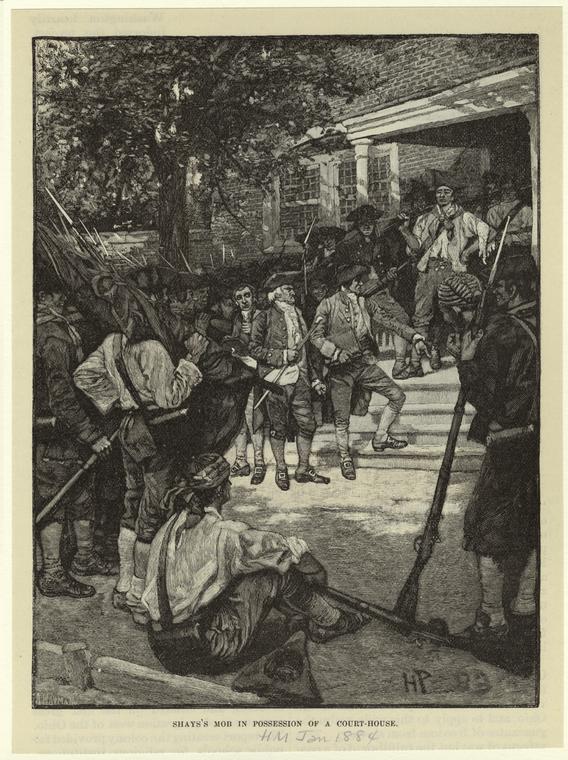
In the early days of the American Republic, insurrections and coups were more common than we may realize today; every month or so, another group rose up against the government and the states had to take action against its own citizens to put down the rebellion. One such insurrection, Shays’ Rebellion, in 1786, lasted several months and almost succeeded in a major disruption of trade and governmental power in the fledgling United States. At that point in American History, the states thought of themselves as mini nations that united first for defense (against Great Britain, for starters) and then for mutual aid and, hopefully, trade. Think of that early system of government to be more like the European Union today—a much looser association of nation-states.

So, yes; it was a time of uncertainty and insecurity, this time that was ripe for rebellion and plots. One such plotter was a man named Jimmy. Jimmy was no dummy, and he recognized that this new nation had a government that was extremely weak in some areas. Like the rebels in Shays’ uprising in Massachusetts, Jimmy thought the people must have more say in such matters as taxes (one of the key issues during the recent American Revolution, in fact) and trade between the states. He hatched a plan to secretly meet with some others who felt the same way to think of ways to overthrow the current government of the US and start a different one.

As quietly as possible, word went out to like-minded souls in other states for the plotters to meet in Maryland in September of 1786. For four days, 12 men from only four of the United States met to discuss what would be the best course of action for them to take to ensure that the current government of the United States would be quickly overthrown and how they could win the people’s support. Even though their numbers were small, these men were united in their desire to fix the “important defects in the system” of the American government.

One of Jimmy’s co-conspirators, a man named Al, suggested that they reach out to people who had been associated with the Continental Army during the recent war. After all, the coup might need a strong military showing if they were to succeed. Al had connections to General George Washington, and he suggested that they include him in on the plot. Others in the group doubted whether Washington would have the stomach for such rebellious talk. They reminded Al of the sentiment of Washington at the end of the war, when he had been urged by some of his officers to assume the role of a de facto King of America. Washington quickly and vehemently squashed such talk, and some at the meeting felt that he would do the same now. Jimmy, also with avenues to the great man, promised to talk to him about the issues at a later opportunity.

The fear of those assembled was that, since people from only a few of the states were at the meeting, whatever plan they hatched would not have widespread support. Nevertheless, again the need to something was recognized by all. Jimmy, realizing that his plan would not be enacted at this point, decided to retreat, to live to fight another day. He asked Al if he would write a letter to send to the other states who had not sent anyone to the meeting to see if they might meet again soonest. The sooner, the better.

At this point, you might be thinking that you have never heard of this plot to change the government of the United States. However, you have certainly heard of it. Today, we call it the Annapolis Convention. And, we might ask ourselves at this juncture, what is the definition of a patriot? Is it not someone who wishes for a better life for all citizens of the nation? That is what these men saw themselves as being: Patriots.

You see, the letter that Al—Alexander Hamilton—wrote at the insistence of his compatriot, Jimmy—James Madison—asking the other states to meet to discuss changing the United States government led to the writing of the United States Constitution the next year in Philadelphia in order to form a more perfect union.

On a Wealthy Widow

After almost 30 years of marriage, Eliza Jumel found herself, at age 58, a widow woman with some money.   Her dead husband, like Eliza herself, had been born in humble conditions, but he had managed his money well and had left her a good fortune. Eliza discovered that money, however, could not keep her company. She wanted a social life and wealthy friends. So, Eliza went looking for a husband who would bring a notable name to go along with her wealth.

She found such a man in New York City only 14 months after her husband‘s death. This older man was a veteran of the American Revolution and had but a modest pension from that and some other government work he had done. He was well known in the town. So, a merger of sorts was arranged; she seems to have married the older man to increase her standing in the society of New York, and he seems to have married her to secure his financial position in old age.

The marriage did not work from the start. These types of things seldom do. The older man got his hands on Eliza’s liquid assets immediately.  He surreptitiously acquired the money and spent it rapidly to cover debts he had incurred before the couple got together, debts that he hadn’t disclosed to Eliza. When she discovered the betrayal by her new spouse, Eliza, understandably became livid. After only four months of marriage, Eliza left the older man, managing to keep her non-liquid assets separate.

In order to facilitate a quick divorce, Eliza enlisted the services of a well-known New York attorney, a man named Alexander Hamilton, Junior. Yes, indeed, Eliza’s divorce attorney was the son and namesake of the famous former US Secretary of the Treasury, General Alexander Hamilton, the man who had been famously killed in the duel with then vice president Aaron Burr way back in 1804.

Hamilton Junior protected as much of Eliza’s estate as he could from the clutches of her new husband, and a divorce was finalized in September of 1836.  When she passed away in 1865 at the age of 90, Eliza was known as one of the wealthiest women and most astute businesswomen ever to live in New York City.

Ironically, the date that her divorce was finalized in 1836 was also the date that the older man, the husband she was divorcing, passed away.

His name?

Aaron Burr.