On a Funeral Procession

The assassination of John Kennedy, as traumatic and as paradigm shifting as it was, almost pales in comparison to the national outpouring of grief when Abraham Lincoln died at the hands of assassin John Wilkes Booth. Even in parts of the former Confederacy, true patriots knew that Lincoln was the best hope for not only national reunification but also for the rebuilding of southern society after such a devastating war.

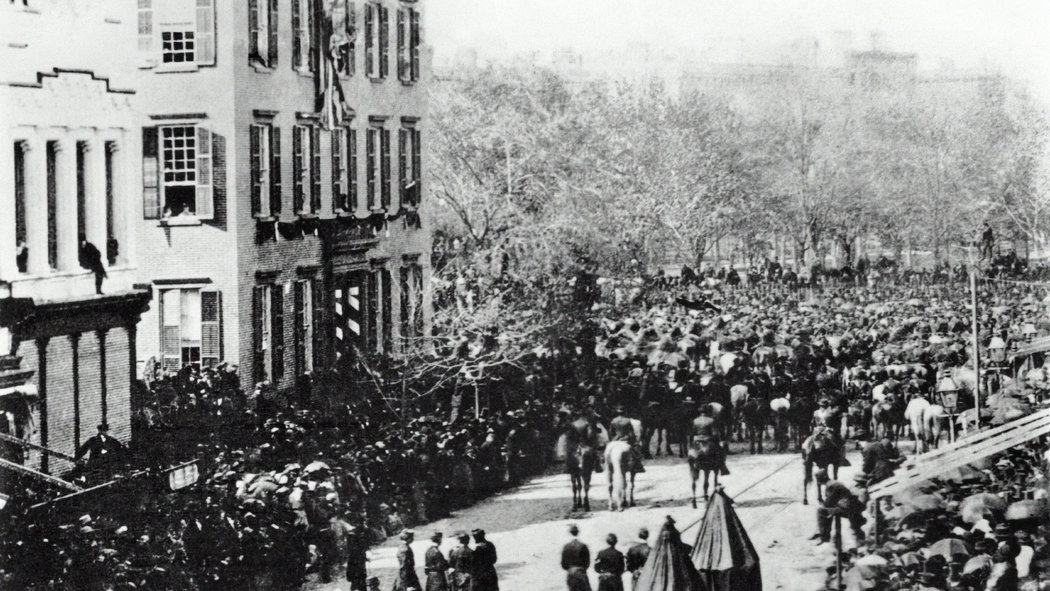
When Lincoln died, it was decided that his body should go around the country by train, with stops in several important cities. The cities would then hold parades to allow as many people as possible to show tribute to the fallen leader. One of the largest parades took place in New York City.

Lincoln had not been always popular in New York. There were several draft riots during the war which caused tens of thousands of dollars worth of damage to the city. Being a democratic stronghold, many in the city viewed Lincoln as a tyrant. But, after his death, they also, mourned his passing because they knew he had steered the ship of state through rough waters into a safe harbor (to paraphrase the New York poet Walt Whitman).

So the city turned out in large numbers to say goodbye to Abraham Lincoln. The funeral procession included huge rows of New York volunteer and draftee troops, freshly home from the Civil War. Family members and well wishers turned out to see them as well as mourners to see the extensive parade. Children who were old enough to witness the event and remember what they had seen spoke about the events of that late April day well into the 20th century.

Look at the photograph above. Years later, someone noticed that the house in the left center of the photograph belonged to one of New York’s wealthiest and most prominent families. They noticed two small figures in the second story window who were keenly watching the passing of the Presidential catafalque.

A relative of the family, in later years, said that she knew exactly who the two figures were. They were two young boys, cousins, in fact, of hers. One of them was named Elliot. This woman was certain of her identification because she ended up marrying the other one—the one whom she called Teedie.          

You know him as Teddy Roosevelt.
On a Civil War Nurse

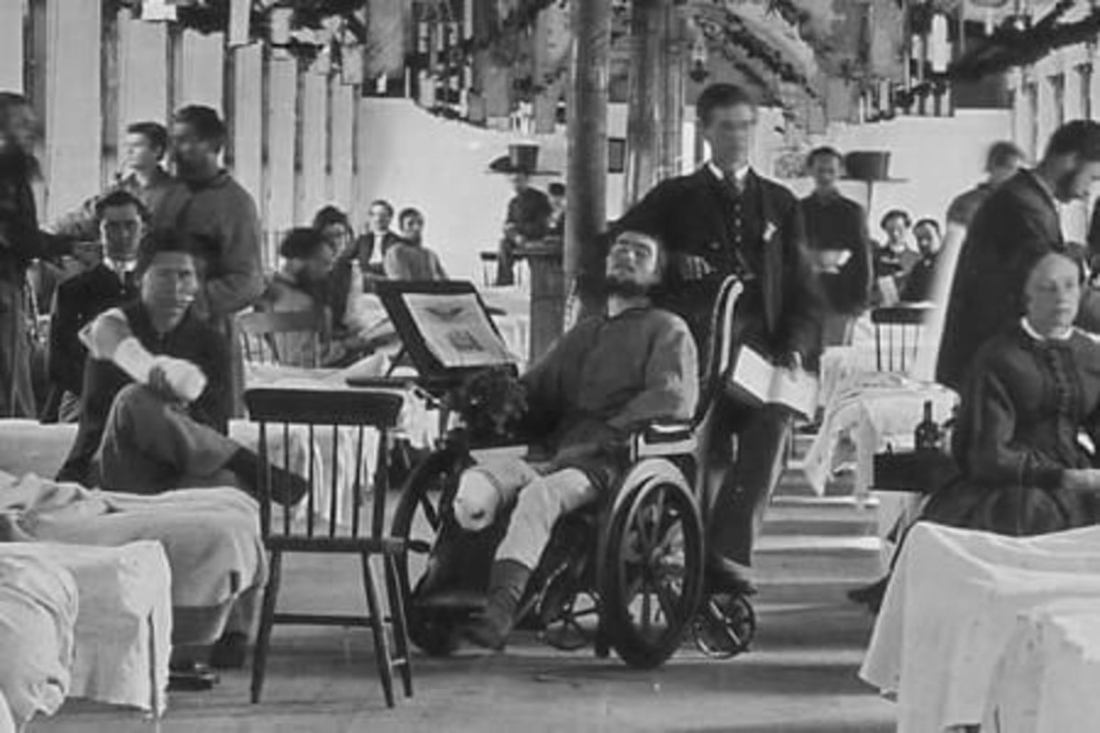
Hospitals in the American Civil War were most often the place wounded men went to die. The conditions were horrible. People such as Clara Barton and others worked to improve the sanitation in the hundreds of facilities in both north and south, but their efforts were largely superficial and ahead of their time.

In the days of no antibiotics and often even distrust of antiseptics, even by so-called health care professionals, the Civil War hospitals became cesspools of disease and death. Men would lie in their own filth and, in the warm months, their own filthy sweat for days at a time, their bandages sometimes rarely changed. Modern nurses would be appalled at the situations if they would have seen them. One medical historian said, “The septic sins of the time [were] responsible for a harvest of death and suffering.”
Volunteer nurses–both male and female–would do what they could to attend to the wounded. If a family member could find where their wounded brother or father or husband was being “cared for”, the family member would go and assume the nursing duties him or herself. One such situation occurred in a family where a young lieutenant named George had received a wound in the Battle of Fredricksburg in late 1862, and his brother came from New York to Washington, D.C., to care for him.
The older brother cleaned his wound, changed the dressing regularly, fed him regularly, too, and George beat the odds and recovered. This man, in his mid-40s, his family obligation finished, looked around him and decided that too many young men needed nursing. Almost 14,000 young men lay in the hospitals surrounding the nation’s capital. Besides, George said, he seemed to have a knack for the profession, so the man decided to rent a room in Washington and work in the many city hospitals.
Much of the work this man did consisted of cheering up the injured young soldiers. The Civil War had invented newer and better ways of destroying the human body, and amputations, disfigurements, and cripplings became almost routine. The men needed a dose of cheer, and this New Yorker brought that to them every day.
His rented room was slightly north of the White House, and his daily walk to the hospitals took him by the place. He came to learn the routine of the resident there, one Abraham Lincoln, and to know when Mr. Lincoln would be coming and going and where. You see, Lincoln, too, visited the hospitals often, also trying to bring cheer to the men who were fighting for liberty and union. Once or twice, even, the New York man and Mr. Lincoln exchanged polite nods as their paths intersected near the executive mansion.
The New York man knew that the injured boys’ thoughts were often of home, so he would bring paper and pencil and, since many of them could not write or their injuries kept them from doing so, he would take their dictation and send the letter home to their anxious families. Because of George’s injury, he knew the fear and dread that news of having a loved one injured in battle brought to a family, and he wanted to help alleviate that fear if he could.
Finally, the war–and the suffering injured soldiers–ended in April,1865. The men in the hospital wards who managed to live through their wounds and surgeries and diseases were sent home to Ohio, Wisconsin, Indiana, New York, and all the other states in the re-United States. The brother-cum-nurse from New York decided to stay in Washington after the war and work in the federal government.
When President Lincoln was assassinated, this man saw Lincoln as the last sacrifice of that terrible war. He felt that since they had worked, each in his own way, for freedom and union, in the nation’s capital for those years, that he and the President were somehow cosmically linked, spiritual American brothers–as much as he was brother to George–George, who survived the war and went on to do heroic things in battle.
Lincoln’s death moved the man so much that he used his pencil one more time to write a poem about it:
O Captain! My Captain! by Walt Whitman.