On a Perfectionist

One of the best bosses I have had across my various jobs was a woman named Kay Tyler. She taught me two valuable lessons. One was to thing things through. What will happen each step of process? What effect will those things have on all involved and on the pursuit of the goal? The other lesson was to have not only a Plan B but also at least have an idea of Plans C-F or so. Those lessons have stayed with me and helped me be a better administrator and even a better person. Ms. Kay was a perfectionist, and she was one of those who backed up what she taught with a lifestyle to match. Another such perfectionist who is about the same age as Kay Tyler is a programmer and code writer named Margaret Hamilton.

Margaret wrote computer code for M.I.T. back in the days when writing code was literal writing–by hand–each line of code on paper. Those codes told the computer what function to do next in a process. Like Kay Tyler’s advice, Margaret also had to think things through, and she definitely had multiple back up plans just in case. People would ask her, “In case of what?” Margaret would smile and answer, “Exactly!” In her capacity as a code writer, people’s lives were on the line; the decisions her code made could make the difference between life and death for some. There’s a story that, one night during a work party, it struck Margaret that one line of her code was incorrect. With her apologies, she rushed out of the soiree and returned to her office. Sure enough, one small part of a line of code was in error. Margaret realized that even something so small could make a world of difference in the right situation. So, Margaret became a perfectionist out of a sense of responsibility and ownership of her work–concepts that are becoming more and more foreign to some in the workplace today.

And remember that, during the 1950s and ’60s, it was rare for women to be in the workplace compared with today. And Margaret was also a mother. People at the time would ask her nosy questions like, “How can you work and have a child?” and “Don’t you love your family?” Yes, those were the types of things people thought about working mothers 60 years ago (not that some don’t still feel that way). Yet, despite knowing that her work was important, Margaret still felt some societal pressure to conform to the middle-class expectations of a woman being a wife and mother first.

So, often, Margaret would bring her daughter to work at M.I.T. with her. And that seemingly little thing led to something amazing. One night, while her daughter was with her in the office, Margaret allowed the child to play with one of the machines she had written the code for. The child, in her innocence, tasked the machine to perform a function for which Margaret had not written code. That piqued Margaret’s attention. What would happen, she wondered, thinking things through, what would happen if someone using her code would accidently make the same input that he daughter had done? Would that cause a catastrophic failure of the system? Should she write code that would keep the machine from even performing that operation at all, even it would be accidental? Better safe than sorry, she reasoned. So, Margaret wrote the code.

Turns out that when the code was finally used in the real world, someone indeed accidently made the same input that Margaret’s daughter had done. However, because of her sense of perfectionism, Margaret was ready for it. And, in the final analysis, it was that mentality that perhaps saved lives.

What you don’t know, most likely, is that Margaret Hamilton wrote code that produced the modern coding systems we use today. In the same way that the invention of the telegraph led to modern cell phones, Margaret’s code is the grandparent of the code used on the device you’re using to read this blog right now. At the time, of course, Margaret’s code was groundbreaking and revolutionary. And, it’s true, her code saved people’s lives.

You see, Margaret wrote all the code for NASA that sent humans to the moon.

On a Class Project

The kids in Mr. Jones’s class were always having fun.

It’s not that the sophomore World History course was easy or that Mr. Jones was not a disciplinarian, no. It’s just that for most high school classes, you walk out and pretty much forget about that subject until you have to go back to class the next day. But that wasn’t the case with this particular class. Mr. Jones made the subject interesting. The kids would talk about what they had discussed that day at lunch, during recess, after school, and on weekends. Mr. Jones was one of those teachers whose lessons stayed with his students years after they left his classroom.

In 1967, Ron Jones was facing a challenge. His kids were having a hard time relating to his lessons. Now, remember that the 1960s was a decade where American young people were questioning, well, pretty much every convention in that society. Choices about clothing, hair styles, music, sexuality, and gender roles as well as racial relations were called into question. The anti-war movement, which many saw as an anti-establishment movement, was growing as the decade wore on an more Americans and Vietnamese were being killed and wounded. So, Mr. Jones had a hard sell to convince his pupils that history was important.

One day, at the beginning of class, Mr. Jones wrote on the chalkboard, in big letters, STRENGTH THROUGH DISCIPLINE. He then ordered the students to sit at attention when they took their seats until he gave them permission to sit at ease. When asking questions, the students were required to stand and to preface each question with, “Mr. Jones, sir,” before composing a short question. Rather than bristle under these new rules, the kids loved it. It was like a game, one said later, and it was different and new to them. Day two of the new order, Jones wrote STRENGTH THROUGH COMMUNITY, began lecturing on the dangers of individualism, and said that he wanted the students to become part of what he claimed was a national youth movement called The Third Wave. He said that kids all across the nation were getting exited about the new movement, and that they found peace and happiness by rejecting personal goals and achievements for the sake of the greater good. The students, who first thought of the new rules as a lark, began to quietly and respectfully listen to what Mr. Jones was saying. You could see that they were soaking it in, Jones reported later.

Day three saw a new slogan on the board: STRENGTH THROUGH ACTION. Jones passed out membership cards, thereby making the group somewhat “exclusive.” He told three of the students to secretly report to him when fellow students weren’t following the rules. Surprisingly, over twenty students made secret reports of rule breaking to Jones. Also, he heard that some of the students at the school who weren’t in the class were interested in joining the movement, and he agreed that these other students could join but had to pass specific tests to insure that they, too, would follow the rules. What had started as a class of 30 soon grew to over 200 students in the school who joined the New Wave movement.

Mr. Jones was facing some pushback. Some students who weren’t part of the New Wave complained that they weren’t allowed to join. Parents of kids in the class had called the school expressing concern because their children were quoting Jones to them, quoting the three slogans, and had changed their behavior at home. They were more involved in the family the past few days, they reported, and were concerned that Jones had started some sort of a cult. The students were actually eager to go to school, they said. One student, a large kid on the football team, volunteered to act as a bodyguard for Jones in case there was any trouble. It was all getting out of hand.

So, Jones called an assembly of all the New Wave members. He said that a national announcement would be made on Television that day, and that they would be able to watch it live on a TV set up in the auditorium. Student guards were placed at each entrance to insure that only card-carrying members of the New Wave would be admitted. At the beginning of the assembly, some of the New Wave students started chanting the three slogans over and over. Finally, when it was time for the broadcast, Jones turned on the TV to show…a blank screen.

Then, as the students watched eagerly, Jones started a film on the large screen behind the TV. It was a Nazi propaganda film. That’s when Jones announced that the students had been involved in an experiment. He apologized if anyone was hurt or if the experiment had caused harsh feelings between friends or family.

But he had taught a lesson his students would never forget: It’s oh so easy for a society so slip into fascism.

On an Old Hippie

The fact that the word “hippie” is in the title of this story instantly marks me as being old. No one uses that word anymore, and anyone who knows it was from the period 50+ years ago when it was part of the cultural and social landscape. The word came from the idea of someone who was “hip” or “hep,” as in someone who was “in the know” and “wise” as opposed to someone who had no idea about what was cool or popular or “in.” In the 1960s and ’70s, a hippie was someone who was on the side of the anti-war, pro-drug legalization, anti-establishment youth movement. The opposite of a hippie would be a “square,” someone who supported the traditional values and power structure in the western world. You could tell which side someone was on based on how they dressed, what hairstyle they wore, and the language they used as well as how they voted and what issues they supported. And, while the overwhelming majority of hippies were young, this story is about one such hippie who was older.

In many ways, this old hippie was against type for many reasons besides his age. He was from the American south, from a traditional background, and had, as a younger man, indeed supported the establishment. But, as he aged, his politics changed. There’s an old saying that someone is more liberal in politics as a youth and more conservative as they age. So, this older man went against this trope. He had seen the effects of the American policy of the Vietnam War, for example, and he became horrified by how morally wrong it was. He became an anti-war supporter. Also, he began to wear his hair longer, much longer than what traditional society would say was acceptable for a man in his 60s. Remember, during that time, men who supported the establishment would not consider having long hair. Yet, this man wore his almost shoulder length. He would decry traditionalist men as “short hairs” because they cut their hair so short like the establishment was used to.

And the music he liked went against type as well. His favorite group was Simon and Garfunkel, and the song by this duo that was his favorite was Bridge over Troubled Water. He would listen to that record over and over for hours at a time. At that time Simon and Garfunkel’s reputation was more anti-establishment and anti-war, and this man embraced those sentiments as well. Finally, his dress also mirrored that of the younger, hippie group. He wore pants that slightly flared at the bottoms, a style known at the time as “bell bottoms.” Instead of wearing a tie and dress shirt as he did when he was in his working years, he wore a loose-fitting shirt and kept it unbuttoned low on his chest. At times, he would run around his property dressed only in shorts with no shoes or shirt, his long hair flowing behind him.

That property was a farm he’d purchased a few years before. In his retirement, he worked to make it more self-sufficient, less dependent on things like chemicals and pesticides. That emphasis on environmentalism was also a mark of the hippie, and this old man saw the wisdom of embracing those concepts in an effort to get closer to the land. Ideas like this meant more to him as he grew older, because his health wasn’t good. He had a bad heart, you see, and he knew that he didn’t have much time to live. The men in his family died young, he said, and he had wasted so much time going for money and position and power instead of working to seek happiness in himself rather in the things he owned or the position he held. That, too, was a mark of a hippie–the rejection of what the establishment considered to be the important things in life. Friends from his old life would stop by to say hello, and they often left complaining about that old hippie who wasn’t the man they knew years before. “I wanted to talk business,” one old acquaintance said after leaving the farm, “and all he was interested in was how many eggs his hens were laying.”

He died of a massive heart attack at age 64, at his farm. He said that he wanted to live to see the Vietnam War end. And that’s what happened. He received a call a few days before his death telling him that the war was over. On the other end of the call, the voice of Richard Nixon said, “We’ve negotiated a peace with North Vietnam. The war’s over. I wanted you to know.”

Lyndon Johnson, the old hippie, could rest, now.

On a Simpleton

Doug Hegdahl was a sailor aboard the USS Canberra off the coast of Vietnam in 1967 when the concussion from the ships large guns knocked the young sailor overboard. His fellow sailors didn’t notice that the 22 year old was missing until later. Meanwhile, Hegdahl managed to swim and float for a bit until some Vietnamese fishermen picked him up out of the sea.

Unfortunately for him, these fishermen were not sympathetic to the South Vietnamese, and they turned him over to some North Vietnamese soldiers. Thus, the sailor from a small town in South Dakota found himself in the notorious Hanoi Hilton, the POW camp. At his initial interrogation, his captors soon found that the young man, who looked much younger than he was, came across as something of a simpleton. He had a blank stare about him, and he was always humming a simple tune under his breath. Even when the North Vietnamese soldiers beat him up, he didn’t change his look or habits. Finally, they simply left the simpleton alone, figuring that he was useless to them for information or as a propaganda tool. Apparently, he couldn’t even read or write. They called him “The Incredibly Stupid One.”

As a result, and, rather unusually, Seaman Doug Hegdahl became somewhat of the camp “mascot” for both the captors and the fellow prisoners alike. For the Vietnamese, he was a cypher. For the other American prisoners, he was like a little brother they wanted to both protect and care for. One prison guard asked another American was the tune was that Hegdahl was that he was always humming. “Oh, that?” the POW answered, “it’s a children’s song called ‘Old MacDonald.'” He was seen as such a simpleton, such an idiot by the guards that he was allowed to wander the compound freely. They knew he wouldn’t try to escape or do anything, and, besides, he wasn’t hurting anybody. He would visit everyone around the camp and make everyone laugh, Americans and Vietnamese alike.

Now, during the war, the US and the communists often traded prisoners. Usually for the US, they wanted the officers to be swapped for North Vietnamese captives. After Hegdahl had been held for two years, he and two American officers were exchanged for prisoners held by the US. It was decided that such an innocent, such a simpleton, should not have to stay in the POW camp. It was even commented on that it was a surprise that someone so simple would have been accepted by the US Navy in the first place.

When he finally reached the US after his release, Doug Hegdahl promptly reported to his superiors. And, after they had debriefed him, he was reassigned. They immediately fly him to Europe to become one of the US representatives at the Paris Peace Talks so that he could talk to the negotiators there and confront the North Vietnamese delegation. You see, this sailor, all the time he was humming the tune to Old MacDonald, he was using the song as a way of memorizing names, places, and information. He walked out of the Hanoi Hilton having an encyclopedic recall of every one of the almost 300 US POWs who were in that facility–names, condition, messages to loved ones, etc.–and details of how each prisoner was treated.

No, Doug Hegdahl was no simpleton–far from it.

Instead, he was the consummate actor.

On A Farming Commune

The hippies of the 1960s and early ’70s were wildly idealistic youth by and large. However, the emphasis on “getting back to the land” by some of them–a rejection of an urban or suburban, consumerist society–is laudable to me. Almost 60 years later, there are still some vestiges of that movement in the form of communes in various parts of the United States and Britain (The Farm in Summertown, Tennessee, comes to mind). The idea of people sharing common ground and working for the betterment of the group isn’t new, of course. In fact, another group tried remarkably similar experiments in communal living back in the ’40s.

That group was in England. It was during the war, and prices for food were high; harvests and weather had also been poor. So, a group in Surrey decided to band together to, in their words, provide food and sustenance to any and all who wanted to help them. They found some empty land on a hillside, and they cleared it and began planting on what they said was common cropland. They collectively built storage sheds and even some houses in which they could stay while they worked. The spirit among those who worked was one of great comraderie and cooperation. Their numbers grew quickly. People were excited to have land on which to grow fresh, well, whatever they could get their hands on. The members of the group reported no infighting, no jealousies, and no rancor. Everyone was happy and willing to share.

Well, as you can imagine, some people outside of the commune, specifically people who owned some of the land this growing group was “borrowing,” began to complain. And it’s not that the landowners wanted to use the land. It was going mostly unused. But it seems that the major objection to the group was that they had decided to collaborate. And any time the people in power feel even an iota of a fraction of a micron of loss of power–real or imagined–they usually react negatively. That seems to be what happened here. And part of it was that people in power often want to be the source of things like food and sustenance for people who are needy; they don’t want the people to help themselves. So, the people who owned the land and had money and power began a systematic reprisal against the members of the group–at least the ones they could identify. Some of the group were attacked and beaten. One case of arson was reported in one of the communal storage sheds.

Finally, one of the landowners took the group to court claiming that their free gardening commune was a encroachment on private land and amounted to theft. At the trial, the group was not allowed to mount a defense. They were found guilty in what amounted to a kangaroo court and ordered to destroy their buildings and remove all trace of their communal garden. If they failed to comply, the court said that the landowners could use the army–the army–to forcibly remove the group. Luckily but also sadly, the the commune peacefully abandoned the land. They indeed removed the building they’d erected, and they pulled up all their crops.

But today, the members of the commune–which came to be known as The Diggers–are considered to be the forebears of the modern agrarian socialism movement that influenced generations to come. Indeed, the hippies of the 1960s certainly found inspiration in that group of intrepid communal farmers.

After all, who could have guessed that a group from the 1640s would cast such a large shadow?

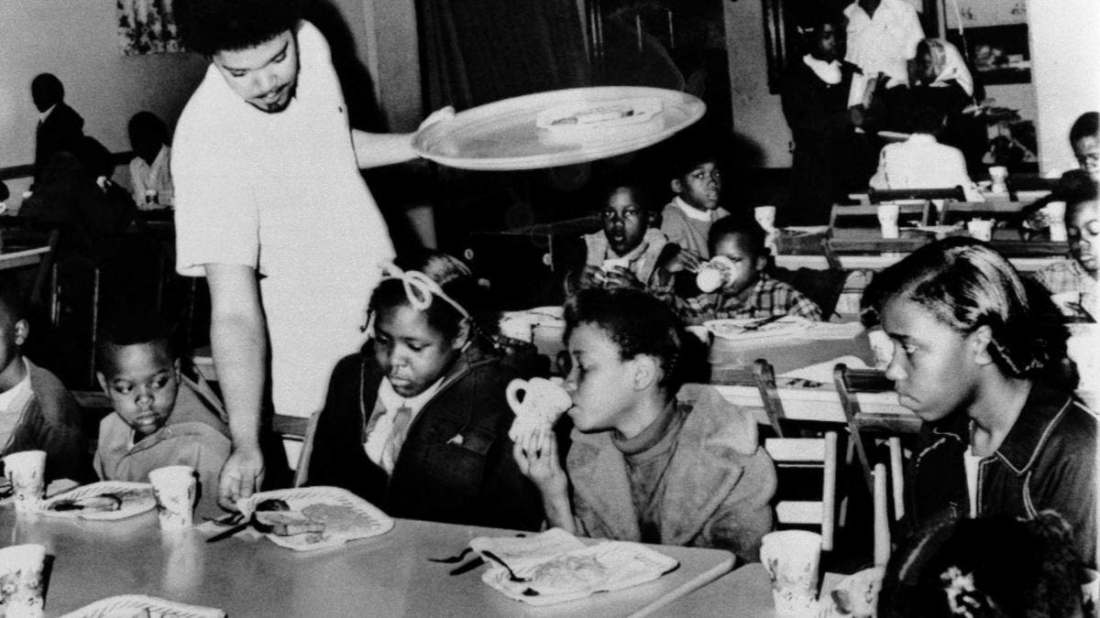
On a Free Breakfast

We in the west generally believe that the “free school lunch” is something that children in need should have access to in order to achieve academic excellence. That concept is fairly new in education, and there’s even some pushback in some quarters today with an increasing number of people questioning whether it is the responsibility of publicly supported schools to provide that nutrition. However, the argument has been made and the prevailing attitude is that free school lunches should be provided.

Interestingly, that type of free food program for lower income children started not because of a government program but began through a non-profit, private organization that worked in inner-city communities to better the lives of the citizens there. The first free meals for poor kids weren’t lunches, either, actually, but they were breakfasts. This group, a group that also had political goals, began serving low income kids in poorer sections of Oakland, California, in the late 1960s. They knew that people would be more receptive to their ideas if they were a positive contributor to the community to begin with. A local Episcopal Church building was used by this organization to give the free breakfasts to the kids. The volunteer group had gone to local grocery stores to solicit donations and had even consulted with nutritionists to see what types of food would pack the most punch for the kids throughout the day.

The results were astonishing.

Teachers and the school administrators reported almost miraculous improvement among their students who were receiving the free breakfasts before school. Test scores, good behavior, attendance, and over-all well-being showed significant increases. The kids were attentive as well; teachers said that the fed children stayed alert longer, they weren’t getting sick as much, and their prospects for school achievement increased. The volunteers were thrilled with their report card; they quickly expanded the program to other communities across the US. Schools in low-income neighborhoods of Detroit, Chicago, New York, and other large cities began reporting similar results to those in Oakland. The program was a success.

And that’s right about the time that the United States government began to take notice. Mainly, one agency of the federal government took umbrage with the efforts of the group. You see, the head of this governmental agency was such a racist that anything that helped minority people was seen as a threat to the nation in his eyes. He declared war on this program and its volunteers. He began ordering his offices around the nation to begin a whisper campaign against the free breakfast program. Parents were sent notices (ostensibly from the schools themselves) hinting that the group was secretly poisoning the children with the free food. And he ordered them to begin photographing the children as they left the places where they ate in an effort to intimidate the kids and pressure them to not return. The free breakfast program was shut down through this systematic harassment by the government.

What type of governmental bureaucrat–no, what type of human–would stoop so low? The program was good; it was free; no tax money was being spent, and the positives overwhelmingly outweighed the negatives here. Who would do this type of thing?

Well, luckily, cooler (and less racist) heads prevailed. Seeing the benefits of the program, the US Office of Education (what the Department of Education was before that agency was set up in the late 1970s) began offering free lunches and free breakfasts to low-income families. The program started by the volunteers in Oakland in the ’60s was reborn, and millions of low-income children have been helped.

But that success never would have happened if J. Edgar Hoover hadn’t’ve hated the Black Panther Party so much.

On a Whim

The Abraham Family had left India and immigrated to the United States. There, they embraced the new nation and its culture, history, and heroes. One day, the husband and wife, with the wife’s mother and infant daughter in tow, decided to do one of the most American things you can do–take a road trip.

This was November 1969, and the nation was in the middle of social unrest and upheaval. The 1960s had been a kidney stone of a decade. The decade had seen assassinations and wars. It amplified much of what had separated the disparate parts of America, putting us against each other in tribes of youth verses establishment, black against white, immigrant against native-born, and pro-war against anti-war. Yet, that is part of what made the Abrahams want to see America’s heartland, to seek out what made their newly adopted nation tick. So, they went to Ohio.

Wapakoneta, Ohio, probably doesn’t rank high on most people’s travel destination lists, but the Abrahams thought it was the perfect American place to see. So, they stopped in the town that today boasts less than 10,000 souls and rests between Toledo and Dayton. Anisha, the infant child, doesn’t remember the trip, but she talks about that visit to Wapakoneta to this day. You see, the reason she talks about that trip is that her family–both adult women wearing saris–decided to knock on the door of one of the houses in the small Ohio burg.

The older couple who lived there were named Stephen and Viola. Now, most people wouldn’t open the door to strangers in a small town, especially obviously foreign strangers. But Stephen and Viola did. Not only did they open the door, they welcomed the newly minted American multi-generational family into their home, the family who knocked on their door on a whim.

There’s a photograph that Anisha Abraham cherishes of that day. Standing on the front porch of Stephen and Viola’s house in that small Ohio town, we can see the three Abrahams, we see Anisha’s grandmother, and we see the welcoming Ohio couple who chose to open their house and hearts to this family. Viola, wearing a coat against the November chill, holds little Anisha. The men wear ties against white shirts. In many ways, it’s an odd composition, but it represents much of what is wonderful and good about the American Experiment: A spirit of camaraderie, a unity that brings disparate backgrounds and races and beliefs together and somehow makes them all, well, American.

Oh, and the photo was taken by Stephen and Viola’s 39 year old son, who just happened to be home visiting his parents that day. On one hand, it would have been great to have had a photo with him in it, but, in a way, it’s ok that it didn’t.

Still, not every immigrant family to America has proof that they knocked on the door of Neil Armstrong’s house on a whim.