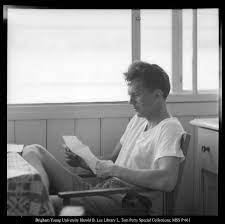
On a Young Hobo

Hobo is one of those words of which we have no clear etymology. However, the word is in our vernacular and has been since the 19th Century. During the Great Depression in the United States, the roads and railways were clogged with young men (and a few women) who were traveling around looking for work, food, direction. With almost 25% unemployment, it’s no wonder why. My uncle Bubba (his name was Melville Carr Baker; that’s why everyone called him Bubba) told his tales of riding the rails in the 1930s from town to town.

Another young man who did this was one Arnold Samuelson. From Scandinavian stock in the American Middle West, Arnold had finished his college work and was, like most men aged 22, uncertain about his future. That’s when he decided to stick his thumb out on the highway and travel the United States, to see what there was of the amazingly large nation. Eventually, Arnold found himself sitting on top of a boxcar as it made its way down the bridges from Miami into Key West, Florida, the southernmost point in the nation on the East Coast. When he arrived in Key West, it was almost summer, the time when people at that time left Florida to escape the heat and mosquitos.

That first night in Key West, Arnold slept on the dock; the sea breeze kept the bugs at bay. But the next night, a couple of local policemen said he couldn’t sleep in public and offered to put him in their holding cell for the night. One rule of being a hobo, at least according to Uncle Bubba, was that you never said “no” to the police. So, Arnold went with them. That started several days of walking around the town during the light and sleeping in the mosquito-filled jail cell at night.

On one of his walks about the town, Arnold found himself in front of a large, older, typical Key West house. He knocked on the door, and a burly, shirtless, mustachioed man came out and confronted him. Arnold stammered hello, and the man asked him, brusquely, “Waddaya want?” Arnold sketched out his tale to the man, and he could see that, the more he explained his situation, the more relaxed the man became. “So, you just want to chew the fat?” the man said with a smile. Arnold nodded. The man said that he was busy, to come back the next morning and they would sit on the porch of the man’s house and have a proper talk. Arnold agreed. That began several days of Arnold waking up in the jail, scratching his new bug bites, then coming to the man’s house and having deep, meaningful conversations about life, love, art, and Arnold’s favorite topic, writing. The man was quite knowledgeable about many topics and filled with good advice and helpful life-tips for the young hobo.

“If I wished to learn about writing and about life,” Arnold asked him one day, “what books should I read?” The man got up and got a piece of paper and a pencil. He made a list of books for Arnold to get and peruse. “Those’ll teach you about what you need to know,” he told Arnold. One day, the man gave Arnold the news that he had to take his boat up the coast. He asked Arnold to do him a favor. “Say,” he said, “would you want to come along? You can live on the boat and watch out for it when I’m not on it.” Arnold eagerly agreed. He couldn’t believe his good fortune. He ran back to the police station and grabbed his tattered bag, thanked the cops, and ran back to the man’s house. That was the beginning of a whole year of sailing on the Caribbean with the man and his fishing buddies and other assorted guests. The man paid him a dollar a day, and Arnold was deliriously happy.

Arnold never did become a famous writer, but he did publish an interesting book about his experience there.

It’s called, With Hemingway: A Year in Key West and Cuba.
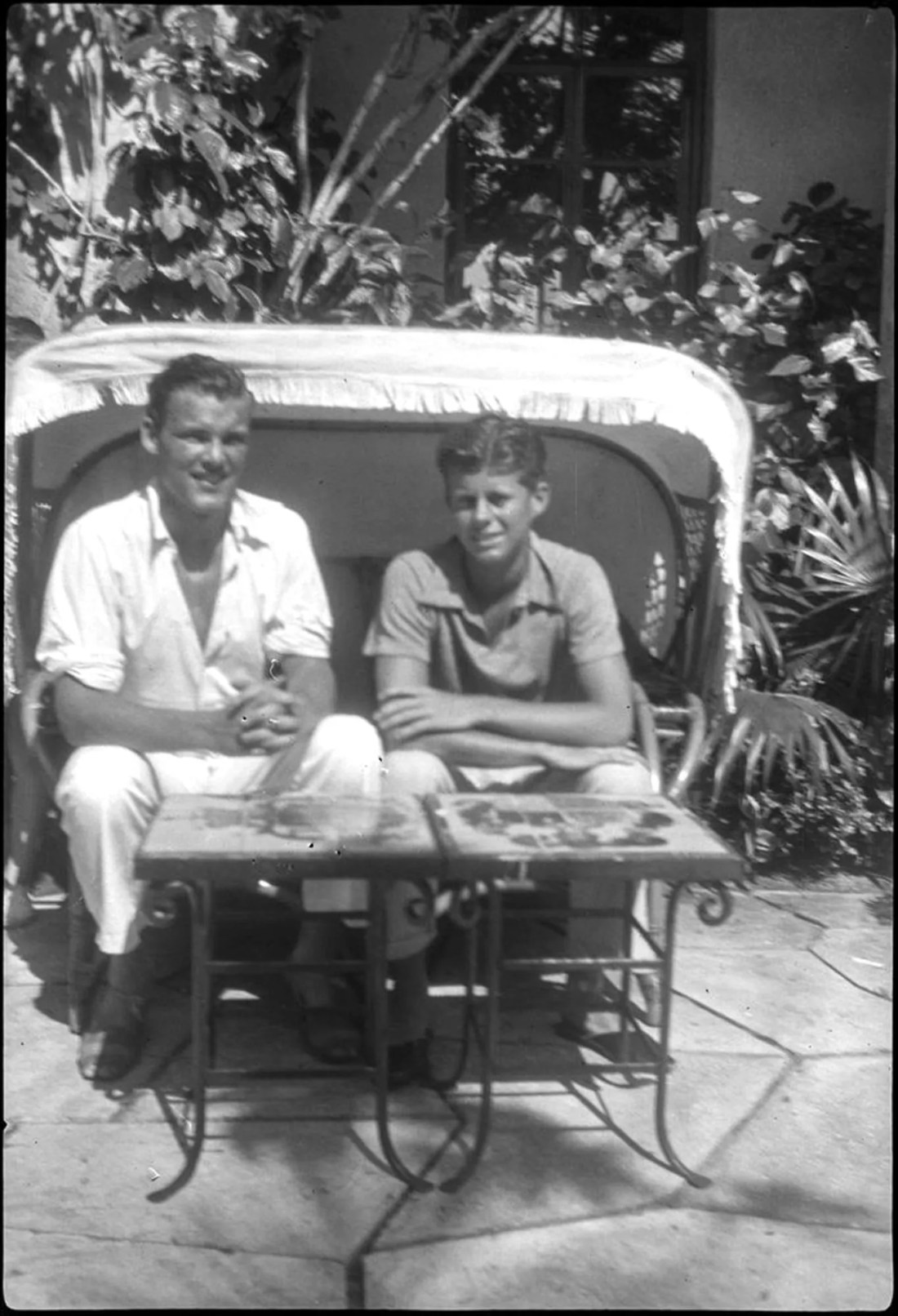
On A Loyal Companion

People say you’re fortunate if you have one or two people in your life outside of your family in whom you can completely confide and on whom you can completely count. Lem had such a friend in John. The pair met at a prestigious prep school, Choate, in the 1930s. Both boys were from wealthy families in the Northeast, and both came from families where the father was largely absent and distant. So, in many ways, it was quite natural that the two would become best chums.

They roomed together at the boarding school for several years. In fact, Lem, a year older than John, thought so much of the friendship that he agreed to re-do his senior year so he could graduate with his best friend. And John was forever grateful for Lem’s sacrifice. They formed a secret society, called the Muckers, whose aim was to play pranks on the staff and on the school at large. Each young man needed someone in his corner, someone who would have the other’s back unreservedly. And they were indeed that for each other. Then, in 1937, the pair spent that summer traveling around Europe. The bond between the two grew even tighter.

Now, at this point, we have to say what you might be thinking. Yes, there was a sexual attraction in play here, but it turned out that only Lem had romantic feelings. John didn’t, but that didn’t stop John from loving Lem as his best friend and closest confidant. John knew that Lem was gay. While Lem would have preferred something more that best friends, he was content that John was in his life in that role if nothing else.

And that’s the way the relationship remained. Lem was in John’s wedding. John’s wife would later joke that her marriage to John came with a built-in houseguest because Lem was always staying over. He often spent holidays at John’s family’s house, and, to keep people from gossiping, he even took John’s sisters to social events. But, society being what it was then, Lem had to remain in the closet.

Both young men served in World War 2 with distinction. They remained close after the war. In fact, they roomed together for a while as bachelors as John began his career and Lem put off attending Harvard Business School for a graduate degree. As John’s career took off, Lem became his closest advisor and confidant, a role he’d had since the two were at Choate together. He was at John’s side when John faced the toughest decisions of his life. John offered Lem positions that would let them work together, but Lem turned them down. He felt strongly that working together would somehow change the nature of the relationship, and he didn’t want to run that risk. John appreciated that sense of love and loyalty in his friend for the rest of his life.

So, yes; having a close companion and a loved and trusted best friend is a rare and precious thing. But the fact that he was gay is a major reason you don’t know the important role Lem Billings played in the life of John F. Kennedy.

On An Exodus Route

The 1930s could be seen as the most pivotable decade of the incredibly violent and paradigm shifting 20th Century. Hitler (and Roosevelt, too) came to power. Japan invaded China. Italy attacked Ethiopia. All of that sets up World War 2 that began in 1939. None of those events begins to look at the absolute disaster that the worldwide Great Depression brought upon everyone.

It’s difficult to fathom 25% unemployment. We can’t imagine not being able to use banks for our economies. A large segment of the population simply not being able to eat is beyond our ken in most of the western world today. Yet, all of that happened in the United States in the 1930s. We have since learned that the Great Depression didn’t begin when the Stock Market crashed in 1929. The grim descent into economic collapse that bottomed out in early 1933 actually started for farmers a few years earlier.

Farmers began to feel extreme economic pressure in the 1920s due to several factors. First, small farmers were finding that they could not keep up with the emerging economy of scale as large, corporation-owned farms began to emerge and started to squeeze prices verses the costs of farming equipment. This forced many small farmers into bankruptcy. Secondly, the middle years of the 1920s saw extreme drought in much of the farm belt mid-west. Finally, outdated farming methods exhausted land and made it useless and unproductive. The result is known as the Dust Bowl, where farmers found that their land literally dried up and blew away.

One of the hardest hit areas was Oklahoma, Texas, Arkansas, and Missouri. So, desperate for food and for ways to provide for their families, many of the farmers there simply abandoned their farms and moved to California. And the route these desperate people took to get to California was along a highway that was one of the first numbered roads in the United States when it was constructed in the early 1920s. It ran from Chicago to Santa Monica, almost 2,500 miles and through seven states.

When John Steinbeck wrote his epic novel, The Grapes of Wrath, he depicted the fate of these Dust Bowl farmers, and he used this same highway as a metaphor for what was happening to the people. He said it represented both despair (the place they were leaving) and hope (their destination), and he likened it to the route the Hebrews took in the Bible from slavery in Egypt to the Promised Land, a journey known as the Exodus. Steinbeck termed the route The Mother Road of America because it birthed a new way of living for these migrants who were so desperate for a start-over. Because they were united by the journey and, thus, the route, Steinbeck pointed out that the journey itself became a unifying experience, an shared moment in history, for these desperate farm families. Think of it as a poor, poverty-driven “on the road” story.

The highway, as you know, is labeled Route 66. Today, it is used by vacationers and tourists, cyclists and RV-ers, people who travel the route for fun and adventure. Most of these travelers probably do not realize that it was the road used by over 300,000 Americans in the 1930s who left behind a dry and barren land for the vision of a green and prosperous Promised Land during our version of the Exodus.