On Crying in Baseball

Tom Hanks’s character in the film, A League of Their Own, Jimmy Dugan, chews out one of the girls he manages in the story, and she bursts into tears. “Are you crying?” Jimmy asks, incredulously. “No,” the player says through her sobs. “There’s no crying in baseball!” Jimmy yells at her.

Nobody told that to Charlie. He loved the game of baseball, but he grew frustrated when he struck out. Often, after a poor performance at the plate, Charlie broke down in tears. His coach and his teammates would try to console him when he cried, but they rarely could make him feel better. Charlie simply loved the game that much.

Now, let’s be realistic here  It’s baseball. You’re going to strike out—often. Even major leaguers who hit the ball safely only 3 out of ten times (batting .300) are among the best players in the game. Failure—on a statistically significant scale—is a major part of the equation.

All of that doesn’t explain why Charlie’s strikeouts pained him so. He knew consistent success actually hitting a baseball was statistically impossible to maintain. His dad, also named Charles, and his granddad, also named Charles, often worked with him to lower his strikeout rate. But he could never get over hearing, “You’re out!” screamed at him by the home plate umpire.

You might well ask—why not quit, Charlie? Maybe your temperament, your passion for excellence might be better served in some field more suitable to your emotional needs. Of course, you might be thinking that Charlie is a little leager, a kid who has issues that could work themselves out as he matured.

Well, yes and no. In many ways, Charlie was a kid all his life. He had a boyish, goofy grin and a shock of sandy hair that gave him the look of a perennial summer day.

But, if you think Charlie—the Charlie that cried after strikeouts—was some kid in a little league park somewhere in America, you would be wrong. He was a major leager himself. And he still cried after strikeouts.

You see, Charlie didn’t go by the name “Charlie.“ His dad had chosen a first name for him from the name of his favorite baseball player, a catcher named Gordon Cochrane. Except Gordon had a nickname—Mickey—that Charlie’s dad chose as his son’s first name.

That’s why you know this crybaby as Mickey Mantle.
 

On A Co-Worker

Nancy, in her retirement, looked around her and decided that, in the world of 1984, it was better to take an active role in the politics of her area than simply complain about them. So, after much thought and discussion with friends, Nancy filed papers to run for political office. She entered her name in the Democratic primary in Pennsylvania for the office of US representative. To her surprise, she ran unopposed and became the Democratic nominee.

Her opponent that year was an incumbent Republican in a district that was also heavily leaning towards that particular party. That’s why she ran unopposed; the election was going to be an uphill battle from the get go for any Democrat. 

However, Nancy had a great attitude. She had made a living outside of politics, you see, and she pointed to other “outsiders” who had become successful in politics – even actors like the current president at the time, Ronald Reagan. Besides listing her years in military service before her career, Nancy felt strongly that listening and caring mattered more than resume. She made an effort to try to connect with voters in the district, and her strategy proved effective. In fact, Nancy polled far better than many people expected, at least at first. 

Then, an outsider became involved in the race, much to Nancy surprise. A former coworker of hers, a man named Frank, a man who was well-known and well respected nationally, volunteered to make a free advertisement for her opponent. 

Nancy was hurt deeply by this. The ad, which ran on radio, labeled Nancy as being way too liberal to represent Pennsylvania values. The ad proved effective, and her numbers tanked.

Why would this former coworker do this to her? The two had not had much contact in the previous almost 20 years or so. While their relationship when they worked together was not cordial by any means, it was certainly professional and, she thought, respectful. “He is not the kindly old man that everyone perceived him to be,“ Nancy said about him later

Was this unsolicited ad against her the decisive event of the election? No, probably not. Odds were that Nancy would have lost anyway. It was the fact, however, that this coworker from almost two decades before would offer himself, completely unsolicited, to her opponent and to say things that would hurt her publicly. That was a wound that cut Nancy deeper than the 2 to 1 margin of defeat she suffered at the ballot box.

To her family and friends, Nancy never allowed Frank’s name to be brought up in conversation. She died a few years later, still not quite sure why such an attack against her was warranted.

By the way, before her foray into politics, Nancy had also made her living the same way as Ronald Reagan. She was an actress who played minor and secondary roles for her entire career. Frank had been one of her costars in one particular show that you probably have seen or at least have heard of –The Beverly Hillbillies. 

Nancy played the secretary of the bank president where those folks from the hills had their millions stashed. In reruns over several decades, Nancy Kulp’s Ms. Hathaway has almost become the prototypical secretary/fixer for executives or wealthy businessmen. She played the part for the entire run of the series. 

Meanwhile, the costar and the man who voluntarily smeared her in her congressional campaign, the coworker who hurt her so badly, was Frank “Buddy” Ebsen, who played the starring role of Jed Clampett. 

On an Ad Man

Ted grew up in Springfield, Massachusetts, wanting to be a professor. His immigrant Dad, the manager of a brewery, approved of this career choice because Dad wanted a better life for his son.
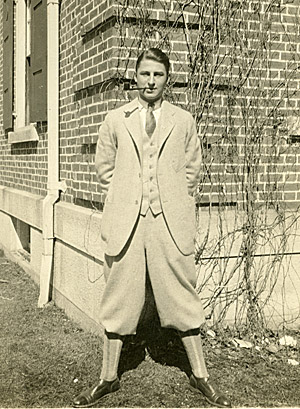
After finishing college at Dartmouth in the mid-1920s, That’s Ted at college in the image above. Ted chose Oxford to study English literature in preparation for exactly such a career. While at Oxford, Ted met a woman there, Helen, who convinced him that his real talent lay in a fairly new but potentially lucrative field: Magazine cartooning.
You see, Ted like to doodle, and he made funny drawings that elicited laughter from this woman. The pair hit it off and were eventually married. Ted returned to United States without completing his degree to pursue his new career in cartoons, attempting to sell to large magazines. This new career proved successful.
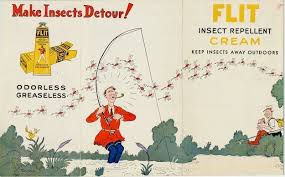
Then, in the 1930s, Ted expanded his graphic art talent into advertising, and he created several nationally successful advertising campaigns for such large corporations as Standard Oil, Ford, and NBC. That’s one of Ted’s ads in the picture below (for a product called Flit, an insecticide).
download
Between the magazine work and the advertising, Ted became wealthy, eventually making more money than many of his rich Dartmouth classmates. He and Helen traveled the world, which Ted felt helped his creativity. They lived a nice life. Children were not important to either of the couple. In fact, his wife once noted that Ted lived his whole life without kids and was very happy without them. Frankly, Ted never really liked children and often felt awkward around them.
This is important because, in 1936, Ted decided to write a children’s book. Helen had written some successful books for kids, and she encouraged Ted to give the genre a try. Perhaps not having a lot of experience around kids wasn’t the best background for writing a children’s book because Ted later said that the manuscript was rejected by over 40 different publishers. But, he persisted, and the book was eventually published by the firm one of his old Dartmouth classmates.
The book was a success, but, then, World War II broke out, and Ted found that he was a bit too old to join the military. So, he went to work creating political cartoons that helped the allied cause. He brought the same wonderfully creative energy to this patriotic effort that he had to the national advertising campaigns. Ted’s work proved to be incredibly influential in keeping both morale high at home and public opinion overseas pro-American.
After the war, rather than returning to the lucrative ad work, Ted resumed his book writing career, again targeting a children’s audience. One of his friends challenged him to create a book that was interesting to kids and that used a vocabulary of only 50 words. Ted accepted the challenge, and that book, too, became successful.
Wildly so.
You’ve read it, in fact.
Green Eggs and Ham by Dr. Seuss.

On Johnny Football

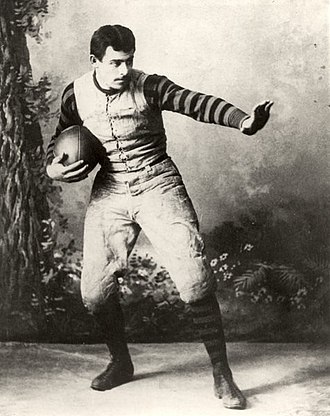
Look at this guy in the photo above. Call him Johnny. He grew up in Cleveland, Ohio, and he played college football for Brown as an undergrad and for Penn as a grad student in law. 159 pounds of pure, uhm, gumption, Johnny played center. That was small for a lineman, even in that pre-1900, no helmet period of college ball.

Johnny’s real love, however, was acting. He had a deep, booming voice for someone who was fairly short and imperially slim. While still a high schooler, Johnny carried himself with somewhat of a theatrical air. His speech at graduation (he was the class valedictorian) was on The Dramatist as Sermonizer. Later, when Johnny decided to marry, he even married an actress.

He chose a career as a professor and, since he had played in college, a football coach. But acting and the stage never left his soul. During the off-seasons from his sport, he raised money for his teams by starting dramatic societies and putting on plays in which he often starred. One college paper at a poly-technical school at which Johnny taught gave a rave review of one of his performances, saying that, “He acted not like an amateur, but like the skilled professional that he is.”

His elocution and diction were perfect. His dramatic and even comedic timing was impeccable. His stage presence was riveting. Johnny used his not inconsiderable talents to win parts in some Broadway productions, and he acted in several plays off-Broadway as well. He toured with a southern dramatic company one summer, and eventually opened his own acting company and then, later, theatrical production company which both bore his name. His influence became so great that after his death from pneumonia at the age of 66, a musical was written about him and the rather odd mix in his life of football, teaching, and acting.

Oh, perhaps you wonder why you don’t know about this football player turned teacher and actor. Today, people around major universities and their supporters certainly know about him, but not for his acting abilities. In fact, there’s a major college prize, awarded yearly, that’s named after him, but it doesn’t go to the best collegiate actor.

No, it goes to the best collegiate football player.

It’s the Heisman Trophy.

On A Monstrosity

Paris often hosted world fairs in the 19th century. The French prided themselves for being on the cutting edge of engineering, the arts, education, and technology. The world fairs in Paris showcased all these and more to an eager world. The 1889 world‘s fair was no exception.

This time, the event was held in honor of the 100th anniversary of the fall of the Bastille, the seminal event in what would become the French Revolution. France held a nationwide contest for designers to create pavilions and buildings and art that would celebrate this historic event and showcase French ingenuity to the rest of Europe and the world.
A civil engineer named Gustave entered his design for the architecture exhibition. At first blush, Gustave seemed to be out of his depth, somewhat—at least that’s what most people thought. He had built his professional reputation on erecting railroad bridges. True, he had built some railroad stations around the world, but they were not remarkable.
But, in many ways, Gustave was a good representative of France as an international power at that point in the national history. His bridges and buildings were found all over the world; Chile, Vietnam, Venezuela, Romania, Brazil, Spain, Portugal, Peru, and even parts of Africa all had seen Gustave’s works erected. Many of France’s colonies had railroads that ran across bridges built by Gustave.
Gustave found, to his own delight and to some other, more prominent builders’ dismay, that his proposal was awarded the contract, and work began on his project. He only used 200 men to complete his structure, and he pre-fabricated much of the work in his shop. Then, he had it shipped down the Seine River on barges to the worlds fair construction site. One historian recently said that the work was put together much like a modern 3-D puzzle.
When the structure was finished, the public and professional reception came pouring in. And, almost to a person, people hated it. “It’s an embarrassment,“ seemed to be on the mild end of the spectrum, while comments such as “Even the Americans would not build such a thing as gauche as this” occupied more of the middle of the road reviews. Decorum prohibits this blogger from detailing the reviews from some of the more nasty critics of that time.
“Well,” some people reasoned, “this national embarrassment, this public monstrosity, will only be around for a few years, and then it will be torn down. Thank God!“
Yet, Gustave was not to be daunted. He felt that history would treat his creation kindly.
And so it has.
For, you see, Gustave‘s last name was Eiffel. His tower is now probably the foremost symbol of the illustrious French nation

On Attacking Orleans

The town of Orleans was named, of course, for the French family of royalty.  The Valois-Orléans family provided several kings for France. But this post is about attacks on the town during two different world wars.

The first “world war” was, arguably, the Napoleonic wars of the early 1800s. Orleans was attacked by the British from the sea during this war, causing its inhabitants to develop a strong dislike for all things English. These British attacks destroyed property, livelihoods, and caused enough damage that it took several years for the area around Orleans to recover economically.  In fact, in a war some 25 years earlier, the British had even captured the town—twice. So, hostility towards the British spanned several generations in and around Orleans. 

Ironically, in one of the next world wars, the Great War, also known as World War I, these residents of Orleans found that the British were their allies in facing the Germans on the Western front of France. The Germans , like the English attackers before them, attacked Orleans by sea. The intent of the attack, apparently, was to destroy some supplies that have been stored in the town.

However, the shelling by the German guns didn’t do the damage the British had done almost 130 years before.  The attack occurred on July 21, 1918. A German submarine shot its deck guns at the town and also destroyed a tow boat and some barges. Luckily, no fatalities were incurred.

Now, it’s possible that some of you may have spotted something curious in the paragraphs above that describe the attacks on Orleans. “Wait,” you might be saying. “Orleans France isn’t a coastal town. How could the British and then the Germans attack Orleans by sea?”

The answer is, of course, this post is not about the city of Orleans in France. And it’s not about New Orleans in Louisiana, either. No, it is about the Orleans (population +/- 6000) that is located on Cape Cod in Massachusetts.

Yes, the British captured the town twice during the American Revolution and caused damage during the War of 1812.  These attacks are why the citizens chose the name Orleans; they wanted no English-sounding name associated with their town.

However, it was the attack by the German U-boat in 1918 that really put Orleans on the map. You see, it is this attack that is remembered in history as the only time Germany attacked the land of the United States during WW1. 

True, it’s likely that the U-boat captain was only trying to damage the barges and tow boats in the harbor, causing some of his shells to miss their mark and land in and around the town. But, at no other time during World War I did Germany attack the soil of the United States—except at Orleans.

On a Borrowed Flat

Harry traveled a lot in his business. Work took him to London and then back to the US quite often. It made sense, then, for him to by a little place “across the pond” for those times when he needed it.

This being the 1970s, and him being a man who enjoyed the cacophony of intoxicants available in that era, Harry found a place close to swinging London’s nightlife. And, having some money and being young-ish, he met several others in the same business as he. And Harry’s friends liked to crash at his well-positioned pad. Which was fine with Harry. He didn’t mind at all. In fact, when business called him back to the states, he would let friends stay extended periods in the one bedroom flat.

Ellen was one such friend of Harry‘s. She needed a place, short-term, because she was going through some changes in careers but had managed to land a gig in London theater district. You see, Ellen had enjoyed some success with a troupe when she was younger, but, now that she was 32, she wanted to strike out on her own.

That proved to be difficult for her. Ellen had a weight problem. No matter what she did, she never seemed to be able to be as thin as other girls in her branch of the entertainment business. She saw this new opportunity as a chance to start over. So, she was thrilled when her friend Harry let her stay at his flat while she tried to get her life together.

Sadly, after only her second performance, Ellen died in Harry‘s apartment. Years of being a large person, along with several crash diets, had damaged her heart. The autopsy revealed there were no drugs in her system; her heart simply gave out. Harry was deeply saddened by this. He always thought Ellen had talent.

Four years passed, and Harry still had the apartment. Another friend in the entertainment business, a guy named Keith, asked Harry if he could use the apartment for a few weeks. Harry wasn’t sure. He somehow felt that the apartment brought bad luck. He told this to Keith, but Keith shook it off and said something to the effect that there’s no way lightning would strike twice.

Like Ellen, Keith was working through some personal issues. However, Keith’s issues dealt with alcohol abuse. His doctor had given him medicine to help him combat the addiction. One morning, Keith, who was also aged 32, simply took too many of the pills prescribed by his doctor and died in his sleep in the same bed where Ellen had died four years earlier.

This was too much for Harry. He sold the flat. In fact, he sold it to a good friend of Keith’s – – a guy named Pete.

You probably know Pete. Pete Townsend? And Pete’s friend, Keith? You probably know him, also. Keith Moon.

Ellen you probably also know. She didn’t go by her birth name professionally, however. You probably know her as Cass Elliot – – Mama Cass.

And what about poor Harry?

As stated above, Harry was a partier. Even though he didn’t die in that bed in that apartment, he still died in his mid-50s because his body couldn’t take the overindulgence that he subjected it to over the years of being a rock ‘n’ roll musician.

At his memorial service, the proceedings were interrupted by a strong earthquake. Someone joked that Harry Nilsson must’ve made it to heaven and found out that there weren’t any bars.

On The Knowledge

This blog says it is about, in part, learning and knowing. That brings us to the City of London. London is home to over 8 million people, and Charing Cross sits in the heart of the city. Six large streets intersect at that site. Over 25,000 streets are laid out within a 6 mile radius of that spot. Theaters, restaurants, government buildings, embassies, and most major tourist attractions are found in this area.
It’s been said that someone could eat at a different restaurant for breakfast, lunch, and supper for 20 years and never eat at the same restaurant twice in the city of London. Many of these restaurants are in that same central, downtown area.
Finding your way through this byzantine maze of spiderweb streets and alleys requires almost superhuman knowledge and memory. You may wonder how long it would take to learn how to maneuver from one place to another in this densely packed urban landscape.
Fortunately, we have an answer to that: 34 months.
Taxis have been in London for about 500 years. It’s been said that the first taxis were the used carriages of the wealthy Londoners. Eventually, the legal right to drive a taxi in London became standardized in the early 19th century. It was then that it became a requirement for taxi drivers to have a basic knowledge of the city and how to get about it.
Today, this knowledge is called, well, The Knowledge. If you want to drive a black London taxi cab, you must possess it. And it requires more than simply learning the tens of thousands of streets in the city.
images
London cab drivers must learn the streets and how to get through the city, certainly, but that is only the beginning of The Knowledge. In addition, taxi drivers must know the attractions, the hospitals, the businesses that are in the buildings, all those restaurants at which you could eat a different meal for all those years, and drivers must be able to tell passengers every location of every theater in London’s West End—in order in which they sit on the street.
This incredible feat of memory must be done within a process that averages 34 months in length in order to qualify to be a cab driver. Using a map, relying on phones or consulting navigation devices or even asking for information over the radio is something a possessor of The Knowledge would simply never do. Traffic issues ahead on this route? A London cab driver should be able to instantly switch to one of the other 319 standard routes through central London by tapping into The Knowledge.
Neophytes training in The Knowledge begin by learning routes on a motor scooter. As they train, teachers and examiners quiz them on crossroads, roundabouts, and what is on either side of them as they whiz along the London streets. And the system seems to work well. Researchers have found that the area of the brain used for memory and navigation, the hippocampus, is altered in cab drivers because of this training.
So, when you hop into your next Uber or Lyft in London, know that you’re depriving yourself of one of the greatest collections of information on the city that you could ever have: A London cab driver.

On a Scientific Exhibition

Edouard Scott was a printer, writer, and inventor in Paris. He lived from 1817 to 1879. He liked to tinker with things and ideas in his shop.
In 1878, Paris celebrated the nation’s recovery from the Franco-Prussian War by hosting one of the first world’s fair. The Paris Exhibition drew international interest from inventors and investors as well as the public, all eager to see what new creations the modern world had created. An early prototype of a monoplane was brought to the fair, Graham Bell’s telephone had a booth there, and the French proudly displayed the head of a giant statue they planned to gift to the Americans–it is known today as the Statue of Liberty. Paris, the City of Lights, even electrified its streets in the area surrounding the exhibition to provide visitors with a nice glow well into the nights. Painting exhibits, music competitions, and dance routines were also shown. International committees on copyright laws and even organizations regarding rights of blind and deaf people convened and set standards for their groups that lasted decades.
download
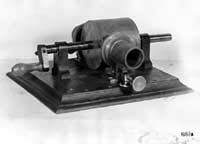
But most people concentrated on the new inventions hall. One exhibit that caused great excitement was by the American inventor, Thomas Edison. The machine Edison put on display purported to show how sound could be captured and reproduced. The concept intrigued Edouard Scott, and he eagerly made his way to the exhibition hall to see the phenomenon for himself.
Sure enough, there it was. The Edison machine had a cone-like projection that captured the sound and put it on a tin foil roll. The exhibition of the new Edison invention, which he called the phonograph, caused a stir among the scientific community in France. Scott was suitably impressed. He asked pointed questions of the curators of the exhibition, showing a good grasp of the technology involved.
The public loved the machine. Edison, ever the capitalist and cocksure of the impact his new invention would have on the public, had even contracted with a local French manufacturer to put his hand-cranked tinfoil voice recording machine on sale.
Scott walked around the Edison exhibit and became more and more depressed. He made his way home slowly. Entering the hallway of his house, he took off his hat and made an announcement to his family.
“It’s my machine.”
You see, Scott invented something similar…20 years earlier in his shop. Instead of tinfoil, Scott’s contraption used charcoal and a stylus to record his own voice singing and talking (1860) and to record a cornet playing a scale (1857). These are the earliest recordings in history.
The design for his machine still sits in the patent office in Paris today. Researchers have found some of his recordings on the old charcoal sheets in the archives of the patent office and have digitally remastered them and found them to be similar in quality to the early Edison efforts.
Heartbroken that his own efforts had been overlooked, Scott died a year later.
His body lies today in an unmarked grave.
Scott had named his machine the Phonautograph.
Take a look for yourself. Here’s Edison’s contraption:
tinfoilsm
And here’s Scott’s:
phonautograph
Only in recent years has Edouard Scott begun to be recognized for what he should be: The real inventor of sound recording.

On a Vaudevillian


Vaudeville is largely unknown by most people in the world today. 120 years ago, vaudeville was the major form of entertainment in most small towns. Films were in their infancy, and they had yet to make an impact in the American psyche.

Vaudeville acts would tour the country, and, if you lived in a certain town, you might see a different act every week at your local theater. The act would contain everything from musical numbers to small dramatic works, magic acts or even trained animals.

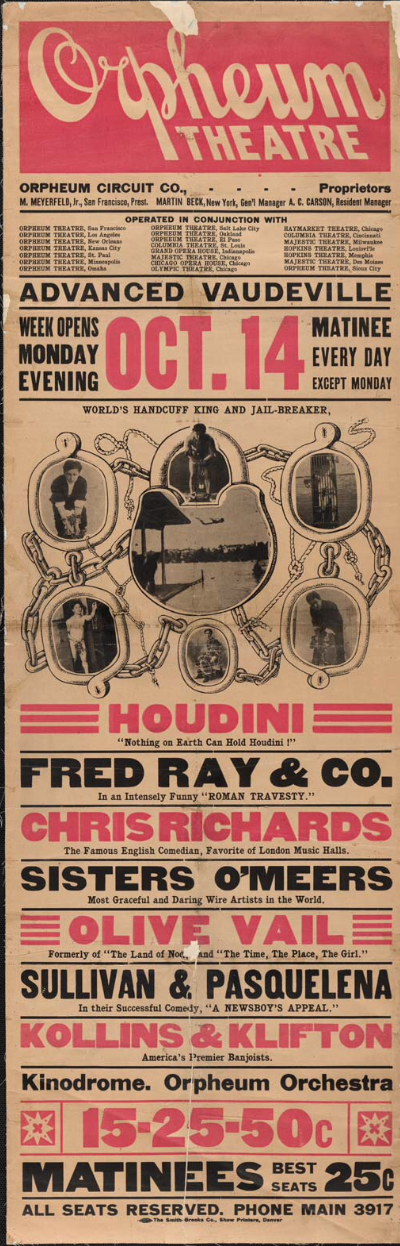
A baby named Joseph was born to a vaudeville family in 1996 in a small town in Kansas. Joe was born there simply because that’s where the family happened to be performing that night. So, it is entirely fair to say that Joe was born to the stage. His dad partnered with a magician who would later go on to great fame, a guy named Harry Houdini. Joe’s dad would perform with his wife and, after Houdini did his magic act, Dad would also sell elixirs and patent medicines to make a few extra bucks.

Joe got in on the act within a few months of being born. As his mom would play the saxophone on the side of the stage, Joe’s dad would toss his young son around the stage, and the baby would giggle. This delighted audiences after they recovered from their initial shock of seeing a child being thrown around so casually. But Joe learned early how to land like a cat; he later said that the secret was to go limp and then catch yourself with an arm or a foot. “Most people don’t last long in this business because they don’t know how to do that,” he explained.

Early on, Joe realized that the laughs from the audience would be greater if he did not giggle so much when his dad tossed him around so cavalierly. So Joe learned to show no emotion during the act. His deadpan face caused the audience to roar even louder. That meant more money for the family.

Years passed , and Houdini left the act to go on to bigger and better things. Joe’s dad began drinking heavily. The family tried to improve their fortunes by going to the UK on tour, but that venture failed miserably and put the family in debt. Joe’s mom eventually took her son and came back to the US. More years passed, and Joe served in France in the army during World War 1.

In New York City, Joe met a guy who worked in the burgeoning new film industry. On a tour of a New York studio, Joe expressed his fascination with the medium, and he asked if he could take one of the cameras home with him. There, he took the contraption apart and looked at it carefully. The next day, he came back and asked for a job and was hired as a bit player and “gag man.“

By 1920, Joe earned his first starring role in a full-length motion picture. Soon, he was one of the biggest stars in the genre, writing, starring in, and even directing his own films.

In an interview, he talked about his early days in vaudeville and how he got the nickname by which he became known around the world. “As a baby, I fell down some stairs and landed at the bottom without being hurt. Harry Houdini laughed at that and said, ‘That boy’s a real buster!’”

Thats why you know him as Buster Keaton.