On a Wheelman

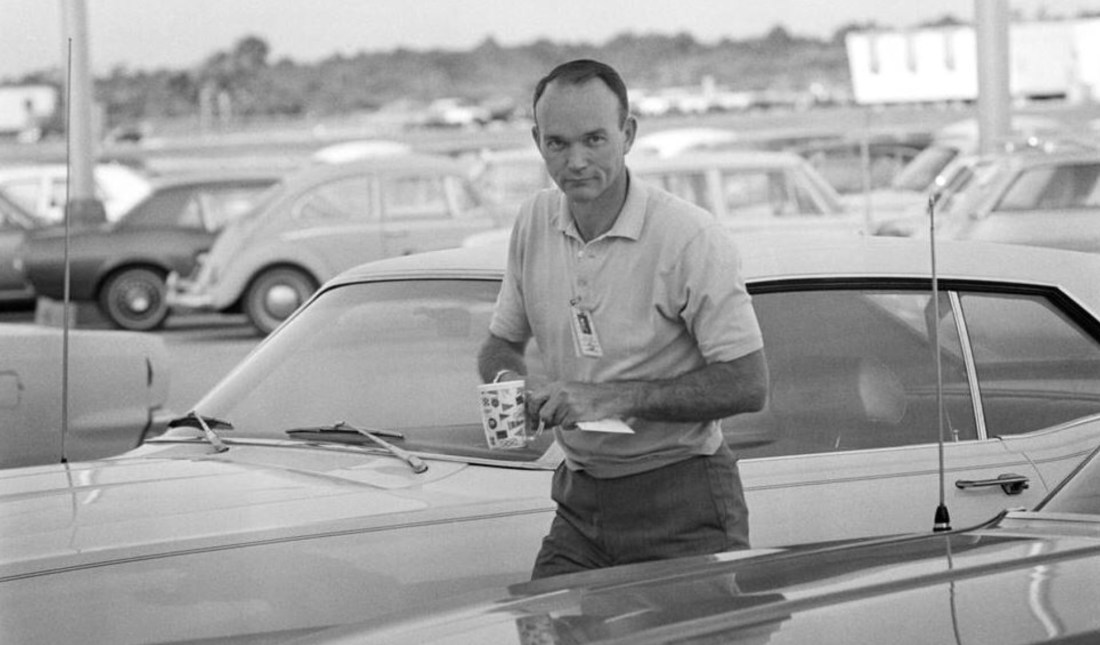
Mike sat in the vehicle alone. His two compadres were doing the job while he manned the “getaway car.” As his chums busied themselves, hurriedly gathering their loot and carrying out their tasks, Mike circled,  running all the worst case scenarios through his head. What if there was trouble? What if they got stuck? What if they couldn’t get out? He tried not to think about it. His buddies were counting on him to be there when they were done. But waiting by himself in the getaway vehicle made him feel, as he said later, more alone than anyone has been since Adam.

The three had practiced and practiced and practiced for every possible scenario. They had spent years working through the job. The idea was that more preparation meant a better chance of success. The trio had not simply gone through practice runs until they got it right; they had practiced until they could not get it wrong. Like Danny Ocean in the movies, they even worked on mockups of the scene. Each man knew his role. They had experience. No, this wasn’t their first time doing this.

And, so, Mike brought the vehicle right around one more time and waited. “What will I tell their families if they don’t make it out?“ He thought. “I don’t want to be the guy, the only guy who lives through this.“ Again, he circled.  No sign of them.  It shouldn’t be taking this long. They should be back by now. He even contemplated going to get them directly, but that wasn’t part of the plan.  Stick to the plan, Mike told himself. Stick to the plan.

Thirty times Mike circled.

You might think that, by this time, the average wheelman would begin to give up and try to make good his own escape. But not Mike. No, in fact, he felt a heightened, “awareness, anticipation, satisfaction, confidence, almost exultation.”  Suddenly, on the final pass, he saw them. Mike’s two pals we’re coming towards him as quickly as they could.  Just as they had planned it, Mike did not even have to stop to let his buddies enter the vehicle.

Mike tried to hide his relief and excitement once his buddies were inside. As he steered away, he asked calmly, “How did it go?“ His buddy Neil gave him a thumbs up while other member of the trio, Buzz, grinned broadly.

That’s when Commander Michael Collins radioed Houston that Apollo 11 was returning to earth.


On a Movie Star

Modern Hollywood owes a large debt to the silent film era. The film industry as it exists today would not be as it is without the stars in front and the creative talents behind the camera of that era. This story is about one of the most famous silent films stars ever.

This star is actually one of the more unlikely Hollywood stories. In the period after World War I, sentiments about Germans and German actors wasn’t favorable. However, this star was German, but he was among the most popular star of the silent era. And, sadly, his contribution to the success of the film industry in the 1920s and beyond is often overlooked.

Throughout the decade of the 1920s, this star made almost 30 pictures. He worked with almost all the leading actors and actresses of his day. He received a key to the city of New York. Fan clubs and well wishers could not get enough of him. There was even a period where he even received more fan mail and sent more autographed photos of himself than did Charlie Chaplin.

Darryl F. Zanuck, the famous Hollywood producer, first made his reputation writing screenplays specifically tailored for this actor. One of these early films did so well that it is said that this actor alone saved Warner Bros. Studios from financial ruin. When film transitioned from silent to talking pictures in the late 1920s early 1930s, this star, despite being from Germany, made the transition seamlessly and had no issue at all adapting to the new medium. Amazingly, he had no accent whatsoever.

Unfortunately, near the height of his popularity, this film star passed away at a young age. Condolence telegrams flooded into Hollywood. The worldwide acclaim for the talents of this actor astounded many in the industry. “His ability to convey emotions on the screen transcended culture and language,“ one foreign newspaper reported. “There will never be another like him.“ Rumor had it that he died in Jean Harlow’s arms, but this wasn’t so.

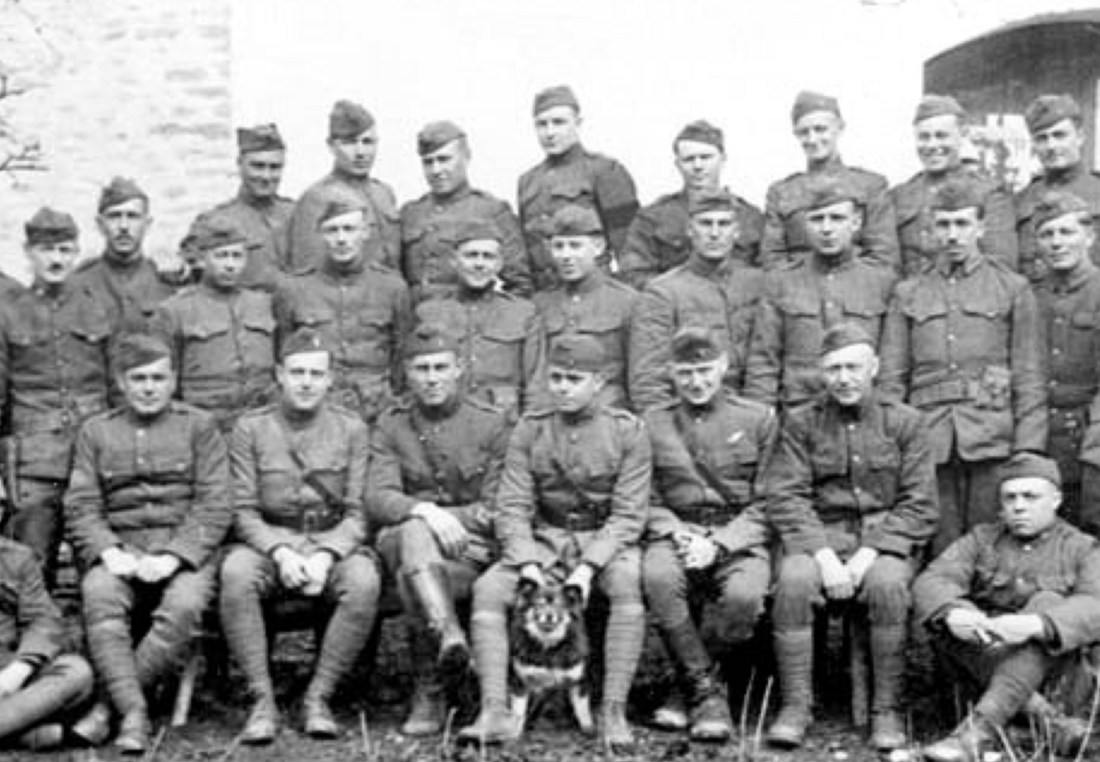
Yes, this German actor, honored and beloved, was discovered by an American soldier who ran across him living in a bombed out shelter in eastern France at the end of World War 1. The soldier took pity on him, noting how weak and thin and malnourished he was. The American GI brought him to the US and eventually to Hollywood, and the rest is history. Yes, even though he was discovered while living in France, he was really German—a German Shepherd, in fact.

You know him as Rin Tin Tin.

On a Wealthy Widow

After almost 30 years of marriage, Eliza Jumel found herself, at age 58, a widow woman with some money.   Her dead husband, like Eliza herself, had been born in humble conditions, but he had managed his money well and had left her a good fortune. Eliza discovered that money, however, could not keep her company. She wanted a social life and wealthy friends. So, Eliza went looking for a husband who would bring a notable name to go along with her wealth.

She found such a man in New York City only 14 months after her husband‘s death. This older man was a veteran of the American Revolution and had but a modest pension from that and some other government work he had done. He was well known in the town. So, a merger of sorts was arranged; she seems to have married the older man to increase her standing in the society of New York, and he seems to have married her to secure his financial position in old age.

The marriage did not work from the start. These types of things seldom do. The older man got his hands on Eliza’s liquid assets immediately.  He surreptitiously acquired the money and spent it rapidly to cover debts he had incurred before the couple got together, debts that he hadn’t disclosed to Eliza. When she discovered the betrayal by her new spouse, Eliza, understandably became livid. After only four months of marriage, Eliza left the older man, managing to keep her non-liquid assets separate.

In order to facilitate a quick divorce, Eliza enlisted the services of a well-known New York attorney, a man named Alexander Hamilton, Junior. Yes, indeed, Eliza’s divorce attorney was the son and namesake of the famous former US Secretary of the Treasury, General Alexander Hamilton, the man who had been famously killed in the duel with then vice president Aaron Burr way back in 1804.

Hamilton Junior protected as much of Eliza’s estate as he could from the clutches of her new husband, and a divorce was finalized in September of 1836.  When she passed away in 1865 at the age of 90, Eliza was known as one of the wealthiest women and most astute businesswomen ever to live in New York City.

Ironically, the date that her divorce was finalized in 1836 was also the date that the older man, the husband she was divorcing, passed away.

His name?

Aaron Burr.

On Apple Cider

As the United States ended its struggle over independence from Great Britain in the early 1800s, the young nation began another struggle. The country started coordinating the movement towards and settlement of the western territories. There were so many issues to consider: Native American displacement, land surveys, government organization, improving overland routes, infrastructure issues, and so much more.

We forget the vital role that alcohol played in the settlement of the American west in the years after the American revolution. Alcohol became one of the most traded items on the frontier of settlement. In fact, in many places along the frontier, alcohol served as the de facto currency.

In order to spur settlement, the United States government offered large tracts of free land in the west if the settlers could show that they were permanent residents on the land. So, towards that end, land claimants were required to grow fruit in order to show permanence and thus keep possession of their claim. Most settlers grew apples—not for eating but, rather, for cider making.

According to those who know these things, apples grown from seeds usually don’t produce fruit sweet enough for eating. Apparently, it takes about a decade for apple seeds to be large enough to start producing fruit, and that’s about how long land claimants needed to prove they were permanent settlers and, thus, receive the land grant for free.

The Smithsonian website notes that, “Cider provided those on the frontier with a safe, stable source of drink, and in a time and place where water could be full of dangerous bacteria, cider could be imbibed without worry.” One historian noted that a history of the settlement of what is now the Midwest must be seen through an almost alcoholic haze as a result of so much alcoholic apple cider.

In fact, many orchards left over from the frontier days dotted parts of western Pennsylvania, Ohio, and Indiana well into the 1920s that, during Prohibition, anti-liquor advocates took axes in hand and chopped down hundreds of apple trees for fear that the fruit—again, fruit never sweet enough for eating—would be used once again for making “that Demon Cider.”

All of this fruit being associated with alcohol certainly would have horrified any frontier folk who were of a religious bent, and many were. In fact, most historians point to a particular deeply religious man who, more than most, was responsible for the establishment of almost all the apple orchards across the Midwest during the frontier days. This man, everywhere he went, preached piety and austerity and thrift and hard work—and planted apple orchards. He would most likely be mortified to think that his life‘s work would be so closely associated with alcohol. His name was John Chapman.

You know him as Johnny Appleseed

On a Curious Boy

Peter was a strange child. For example, one of his favorite things to do was to rife the pockets of the adults around him to see what interesting things could be found there. He was born around 1713, and, like most kids from the lower classes of the 18th century, Peter had no formal education to speak of. The farm where he eventually came to live and work, owned of course not by his family, came to see him as a sort of mascot or pet, even when he became an adult. He had a natural curiosity about him, Peter did, and part of that curiosity may have stemmed from an unusual event in his life. It was at the age of about 12 when Peter moved from Germany, his homeland, to Britain. Such a move was unusual for a person of his social status at that time in history, and the change of venue obviously changed Peter’s life forever.

Again, unusually for someone of his station, Peter came to be feted by members of the British Royal family. In fact, his move to the British Isles was precipitated by the daughter of King George I, Caroline, the Princess of Wales. She met Peter near his home outside of what is now Hanover, Germany, when he was but a young boy, and she immediately was captivated by his unique character.

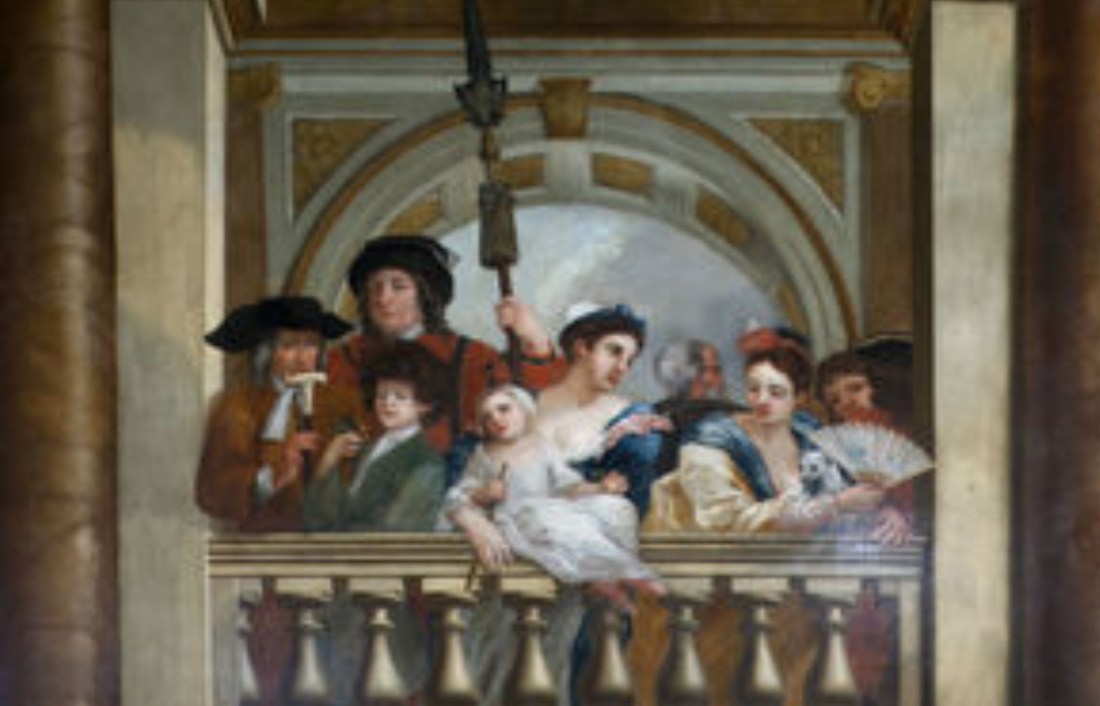
In fact, the princess was so taken with the boy that she ordered he be painted into one of the official portraits of the King’s court. The painting, by William Kent, now hangs in the hall of Kensington Palace in London. You can see Kent’s depiction of Peter today, the boy depicted wearing a smart green coat, standing to one side of the large group of the courtiers, and holding some tree foliage in one hand.

The princess even arranged for Peter to be tutored by an important physician of the day, the famous Scottish doctor, John Arbuthnot. Dr. Arbuthnot worked with Peter to teach him to read and write and speak the King’s English, but Peter had no interest in those things. In fact, Peter preferred to spend time outdoors, walking in the fields or running through the woods—both perfectly normal things for a young boy to want to do.

Eventually, Dr. Arbuthnot gave up. The princess, despairing of her young charge, eventually decided that it would be best for Peter to go to live with one of the chambermaids of her mother’s, a woman who came from the country originally. This woman, in turn, entrusted Peter to a yeoman farmer she knew, and so Peter ended up spending most of his life on the farm where, as stated above, he became a favorite of all who knew him there.  A nice yearly sum was given to the farmer by the royal family on Peter’s behalf. He lived to be about 70, loved and cared for all his days. His grave is near the door of the local church in Northchurch.

You might think that Peter’s parents would have had a say in what happened to their son, but Princess Caroline did not even consult them in making her decisions regarding the boy’s future. Thus, Peter’s father and mother had absolutely no choice in deciding Peter’s future.

How could they?

After all, no one knew who Peter’s parents were.

By the way, when Peter would bunk off from his lessons with Dr. Arbuthnot and run in the woods, he even did that in a curious way. He ran…on all fours. Also, one reason Arbuthnot had no success with Peter was that he couldn’t speak at all. You see, Peter had been found living naked and alone in the woods near Hanover by some hunters led by King George.

He was the original feral child.

You may know him as Peter the Wild Boy.

On a Visit with Charlie

It’s difficult for a person in today’s world to understand how immensely popular Charlie Chaplin was during his heyday as a silent film star and director. Chaplin was mobbed everywhere he went. People could not get enough of stories about Charlie. Photos of his most famous character, the Little Tramp, filled magazines and newspapers.

Sometimes Charlie found it difficult to make his movies, even when he would be filming or directing on a studio lot. People, famous or not, would often stop by and demand that Charlie take a moment to speak to them and maybe have a photograph or two taken with him. As you can imagine, this became very annoying and disruptive to Charlie as an artist. Yet, when someone showed up on set, Charlie rarely turned him or her away. Such was the case in 1919, when a young woman showed up to meet him on the set of his movie, Sunnyside.

Usually, Charlie would tell the cast and crew to take a short break while he made small talk and posed for the obligatory photographs. But, on this day, something was different. Rather than taking just a few moments and then getting right back to work, Charlie seemed  immediately and absolutely captivated with the young woman. It seemed odd. She was certainly no beauty.

You probably know that Charlie had a deserved reputation as being a man who had an eye for beautiful women, and one could almost understand him taking a little extra time if the woman were especially attractive, but this was so obviously not the case. This woman was awkward. Her movements were stilted. Yet, Charlie ended up spending several hours talking to her. And, again oddly, during their whole time together, the woman said absolutely nothing to Charlie—not one word.

That actually suited Charlie quite well. It was said about him that he was someone, “who tries to avoid people who talk too much, which gets on his nerves.” Perhaps that’s why Charlie became friends with a artist in California named Granville Redmond. Redmond was a deaf mute, but he and Charlie got along famously. Charlie said that he learned from Redmond that subtle movements and actions carry great weight if they were done properly. Redmond also taught Charlie sign language, and Charlie helped promote Redmond’s art career.  But, at the heart of their friendship, the fact that the two men could communicate without speaking seemed to be important to Charlie.

And that may be why he spent so much time with the woman that day. For, like Redman, this woman was also a deaf-mute. In fact, she was also blind.

The great silent comedian did all the talking that day because he had spent the hours with a young woman named Helen Keller.

On an Immigrant

Odds are that, if you are an American, you have an opinion about immigration. The issue of undocumented aliens coming to America is certainly not a new one. All throughout the history of this land, people who have come here illegally have been seen as being suspect and, often, treated as inferior and unwelcome.  Germans, the Irish, immigrants from southern and eastern Europe, Asians, and many other groups have all been shunned as being “different“ and, therefore, un-American.

It has been rare that someone from American History has welcomed foreigners and treated them with respect. Rebecca was one such person.

Rebecca was, by all accounts, a strange child from birth. She grew up gregarious and inquisitive in a period when women were encouraged to be neither. Hers was a family of privilege and power, her father holding a position of authority in her town. So to say that she was different than the other girls around her would be accurate. Perhaps that’s why she had such tolerance for other people who were labeled as being different since Rebecca was much the same herself.

There was one famous instance when she was in her teens when an illegal alien had been captured by some of the local men. Rebecca insisted that he be treated fairly. In fact, she brought him food and water during his incarceration, making sure that his needs were met. When some of the men in her town wanted to punish the immigrant man, Rebecca actually spoke up for him and even went to her dad and asked for mercy on the man’s behalf. Her father, touched by the compassion his daughter showed, granted the man leniency.

Yes, Rebecca’s attitude was rare in a period of great intolerance. Her era is much like ours, today, sadly. In a time when illegal immigrants are viewed with outright hatred in some quarters, we need more people like Rebecca who will speak for those who are different from us, speak for those who are coming to America to make a better lives for themselves and their families. After all, we are all immigrants, right?

The man Rebecca spoke up for was a man named John Smith. Captain John Smith, in fact. He was an Englishman, an Englishman in the early 1600s who came to America and settled, illegally, on land settled first by indigenous Americans.

Rebecca, you see, was this young woman’s Christian name. She is better known in history by one of her her native names: Pocahontas.

On a Risky Venture

Investments are tricky. It doesn’t seem to be a matter of throwing money at the popular or profitable company now, but the secret to good investing seems to be the ability to predict the Next Big Thing. Such an opportunity befell John S Gray in the early 1900s.

Gray was part of an immigrant family from Edinburgh, Scotland, who came to the United States in the 1850s. By the beginning of the 20th century, Gray had become a typical American success story. He had become a successful candymaker, businessman, and banker. That’s when his nephew, a man named Alexander Malcomson, approached Mr. Gray with an investment opportunity.  The nephew said that he had a friend who was on the cutting edge of some new technology that was going to be the next big thing.

Another business axiom is that people who have money often keep it because they don’t invest in risky ventures. That’s why, at first, John Gray wasn’t interested in his nephews proposal.  Look at the picture of John Gray above. He is solid, respectable, and conservative. He does not seem to be the type of man who would suffer fools gladly. But, Malcomson persisted, and he promised Gray that investors could take their money out of the company at any time.

John Gray thought about this for a long time. Perhaps it was his Scottish blood that made him not want to throw good money at a risky venture. His nephew had an up-and-down record of risky investments, and it was Gray’s feeling that this was one of the more risky opportunities. However, the promise that his money could be recovered at any time proved enough for Gray to reluctantly invest $10,500, which gave him just over 10% of the company.

On the strength of Gray’s name, Malcomson was able to convince other investors to join the risky venture that he and his other partners were pursuing.  Interestingly, some of the investors in this group included the Dodge brothers, who would go on to build the successful line of automobiles. Because of his stature in the financial community, John Gray was elected the first president of the new corporation at the first meeting of the 12 investors.

Oh, the venture was profitable from the start. Within a few weeks, all the investors made back their initial outlays several times over.  Yet, despite the success, friction arose between the investors. Some of them had their own businesses – – Malcomson and Gray among them. Some of the investors only worked at the new company.  The friction centered on what direction the new company should take going forward. Surprisingly, Gray sided with those who worked only in the company. He and the other investors eventually froze Malcomson out, and the company bought Malcomson’s shares.

The future looked bright for John Gray, and this risky venture now seemed to be a stroke of genius. Unfortunately, only three years into the venture, John Gray died of a heart attack. He was replaced by the vice President of the company—the man upon whose idea the company was based.

By the way, when Gray’s estate finally sold his shares back to the company, the original $10,500 investment produced a total return of almost $40 million.

You’re probably wondering what company John Gray risked his money over. The company was named for that vice president who took over when Gray died, and the product the company made became synonymous with the man who started it.

You know it as the Ford Motor Company.

On a Young Patriot

Gabe loved his country. In fact, today, Gabe could be called a super patriot. Born in the Austro-Hungarian Empire in the late 1800s, he grew up wanting to make his country better. So, against the wishes of his farmer father, Gabe went to university.

There he learned more about his people and their past, and this only fueled his love for his land. When he heard that the heir to the Austro-Hungarian throne, Crown Prince Franz Ferdinand, was coming to visit his part of that world, Gabe excitedly vowed to see the Crown Prince when he came.

What the world didn’t know was that over a half-dozen assassins lined the streets of Sarajevo that day, each one dedicated his life to killing the heir to the throne. In some similar ways, each assassin on that route had the same passion that Gabe had for his country.

As the motorcade carrying the heir and his wife traveled through the city, one of those assassins first attempted to kill the couple by throwing a bomb at their motorcar. The bomb had a delayed fuse, and it bounced under one of the following cars and exploded, injuring the occupants, but the Crown Prince was unharmed. Amazingly, the parade continued.

Gabe stood nowhere near that part of the parade route, but he heard in the crowd about the assassination attempt and felt like many others did—that parade would surely be called off. So, he decided to go into a nearby restaurant and eat some lunch, nursing his hurt feelings that he didn’t get to see the royal couple.

You know what happened next. Franz Ferdinand gave a speech and then decided to visit those who had been injured in the assassination attempt earlier. He and his wife got back into their motorcar in the parade continued somewhat. The Crown Prince’s head of security decided to change the parade route, but he didn’t tell Ferdinand’s driver.

The chauffeur of the Crown Prince’s car then turned down the wrong street. From behind him, people in the following cars yelled for him to turn the motorcar back around and follow the new parade route.

At that moment, Gabe stepped out of the cafe and realized that, to his astonishment, the motorcar had turned down the exact street where he had been eating lunch. The young patriot had chosen that moment to walk out of the cafe, and he found himself looking directly into the open back seat of a vehicle in which sat the future emperor of the largest nation in Europe.

Yes, Gabe was a patriot. He loved his country. Except, in Gabe‘s mind, his country was not some empire. His country, at least in his mind, was not made up of Germanic Austrians or ethnic Hungarians, but, rather, of the collection of Slavic people in the southern and eastern part of the empire.

You see, Gabe wanted Austria Hungary to grant the southern Slavic people their independence. He wanted it so badly that Gabe volunteered to be one of those assassins on the route.

Thats why, when sheer chance caused him to come face-to-face with the royal couple, Gabe—Gavrilo Princip—fired his pistol into the bodies of the Austro-Hungarian prince and princess, killing them both, and lighting the fuse that brought about World War 1.

On Bob’s Jinx

Bob should have lived a charmed life. Born into wealth and privilege, Bob attended the prestigious Phillips Exeter Academy for his high school. He got his undergraduate degree at Harvard. He got a law degree from Northwestern in Chicago.

During the American Civil War, Bob served on the staff of an important union general. However, by the time he died in the 1920s, people who knew him reported that Bob felt that he was one of the most unlucky men who had ever lived.
You see, Bob thought himself jinxed.
Three events in Bob‘s life let him to feel this way. The first one was almost an accident of fate. He was in Washington DC the night that President Abraham Lincoln was shot. In fact, Bob had tickets to see the same play that the president saw that night at Ford’s Theater. However, he decided not to attend the performance. Like many in Washington, when he heard of the president being shot, he made his way down to the boarding house across the street from the theater where Lincoln‘s dying body was carried. In fact, Bob was allowed into the room where he joined the large crowd who witnessed the great man draw his last breath early the next morning. So, he indirectly saw the Lincoln assassination.
The second event that caused Bob to feel like his life had been unlucky occurred about 15 years later. By this time, Bob had made a name for himself as a lawyer and in politics. His experience had earned him a job in government. It was in this capacity that the president at the time, James Garfield, invited Bob to catch a train with him in Washington. It was while standing on the train platform with Garfield that an assassin came up and put a bullet into the president, a bullet from which Garfield would eventually die. Two presidents—two deaths.
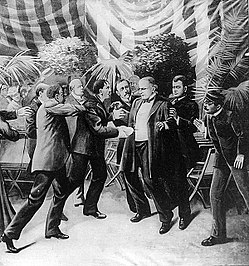
The third event happened in 1901. Again, the situation involved a sitting president. This time, President William McKinley invited Bob to the opening of the Buffalo worlds fair. Bob was standing outside of the building at the exposition where the president was having a reception when another assassin came up and shot McKinley, fatally wounding him.
That was it for Bob. A man who had wealth and prestige and some power felt that his connections to three presidential assassinations made him some sort of a jinx. After 1901, when any president would invite Bob to an event he would answer, “No, I’m not going, and they’d better not ask me, because there is a certain fatality about presidential functions when I am present.“
Oh, there is one other interesting historical footnote about Bob’s life. When Bob was in college at Harvard, he was accidentally pushed off a train platform in New Jersey and into the path of an oncoming train. To hear Bob tell the story in later years, the next thing he knew was that a large hand grabbed him by the collar and, in one quick motion, pulled him up to the safety of the platform. He turned around to see who his savior was and found himself looking into the face of the famous American actor, Edwin Booth, the brother of the man who would be Lincoln’s assassin, John Wilkes Booth.
Lincoln’s assassin—his father’s assassin. For, you see, Bob was known publicly as Robert Todd Lincoln.