On the 1936 Olympics

This is not a story about Jesse Owens, although it is about the 1936 Berlin Olympics. These Olympics were designed as propaganda for the Nazi Regime and Hitler’s warped idea of Aryan superiority, and films, books, and documentaries have been created that detail all of that effort to promote the New Germany. In fact, German athletes won almost twice as many medals (101) as the second place nation, the United States (57). Between that propaganda emphasis and the story of the great athletic feats of Owens, other interesting facts about those Olympics often get overlooked.

For example, were you aware that the Berlin Olympics were the first to be televised? If you’ve seen the film Contact, you are probably aware of this. The Germans had over 70 hours of grainy coverage of the games broadcast into several viewing rooms around Berlin that allowed tens of thousands of people to see some of the sporting events as they happened.

Also, a pair of brothers who made sports clothing, Rudi & Adi Dassler made their marks on the sports world by having several of the important athletes in these games wear their specially made athletic shoes. Owens won his medals in the Dassler brothers’ shoes. The publicity generated by the success of his shoes propelled the Dasslers’ company into international fame. Later, creative and personal differences made the Dassler brothers part ways and set up rival companies. Perhaps somewhere in your closet or maybe on your person, you have Adi’s brand, Adidas, or Rudy’s brand, Puma

We can’t imagine the Olympics without the famous torch being carried into the stadium. For many, the flame represents the athletic spirit and the unity of the athletes on the world’s stage. The torch for the Olympics is lit on Greece’s Mount Olympus and then carried across borders and nations to light the flame at the Olympic stadium. That first happened at the Berlin Olympics as the Germans used 3,000 runners to take the torch from Greece to Germany. The flame was lit by magnifying the sun’s rays on Mount Olympus. We don’t realize it, but the fire/flame motif was important to the Nazis, and their desire to use that imagery is why we still have the torch relay today.

At that time, the nation that hosted the summer Olympics also played host to the winter games. Thus, the Bavarian town of Garmisch-Partenkirchen saw the world’s best amateur winter athletes descend on it earlier in 1936, in February. For the German organizers, the winter games were seen as sort of a dress rehearsal for the real showcase of the summer games to be held later that year. The German winter games were the first to showcase Alpine Skiing. After the ’36 games, the same nation would no longer host both summer and winter games.

While Owens got the (deserved) accolades for his performance in the games, some of the other almost 4,000 athletes were overshadowed by his amazing athletic feats. For example, A black American named Mack Robinson won a silver medal by breaking the men’s Olympic record for the 200m dash–but he still finished 0.04 seconds behind…Jesse Owens. You might know Mack’s younger brother, a decent baseball player named Jackie.

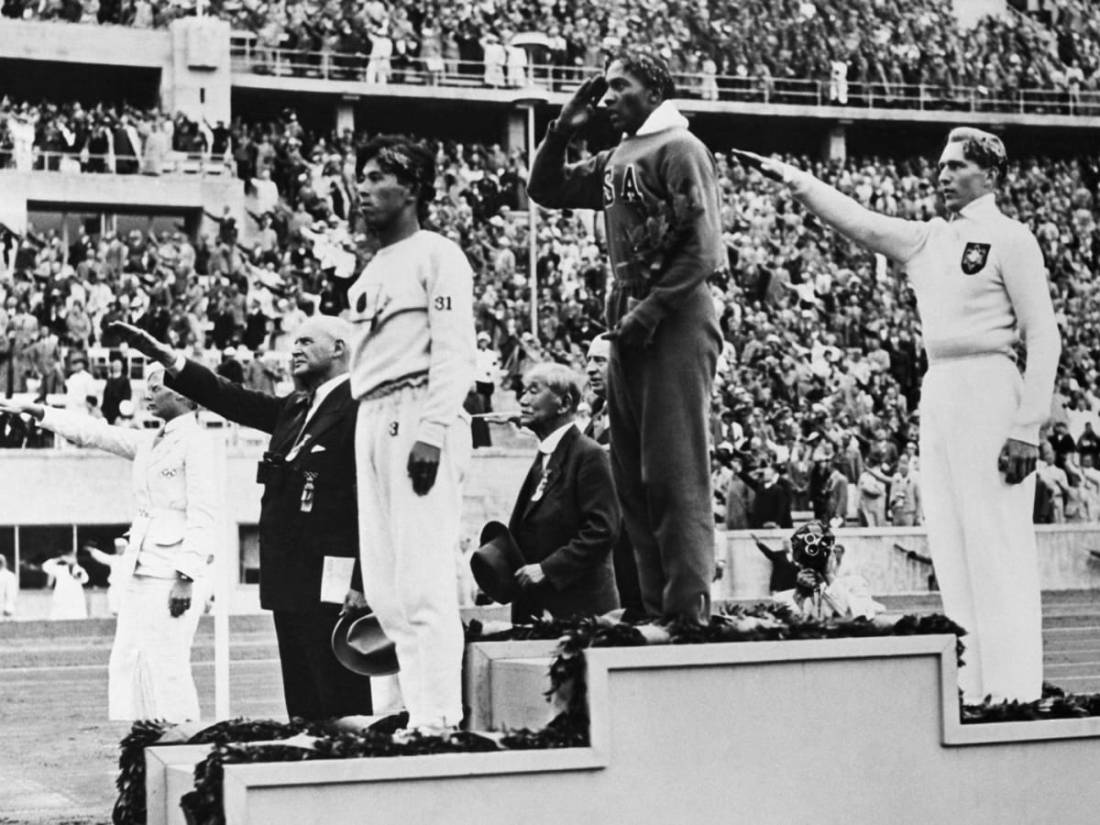
The man who won the bronze medal in the long jump (Owens won gold, German Lutz Long grabbed silver) was the Japanese athlete Naoto Tajima. Tajima, it is often forgotten, won the gold in the triple jump by setting a world record that stood over 15 years. (Tajima’s the man at the front of the podium in the photo, above.) Finally, these Olympics saw the youngest ever gold medalist as American Marjorie Gestring won her championship in the 3-meter springboard diving event at the age of 13.

On a Military Funeral

Full military funerals are usually only reserved for, well, soldiers who have shown exemplary service to their countries or national heroes and the like. They are rarely given to women. In the case of a particular funeral in 1975, in France, a woman indeed received full military honors—the only time that has happened in French history.

Who was she?

Well, I can tell you that she wasn’t born in France. In fact, this woman was born in St. Louis, Missouri, in 1906. She dropped out of school at age 12. By 13, the girl was practically living on the street, and she found work as a waitress. There, in the restaurant, still at age 13, she met and married a much older man. By the time she reached the ripe old age of 15, she had left that first husband and married a second one.

Yes, I’m sure that this is the woman who received the accolades and appreciation of the French government at her death.

Want to know more? Sure. This woman was accused by newsman Walter Winchell of being an active Communist in the 1950s. She met and became friendly with Cuban dictator Fidel Castro in the 1960s. Clergymen and morality enforcers protested against her. She had public and well-publicized affairs with both men and women across several decades. At the end of her life, she had to rely on the kindness of others for a place to live and for her basic needs.

And this is the woman France chose to honor?

Yes.

Because, as well as those things renumerated above, this amazing woman was also recognized as a hero of the French Republic. She had help to organize and lead French resistance groups against the Nazis in World War II. She’d left the United States and moved to Paris in the mid-1920s, and she fell in love with the country and its people. She worked tirelessly for the downtrodden, the voiceless, and orphans—even adopting several children over the course of her life. As you have guessed, this woman was famous as a singer and performer. She rubbed elbows with the rich and famous across all of Europe and much of the world. She became beloved and much respected, admired, and imitated in France.

Ironically, it was her home country of America that rejected her. She would point to this rejection as a major reason for her decision to move to France in the first place. Yes, the United States would not let her even have a cup of coffee at a lunch counter in a café or enter a hotel through the front door.

That’s because this woman, so lauded and appreciated by her adopted nation of France, was still only a Black woman to American society. Yes, when Josephine Baker died, France showed its appreciation for its adopted daughter, even if her native United States had rejected her.

On a Complete Rehab

Lorenzo Winslow is a name you probably don’t know. Lorenzo was a high-priced architect on the East Coast in the middle of the last century. During World War I, Lorenzo was in the Army Corps of Engineers in France, and, after the war, he studied architecture in Paris. Coming home after his education, Lorenzo worked for a prestigious architectural firm in North Carolina. Eventually, he moved a bit north and began specializing on designing houses and, for a time, he was employed by the US Government where he worked on a partial rehab of the Statue of Liberty. However, Lorenzo’s passion was private residences. He received a call one day about a commission for a house that would prove to be one of his most challenging.

It was a rehab job, he was told. The house was one of those old, early American Eastern Seaboard piles that had been allowed to fall into decline over the decades. Lorenzo made the trek to the house to see it for himself. The resident met him and took him on a tour. Impressive place, he thought, old but with potential. It worried him that the floor slanted and the old chandeliers shook when one walked on the floors above them.

After a more detailed inspection with his engineer, Lorenzo informed the client that, yes, the house could be salvaged, but it had to be immediately gutted, leaving only the shell from which to reconstruct the house. The client questioned that level of reconstruction; the price Lorenzo quoted for the repairs rivalled what it would cost to raze the structure and rebuild from the ground up.

Lorenzo argued against that. He said that the 150-year-old house had good bones and some historical significance and should be saved, if possible. The client rubbed his chin in thought and agreed. Lorenzo further told the man that he had to vacate immediately, that parts of the structure was unsound and was in danger of collapse. The man’s wife balked at this despite the fact that a piano on the second floor almost fell through to the floor below. The wife loved the old place since the family (a daughter also lived there) had moved in a couple of years before, taking possession from another family who’d lived there for over a decade. Finally, and reluctantly, the wife agreed to move out while the rehab took place.

Soon, Lorenzo’s contractor had all interior walls removed. The house barely resembled what it was before, and the client began to question whether such drastic measures were needed. Lorenzo insisted that they were. He took the man on a tour of the work, and he pointed out that, sometime in the past, the structure had even suffered a fire; burn marks on some support timbers and scorches on the masonry proved his point. The client showed up several times during the almost three-year rehab and walked through the changing interior of the house. He was always amazed at the scale of Lorenzo’s vision for the work.

As these things often do, the project ran over time and over budget. Both of these contingencies angered the client. He didn’t exactly blame Lorenzo, but, being a man who usually pinched pennies, he felt that somehow he had not gotten his money’s worth out of the reconstruction.

“I could have done all of this for half the money and half the time,” a frustrated Harry Truman said on his first night back in the renovated White House.

On an Unattractive Announcer

Rita Zucca was not pretty. I will go ahead and tell you that about her from the start. Not much attractive about Rita, and she would be the first to admit that. A newspaper later described her as being “crossed-eyed, bow-legged, and shallow-skinned.” And that was one of the kind descriptions. As a young girl, Rita faced taunts because of her crossed eyes, but she found that she was smarter than most kids (and many adults), and she learned to answer the teasing with pithy and witty retorts that were often lost on her targets. And, luckily, Rita grew up to be in a business that didn’t require looks.

No, Rita is best remembered for her voice.

But we’re getting ahead of our story. This New York City native was born to an Italian immigrant family that had made its money opening a restaurant. The family scrimped and saved every nickel until it could relaunch the place as an upscale dining establishment. Rita’s dad worked day and night as did her mom and the rest of the family, including Rita. The West 49th Steet location for the restaurant was prime real estate, and Louis Zucca made it count. The eatery even had its own postcards! Such was its notoriety in the neighborhood—The Italian Garden, Louis called it.

Rita attended parochial school and then learned secretarial skills to become a typist and transcriptionist. Such was her head for business that her dad decided she should go back to Italy to see after some of the family’s land there. After all, in the late 1930’s, rumblings of war in Europe had turned into shouts of war, and it would pay the family to have someone on-site to protect the family plot when war came.

As we know, it did come, and with a vengeance. Mussolini’s Italy was a key ally to Hitler’s Germany, and the Italian dictator began clamping down on anyone who seemed to be disloyal to his regime and the Italian war aims. Rita’s dad advised her that the best course of action to protect the family land would be to become an Italian citizen, which she could easily do since her parents were still citizens. So, early in the war, Rita renounced her American citizenship and became Italian.

Because of her fluency in English, the National Italian Radio Network, which was looking to hire someone for some planned broadcasts in English, hired Rita on the spot. That’s why her voice was more important than her looks. One person later said about Rita that she sure was “no looker,” but, once she opened her mouth, the golden tones that came out sounded like dripping honey on the radio. And that’s exactly what the national radio company was counting on. She had more work than she could keep up with, almost, because her broadcasts were quite popular. Meanwhile, Rita fell in love and birthed a son in 1945.

After the war, Rita’s work on Italian radio first caused the United States to possibly consider bringing charges against her. When the Americans realized that she had renounced her citizenship, they dropped their case against her. The post-war Italian government, now virulently anti-fascist, did succeed in bringing charges against her. Rita served time in jail and was barred from ever returning to her home in New York.

All for being on the radio and speaking in her native tongue.

You see, the target audience for Rita’s broadcasts wasn’t Italians. No, rather, the target audience for Rita was her former fellow countrymen. Rita broadcasts were bits of news and entertainment specifically designed for the American servicemen fighting in Italy. The Americans were there after the Allied invasion of Sicily and then of the Italian mainland beginning in 1943. Her radio show was intended not to inform or entertain the Americans exactly, but, rather, to hurt their morale.

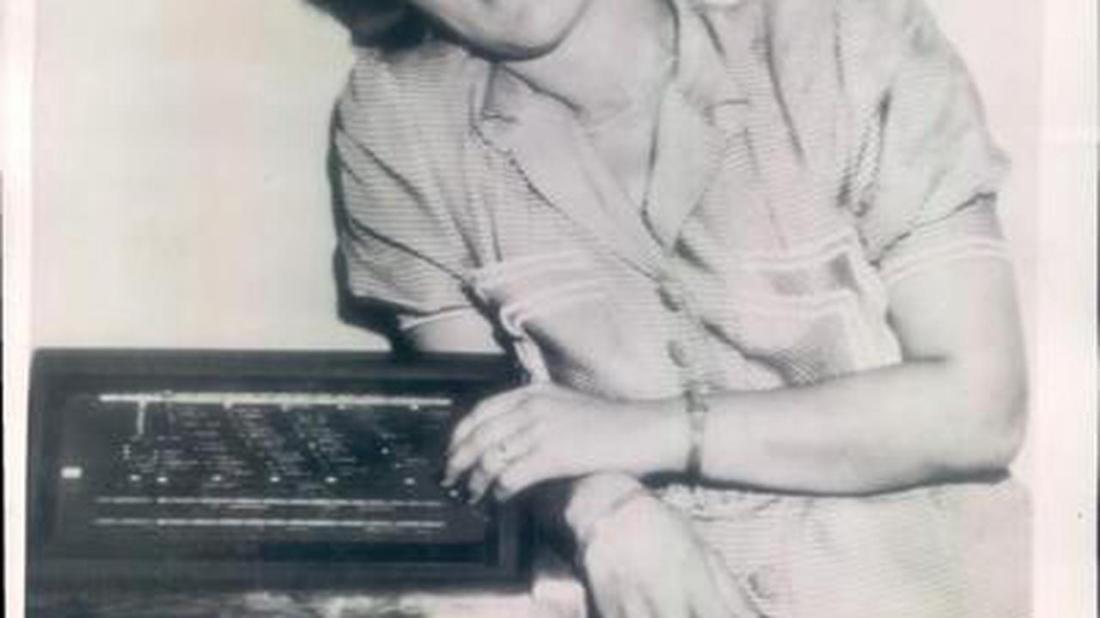
You may know her as one of the women the Allies called Axis Sally.

On a Young Poet

Liz loved poetry. She dabbled in photography as a teen, but that hobby was expensive, and, as the daughter of a single mom who worked as a piece-meal seamstress, money was tight and hard to come by. But the poetry—she kept that habit throughout her life.

In the 1920s in the suburbs of Dallas, Texas, opportunities for young women were few and far between. Most young women simply bided their time until they could find a man and get married. That was the ambition of most of her friends, and Liz was no exception. As a high school sophomore at age 15, she met a man named Roy Thornton, and the pair of young lovers dropped out of school and married less than a month before she turned 16.

The marriage proved, unsurprisingly, to be a dud. Roy turned to petty crimes to make money—the Great Depression hit the south long before the Wall Street Crash of 1929—because he couldn’t find honest work or, more likely, simply because it was easier. Roy ended up incarcerated because, well, he wasn’t a very good or bright crook. The pair never spoke to each other after January 1929. While Liz never really talked about him in later life, she did wear the cheap wedding ring he gave her until the day she died.

Yet, Liz continued to write her poems. Many of them had dark themes that reflected her desperate financial situation that Roy had contributed to. One of her stanzas, written in a small notebook she got from a bank as a gift for opening a short-lived savings account, seems to describe her feelings for her long-gone husband:

If he had returned to me sometime

Though he hadn’t a cent to give,

I’d forget all the hell that he’s caused me

And love him as long as I lived.

The rather long poem shows that young Liz had a decent sense of rhyme, and the work makes references to historical women like Helen of Troy but also exhibits a working knowledge of street/petty crime jargon of the day. She continued to write throughout her life, scrawling verses on any scrap paper she could find.

One day, a friend asked Liz to stay with her to assist her around the house because of a broken arm. Out of the kindness of her heart, Liz agreed, and she moved in with the friend. There, and through this friend, she met a young man who was also from the west Dallas suburbs. Liz would later describe their meeting as electric, and the pair hit it off despite the fact that he, too, preferred to make his money via nefarious means rather than through honest work. Liz found in the young man a source of inspiration for more poems. Love does strange things to people, and, in Liz’s case, it caused her to lose herself in the criminal life of her new beau. She was 19; he was 20.

One of her last poems tells you what you probably have already guessed, that Liz—Elizabeth—was her middle name. Let’s let her last poem tell you who she is:

Some day they’ll go down together

They’ll bury them side by side.

To few it’ll be grief,

To the law a relief,

But it’s death for Bonnie and Clyde.

On a Lighted City

We in the western world take such things as indoor plumbing, on-demand hot water, and instant cooking abilities as not only normal in our daily lives but also as fundamental necessities. We forget that, within less than 300 years ago, such things were practically unheard of anywhere in the world. Those types of things are taken for granted by us; we have little appreciation for the way people lived in recent history.

Take streetlights for example. The use of natural gas for lighting a city brought fundamental changes in safety, security, and productivity/work habits to those inhabitants who were among the first to enjoy this modern invention. While this first system to provide this luxury to an urban population was of crude construction, it proved effective in providing adequate street lighting and became popular where it was first installed.

However, as you can imagine, there were detractors, and these nay-sayers represented loud and powerful interests. Traditionalists argued that nature demanded humans sleep at night, undisturbed by the “unnatural” light thrown off by the gas lamps. Religious zealots warned that illicit and illegal behaviors would invariably occur because humans now had the ability to extend the daylight hours into the nighttime. They prophesied that, rather than the advancement of civilization, the gas streetlights would lead to the destruction of life and culture as they knew it.

Economists and engineers and politicians fretted over who would bear the brunt of the cost for the new system and how to enact it practically. The gas had to be brought in by a pipe system. Who would build that? The fuel had to be regulated; did that mean a tax? Would consumers bear the brunt of the costs? And, while we take it for granted that there would be lampposts, even that detail had to be discussed and decided before the lighting system could become practical. Would one giant light be better than many smaller ones? And who would maintain the system? Who would light the lamps and extinguish them daily? And at what time would those two events take place? You can see that the logistics had to be worked out somewhere along the line.

Ah, such is the price for modernity. And we don’t even think about those practicalities today.

Yet, those difficulties worked themselves out for the first city to have public gas lighting: Beijing, China, 2500 years ago.

On a Political Moderate

It’s difficult for us today to grasp how divisive the issue of slavery was in the United States before the American Civil War. Of course, today, we think that the United states is terribly divided politically between Republicans and Democrats. However, today’s political divisions pale in comparison to the schisms that led this nation to the bloodiest conflict in American history.

Even politicians we might think of as moderate for that time still professed strongly held beliefs in the idea that the races were unequal and so created by God. One typical mid-western moderate politician of the era said, “I will say then that I am not, nor ever have been, in favor of bringing about in any way the social and political equality of the white and Black races.” This same former member of the United States House of Representatives went on to argue that Blacks should not have the vote, were unqualified to be on juries, hold office, and most certainly should never be allowed to marry white people. God, forbid!

On another occasions, this same moderate argued for the resettlement or colonization of Blacks to, well, somewhere else in the world. Liberia, the African nation set up by former slaves of the U.S., was one of the possible places Blacks could be sent, he said. Central America was also floated as a potential resettlement spot by this man. He justified this belief by saying that the differences between the races were simply too great to be resolved and, therefore, separation was the only safe and sane recourse.

He further held that he must support slavery simply because he believed in the United States Constitution. While the Constitution did not specifically mention slavery as a right, the fact that such things as the 3/5 Compromise and the reference to Fugitive Slave Laws in the document supported the idea in his mind—even if he personally disliked the institution. These feelings echoed those of Thomas Jefferson—himself a slave owner—who supposedly said that slavery, “was like holding a wolf by the ears. You didn’t like it, but you sure didn’t let it go.”

You can see that even moderates of that period such as this man held beliefs that today are wildly inappropriate and wrong. That should show you how deeply held the racial animosity was among those considered to be radical in the period leading up to the Civil War.

Yet, this politically moderate man further felt that the institution of slavery was a “necessity” in those area where it existed. When, during the Civil War, the discussion of declaring slavery to be illegal in the areas of the United States where it did not exist—the idea of an Emancipation Proclamation—he posited again that he wished to not interfere with those parts of the nation where slavery still was legal.

Yes, Abraham Lincoln’s position on slavery was indeed moderate for its time, even if he eventually came to see the Civil War as the method for eliminating it once and for all.

On an Uncouth Tourist

Americans have a reputation of being some of the most uncouth and self-centered travelers anywhere in the world but particularly in Europe. Perhaps it’s the American educational system that fails to properly prepare people by not providing them a broader view of the world. Maybe it’s that Americans are so self-centered that, if it doesn’t concern us, we simply tend to not care about it. For whatever reason, the reputation of many Americans who travel overseas is not a good one. In fact, you may sometimes hear the phrase “Ugly American” to describe someone from the United States who is unaware or unconcerned with another culture, language, or customs while traveling.

Case in point, a man in his 70s from the United States who visited France. What made this particular tourist noteworthy was that he had some money. He also had some education, so that excuse for his uncouth behavior in Europe doesn’t hold up. What is beyond dispute is that his actions shocked the people he encountered on his trip. For example, in a nation like France that is known for its haute couture, this American eschewed all sartorial convention and chose clothes of a much poorer person. This mystified the French he encountered.

And the wanton behavior! His wealth and business position in the States had caused a rift between him and his wife, and, while they never divorced, they lived separate lives for some time. She had recently died before he left for his France trip, and the man felt that he had the license to enjoy the company of some high-class French prostitutes. So, he did. In fact, he moved one of them into the apartment he rented in a Paris suburb. What made this behavior unseemly, even for the normally licentious French, was that the woman was more than 40 years his junior. And she was by no means not the only one he shared his bed with.

While these antics may seem eccentric in the case of the clothing or harmless in the case of the sexual exploits, it’s what we know of the man’s behavior in London that may be the most shocking of all his European escapades.

We might not have known about this most disturbing side of the man, but, luckily, the house the wealthy older American rented in London was renovated in the 1990s. It was then that the bones were discovered. A worker in the house’s basement unearthed a human thigh bone, and he called the police. Soon, hundreds of human bones were unearthed from the basement. And they could all be traced to the time when the American rented the house.

Was the American a murderer? Why would there be bones buried in the basement?

To this day, we don’t know for sure exactly what Benjamin Franklin had to do with it.

On a Charming Prisoner

The world is filled with stories and films like The Green Mile that depict relationships between prisoners and their guards. It makes sense that people who spend time together in enclosed situations would talk and, on occasion, become friendly. This is a story like that.

The guards, in this case, were 12 young American soldiers in charge of a single prisoner. To many of the guards, this older man seemed like a genial grandfather. They would swap stories with him about growing up. They would smoke cigars together with him. The older man was charming and seemed kind. Bonds developed between the prisoner and the 12 young men guarding him.

That’s always a dangerous situation to be in, isn’t it? When you become emotionally involved in a situation like that, you start to lose perspective on things like right and wrong, crime and punishment, good and evil. That seems to be the case here.

The old man told the younger men jokes, he wrote poetry for them, and, when he complained that he wished he had books to read and a way to document his time in custody, the young men found some space for him where he was being kept and turned it into a sort of office so that the old man could have his own private area in which to write and to read.

Again, it makes sense that these young soldiers—who were either guarding the prisoner or sequestered in their quarters—would become emotionally connected to their only prisoner. Inevitably, the subject of why he was being held prisoner came up. The old man told his minders that he was baffled as to why he was being held by the Americans. All he wanted to do was read Dostoevsky and write in his journal. He always considered himself a friend to the United States and could not figure out why they did not see him as an ally. They agreed with him.

One of the 12 guards told the old man one day that his brother had died. The old man rose from his bed and enveloped the younger man in a warm embrace. “I will be your brother,” he told the young man, and the two of them shared tears. Soon, the guards did not even bother to close the door to the old man’s cell. They knew he would not run away. They trusted him, and he trusted them. He even offered to pay for college for one of the soldiers. The guards shared American popular music with him, and he came to love it and request it often. He ate American food because of the 12 guards.

Once, he asked for access to his prison’s courtyard, and the guards were amazed that he wanted to water some weeds that he had seen growing in one corner. They allowed it and were again shocked that he began caring for the weeds as if they were beautiful plants. Again, the young men began questioning the morality of incarcerating someone who seemed so caring and so loving, someone who appeared so empathetic and wise and nurturing.

Inevitably, the old man sentence was handed down, and he was ordered to be hanged. The young guards were stunned. They felt a terrible injustice had been done.

But that’s the thing about psychopaths, isn’t it?

You shouldn’t ask his charmed American guards if the old man deserved death. Instead, you should ask the families of the tens of thousands that Saddam Hussein killed if he deserved his punishment.

On a First-Class Rail Carriage

The train trip began quiet enough. The dapper young lawyer showed his first-class ticket to the conductor who validated it.

The lawyer took his seat.

In 1893, segregation in South Africa was not only in practice, but it was also ingrained in the mentality of the minority white population. As difficult as it may be for some to believe today, at that time, Black South Africans were not simply treated as inferior people; they were considered sub-human. All aspects of both public and private life were segregated.

So was this train.

The first-class section of the train was usually occupied by white business types and white “gentlemen.” They not only did not want to be around the Blacks of the country, but they also did not care for the white lower classes, either.

The young lawyer had purchased his ticket for the first-class coach because, as an attorney, he could afford the ticket and he enjoyed the space and comfort it provided. When he took his seat in his neatly pressed suit and perfectly tied cravat, the young man sat back to read his newspaper while the journey continued. He didn’t notice the man opposite him begin to frown at him on the other side of the paper.

A few moments later, the man got up and found a conductor. “I want him removed from the coach,” the man told the conductor, motioning to the young lawyer. “Sir,” the man replied, “he has a ticket. He is not from South Africa.” But, the man persisted, and he threatened the conductor’s job if he didn’t remove the lawyer from the coach. The conductor reluctantly relented.

He entered the train car and cleared his throat uncomfortably. The lawyer put down his paper. “May I help you?” the lawyer said. “Sir,” the conductor began, “it seems that your presence has made the other passengers…uncomfortable. I am asking you to move to the second-class compartment.” The lawyer was incredulous. He produced his ticket again and insisted that he had done nothing wrong. “I realize that, sir,” the conductor explained, “but I must insist that you remove yourself from this coach.” The young lawyer was shocked at such behavior, but he refused to move. “Your railway sold me a first-class ticket. I will hold them to their contract,” he said.

The conductor turned to the man who had complained. The man narrowed his eyes and said, “If he refuses to move, you must do your duty.” The conductor assessed the situation and made the decision that would change the course of history. At the next stop, Pietermaritzburg, he had the young lawyer forcibly removed from the train.  

That cold night, the lawyer shivered in quiet anger on a bench at the station until another train came along the next day. Even though he was not a Black South African, this incident played a major part in his decision to create his doctrine of non-violent civil disobedience with which he would change the world.

“I was born in India,” Gandhi once said, “but I was made in South Africa.”