On an Famous Golf Shot

The Masters Tournament in Augusta, Georgia, has always been a marker for spring for me. The beautifully manicured greens and fairways, the gorgeous azaleas in full flower, and the pageantry of the donning of the famous Green Jacket by the winner represent the popularity of the sport of golf in the United States and around the world. In 1971, a man named Charles Coody recorded his only career major tournament win by besting Jack Nicklaus and Johnny Miller for the victory by two strokes.

In an ordinary year, that would have been the major golf news of the year, but a golfing amateur upstaged Coody in February that year. This amateur’s name was Alan, and his impact on golf is still celebrated today. We may not remember much about that 1971 Masters Tournament, but we certainly remember what Alan did that year. In fact, it is said that Alan hit the most famous golf shot ever made.

The shot Alan made was with a 6-iron, a club that was made by the sporting goods company Wilson and the style of club was called a Dynapower. And that’s part of the story. You see, it wasn’t that Alan made a golf shot that was accurate or that defied the laws of physics or bounced around and settled in the hole or even that he made a hole-in-one. No, Alan’s 6-iron golf shot is significant because of the distance he hit the golf ball with that 6-iron.

Now, most amateurs would hit a 6-iron about 150 yards on a good day. Not Alan. After a couple of practice swings, Alan addressed the ball and took a rather unorthodox swing at the ball; he hit it one-handed. Please know that the average golf shot with a driver (the larger clubs) stays in the air for about 6 or 7 seconds. Alan’s ball took off…and was airborne for over 30 seconds. In fact, the shot Alan took was measured by one scientist as having traveled one mile.

Yes. One mile.

Alan passed away in 1998, but, before he died, he donated the 6-iron with which he hit his famous shot to the United States Golf Association Museum in Liberty Corner, N.J. The club can be seen there today, and it is one of the most popular exhibits at the museum. People want to see the club that made the most famous shot in history.

After all, it’s not everyday you see a golf club that astronaut Alan Shepard used to hit a ball on the moon.

On an Accompanist

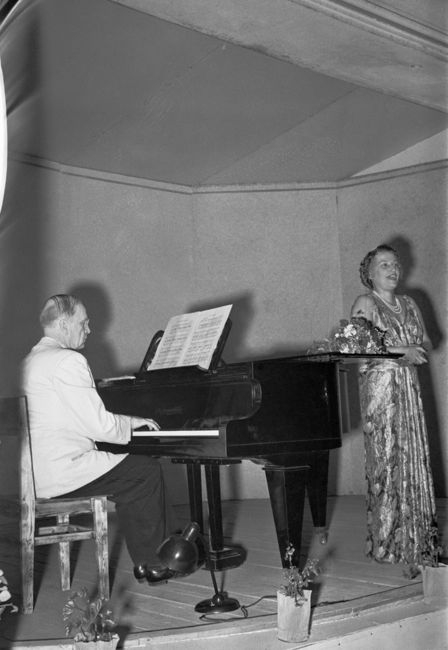
Kosti Vehanen was a pianist and composer from Finland. Eighty years ago, most people who followed classical music knew Kosti as one of the premier musical accompanists in the world. At age 18, he entered one of the best performing arts academies in Europe (now known as the Sebelius Academ) and there excelled at both performance and composition.

You may wonder why a musician you’ve never heard of merits a few minutes of your time. Well, Kosti Vehanen wasn’t your typical accompanying musician. Many of the major classical singers of that day preferred the Finn’s delicate and sensitive and almost anticipatory playing as they performed. He found himself on stages all over the world in the first half of the 20th Century, both as an accompanist and as a featured player with symphony orchestras. Remember that this was the days when radio was almost omnipresent in most homes of the western world, and people tuned in regularly to hear Kosti play with this singer or that orchestra.

What made him even more special in his day was that Kosti did not play favorites and did not discriminate. The 1920s and 1930s saw a rise in the public expression of racism around the world. The Nazis, the KKK, and other racist and fascist groups grew in number and in the expression of their hate. Kosti ignored the hate, and he performed with people of all races and religions.

In fact, it was 84 years ago that Kosti Vehanen played piano outdoors in Washington, D.C., before a crowd of 75,000 live listeners and millions who tuned in on several radio networks to hear him. One thing that made this outdoor concert even more special is that, when the racial hatred of Europe was about to burst into war within the next five months, Kosti played in front of the Lincoln Memorial, a monument dedicated to a man who fought for equal rights in his day. When he was asked to play that day, Kosti accepted the invitation without any hesitation. In fact, his schedule had suddenly become clear because one of his performances had been cancelled.

You see, Kosti and the singer he was going to accompany that day had been scheduled to perform in the largest concert hall in Washington, Constitution Hall. The problem was that the hall was owned by an American racist organization, the Daughters of the American Revolution. Posing as a patriotic group of women, the DAR openly discriminated against minorities and religious groups they deemed as being un-American. To them, that meant anyone who was not white, Anglo-Saxon, and protestant.

We think of Germany and Italy and Japan as being jingoistic and racist in the 1930s, but we forget that organizations not that much different than the fascists operated openly in both the United States and in the United Kingdom during the same period. The DAR cancelled the concert at Constitution Hall because not only was it to have an integrated audience listening to the performance, but they cancelled it also because the featured performer was a black woman.

That’s why Kosti Vehanen, with his sensitive and delicate style and his strong convictions that all people are created equal, moved his performance from the 3,700 seat Constitution Hall to the open spaces of the Mall in front of the Lincoln Memorial. It was there on April 9, 1939 that this talented Finnish man accompanied Marian Anderson as she sang to the American people.

On an Eldest Son

Karl’s dad died when he was seven and his little brother and only sibling was an infant. His memories of his birth father, understandably, are muddled and mixed. He was raised throughout the remainder of his youth by his doting mother (who used to be a professional singer as a younger woman) and his step-father and went to school in Prague. The step-father, a man named George, had little to do with him; he didn’t adopt Karl and was happy to send him off to school.

Karl apprenticed to a trading company in Italy. It didn’t suit him Following in his mother’s footsteps (and her deepest wishes), Karl then pursued music as a career when he found the business world too difficult to break into. He took music lessons with some of the most important Italian teachers in Milan, thinking that the occupation of his mother was also possible for him. Besides, it would please her greatly. He soon proved to be a gifted pianist, but he also knew that the music business was so fickle and insecure as a career.

Then, when the opportunity for a position with the Austrian government came along–and with it the promise of steady income, unlike the musician trade–Karl took it. He became an accountant for the government’s department in Milan and a translator for government officials who were stationed there. And so, the oldest son of the family became a life-long civil servant in Italy.

Karl soon realized that he made the correct choice of career in eschewing music for the security of public administration. The job allowed him to enjoy some of the finer things in life as he became an indispensable member of the Austrian delegation in Milan. He hobnobbed with Italian royalty, rubbed shoulders with musicians (with whom he could converse knowledgeably) and artists, and gained a reputation for being a hard worker who took his position seriously.

Karl eventually purchased a sizeable house in a village north of Milan in the foothills of the Alps not too far from Lake Lugano and Lake Como where he enjoyed his life before dying at age 74. Upon his death, he bequeathed the house to the village. As a life-long bachelor, Karl had no other heirs who would make a claim on the property. The grateful village erected a plaque on the house to Karl’s memory in honor of his gratitude.

Karl’s younger brother also never married. However, that little brother did decide to follow his mother’s example and pursue music. You see, music was in his blood because both of these boys also had a musical father. And it makes sense that the younger brother would pursue music as a career because he bore the same name as their father, the father that neither of them remembered well:

Wolfgang Mozart, Junior.

On a Stone’s Throw

It was a normal day in November 1946 for Mohammed edh-Dhib and his two cousins.

Hot.

The boys’ job was to watch the sheep in the sparsely grassed area not too far from a place known as Cliff Springs (Ein Feshkha) in the southern part of what is now the West Bank area of the Jordan River and near the sea. When you spend all day with the sheep, day after day, you begin to create things to do to pass the time. Sheep aren’t that much trouble, after all, and predators were few in that area. So, the boys created games for themselves to have something to do while the sheep grazed on the brown grasses.

The rocky soil meant that “ammo” for throwing was plentiful. The boys knew better than to throw at the sheep. Besides, they loved the sheep. No, the boys looked to the cliffs around them for places to throw rocks to see who had the best aim. Jum’a, Mohammed’s cousin and best friend, had the best throwing arm, but that didn’t keep the other two boys from trying to show him up and prove that they weren’t so bad themselves.

The cliff sides were littered with holes and caves, carved out by centuries of water running through the soft stone. The challenge for the boys was to hit the mouth of a specific cave with a rock. Sometimes, the sound of the rocks landing inside the caves echoed inside the opening and resounded down the cliffsides.

It was that hot November day that Jum’a’s thrown rock found the opening of one particular cave. Instead the the usual sound of bouncing stone on stone, the boys heard another, unfamiliar, sound.

*clink*

The three boys exchanged surprised glances. The rock had hit something unusual. It was Mohammed who was the first to clamber into the opening to see what Jum’a’s rock had struck. Mohammed shielded his eyes to help them adjust to the darkness inside. When he could see clearly, he yelled out to his cousins what he found: Clay jars. Several of them. Lined up agains the side of the cave not too far into the entrance. It was sheer luck that the rock had found the jar’s side. The rock had cracked it.

The boys took some of the jars back to their encampment to show the adults what they’d found. There was some discussion among the grown-ups about what should be done with the jars. Finally, it was decided that the jars should be sold. The boys were asked if they thought they could maybe find more of the jars. Mohammed admitted that he didn’t venture much more into the cave, that there might have been more jars deeper in.

The jars were sold to a market in the old town of Bethlehem. The Bedouin shepherds fetched about $350 in today’s money for the jars. They felt they’d made a good deal, sort of pulling one over on the purchaser.

They didn’t care that inside the jars found by Mohammed and his cousins were the Dead Sea Scrolls.

On a Fitting Resting Place

Some of my earliest memories are of going with my mother to the cemeteries that dotted the western panhandle of Florida where my ancestors are buried. She’d stop at the graves of those she especially loved and tell a story about that person. For my mother, to have all these loved ones surrounded by their families and friends was fitting and right and proper. These weren’t places of sadness to her; they were places of love and family. This is another such story of a fitting final place for a loved one.

With the advances in medicine in most of the western world, we take for granted that childbirth will be relatively safe compared to what it has been historically. Yet, 400 years ago, childbirth was fraught with danger (We’ve looked at the development of the Cesarean section before). In 1631, a woman named Mumtaz died in childbirth in what is now north central India. She was only 38. Her husband, a rich man named Jahan, was devastated by the loss. Mumtaz was his life. In a time when women were often seen as property or worse, Jahan looked to Mumtaz as a true life-partner. Not only was she incredibly beautiful, but she also was wise, and she acted as one of Jahan’s closest advisors. She was clearly the light of his life.

For an entire year, Jahan remained in seclusion. He forbade anyone to see him. Servants would bring his meals and leave them outside his door and return later to collect the dishes and half-eaten food. When he emerged after the year of mourning, reports say that Jahan’s hair had turned white in his extreme grief. He emerged from his seclusion only when one of his daughters–one that favored Mumtaz to an incredible degree–begged him through the closed door to come out and continue to live, to love on the family that remained. Jahan reluctantly agreed, but that’s when he announced plans for the fitting resting place for his beloved light of his life.

And Jahan vowed that Mumtaz resting place would reflect that fact. And even though we think of graves or cemeteries as being places of sadness, Jahan conceived of a grave for Mumtaz that would evoke her beauty, her grace, her elegance. In short, he wanted people to see the grave and not think of death, but, rather, to think of love. Therefore, Jahan ordered that no expense be spared in preparing her grave. You see, Jahan was wealthy and powerful. He had the money and the ability to build a fitting monument to his bride. And so, he did so–a the cost of $1 billion dollars in today’s money.

Jahan would live another 30 years without his beloved by his side. And he grieved for her every day. He longed for sleep, he said, because it was there and only there that his Mumtaz would be able to visit him, to touch him, to be with him again. When he died, he was entombed with her, their mortal remains lying side by side in the great, illustrious, and fitting final resting place.

His shrine to her, still shines today.

In fact, over 6,000,000 people a year visit Jahan’s shining monument, a place that’s not a monument to death, but, rather, a testimony to love.

The Taj Mahal.

On a Traffic Stop

Officer William West served the District of Columbia police force with pride and efficiency. An army veteran, William took his job of serving the public seriously. People who knew William (never “Bill,” always William) said he was tough but fair, honest, and believed that policemen and fireman and other first responders were grossly underpaid and underappreciated. In William’s case, that was certainly true. The pay at the force wasn’t great, but he prided himself in never taking a bribe to look the other way or to let someone off if they broke the law. For William, to be corrupt would make the entire system corrupt. He loved his country, his police force, and his job.

One week in the city, William was assigned traffic duty. That meant, basically, to set up what most people would call a speed trap to catch those who ignored the limit. William, characteristically, saw it differently. There had been serious incidences of speeding recently, and a mom and her kid were injured when a driver hit them while going too fast in the city limits. So, William saw his job that week as being important.

Oh, there’re some other things you should know about Officer William West at this point. He was a black man, born in Maryland, and lived in the area of Washington his entire life except for his time in the US Army. He and his wife, Katherine, had six children. He was 30 years old when the following events occurred.

William was patrolling near 13th Street an M Street when a vehicle flashed by. William quickly signaled for the driver to pull over. The man did. He was a white guy, about 20 years older than William, and when William approached the vehicle, the man said, “Well, officer; what do you want with me?” William later reported that he recognized the man, and that the man’s attitude was condescending. However, William, as usual, kept his professional cool. William calmly explained why the man had been stopped, and he politely asked the man to drive slower and gave the man a warning only. “We’re looking for people to set an example, sir,” William explained. The man sheepishly promised it wouldn’t happen again and apologized for speeding. William let him go on his way.

But that wouldn’t the last interaction between the two.

The next day, near the same spot, William spied the man again speeding through the area. It took William some distance to pull over the man this time. “I gave you a warning yesterday,” William informed the repeat offender. “You gave me your word that you wouldn’t speed again.” The man could not protest. William, making sure to be as polite as he could, placed the man under arrest for speeding. “I’m sorry, sir, but duty is duty,” William told him. William took the man to the station and turned him over to the booking clerk.

“You sure about this?” the clerk asked William. “I am,” the duty-bound officer replied. The man paid his bond and was released.

Until recently, Officer William West’s arrest of President Ulysses S. Grant was the only time that had happened to a President of the United States of America.

On a Tutor

Isabel Ingram’s life is the stuff of novels and adventure tales. Her American family were Congregationalist missionaries in China over a hundred years ago, and she was, in fact, born in Beijing in 1902. Her parents sent her back to the United States to attend college at Wellesley College in Massachusetts. Upon graduation, she promptly returned to the land of her birth. Her college education qualified her to be a teacher and tutor, and she soon found employment as such upon her return to Beijing.

The custom of that culture in that day was that Ingram could only tutor other women. Her first student was a Chinese woman her age who was marrying a well-to-do Chinese young man who spoke English. The desire of the Chinese woman’s family (and the prospective husband) was that Ingram could help her with her English as a complement to her future husband in his career in government service. You see, she was of a lower class than he was, and Ingram had been engaged to help her, in effect, “catch up” with her husband’s privileged, private education as much as she could.

The American and Chinese women soon formed a fast friendship. Having by nature a shy personality, the Chinese woman embraced the opportunity to have a female friend with whom she could talk about topics that would be considered out of bounds with her soon-to-be husband. Ingram also felt a kinship with the woman, and the pair got on famously. Ingram soon found her pupil was quite intelligent; the Chinese woman took to her English lessons easily and gladly (she especially enjoyed the lessons the two shared on American culture and society). And, not having many friends in China, when it came time for the wedding, Ingram found herself invited to the ceremony. She considered it a great honor as she was the only woman there who wasn’t Chinese.

In her diary, Ingram recorded the beautiful, full-length yellow wedding gown made from expensive satin that was worn by her pupil turned friend. And the tutoring continued after the marriage began. The two women secretly engaged in a competition unknown to the Chinese woman’s husband; they worked on the wife’s vocabulary, planting new words in English that the husband might not know so that he could be impressed with his new bride’s burgeoning English prowess.

In addition, the pair of women from such divergent backgrounds became even closer as friends. They swapped clothing–Ingram being about the same size as the Chinese woman–and they even together chose an English name that the woman could use: Elizabeth. On occasion, the two chums would dress alike and try as closely as possible to speak like the other one.

But, sadly, as happens in many lives, events conspire to drive good friends apart. The pair of friends would lose touch over the years, and, once Ingram stopped being the woman’s tutor, the two never saw each other again. As you know, the Japanese invaded China in the 1930s, and the war brought disaster after disaster to China, ending with the capture of the country by the Chinese Communists under Mao Zedong. The woman, as best as can be known, was put in a communist prison camp where it seems she died about 1946.

By the mid-1930’s, Isabel Ingram had married an American serviceman and returned to live in the United States, in Maryland. Before she passed away in 1988, she decided to write a book about growing up in China, of her experiences in that nation in the 1920s, and about her wonderful friendship with the pupil she tutored.

Oh, by the way, the name of the Chinese woman Ingram tutored and befriended, in English, is Wanrong. She’s known today as the Empress of China, the wife of the last Emperor of China, Puyi.

On a Lack of Decay

The body had been declared dead six days earlier. Yet, it showed no signs of decay or decomposition. The weather had been warm and moist. Any normal body would begin to show signs of death. Yet, nothing seemed changed despite the passage of time. People began to talk and speculate as to why there was such a lack of decay.

You may well be wondering why someone would allow a body to lie uncovered and unburied for almost a week after a declaration of death. Well, the situation was complicated. There was some considerable conflict over exactly who would take possession of the corpse. That question had to be answered before the authorities would release the body to be interred. The young man was indeed loved, had a mother and siblings. His mother, well, the young man once said that she was so nosy in his life that she charged high rent for only 9 months of occupancy. Also, the young man had a large a coterie of friends who all felt that they should be the ones tasked with the embalming and burying of him. In fact, some unseemly fights broke out between some of those who claimed to be the ones who loved the young man more than the others.

His own wife and child, however, weren’t considered, oddly enough. They were more, well, ornamental than practical to the man. His life was his career, his work, and everyone who knew him understood that. We don’t talk much these days of destiny and fate, but people around this particular young man certainly saw him as being fated for success. And, indeed, he was successful in his chosen career. Maybe too successful.

The young man worked extremely hard, often worked harder and longer than others who were under him, but then, when work was over, he also partied hard, longer and later, than any others, too. That was part of the reason there was some dithering over the body. Nobody, including the doctors, were sure what he died of. Could it be that the excesses of his hard drinking and partying caught up with him? We still don’t know. We do know that he was cut down at the young age of 33 after rising to the top of his profession.

What most people today think is that, whatever he died from, quietly and in his own bed, we have an idea why his body didn’t decay. The best theory is that the young man wasn’t, in fact, dead at all. He may have had an auto-immune condition named Guillain-Barre Syndrome. That can manifest itself by extreme muscle paralysis–the patient mimics death by having such shallow breathing that he may seem to not be breathing at all.

And that’s why it only seemed that his body didn’t decompose. Oh, all those around him thought that the lack of decay meant that he was a god. But now we know the truth.

In other words, it might well be that Alexander the Great didn’t actually die until his friends had him cut open and disemboweled in preparation for his embalming.

On an Benevolent Racist

We’ve looked at the topic of racism in other posts in this blog series, but this particular post is about a racist that most people didn’t realize was a racist when she was alive. To begin with, this woman felt that those of the so-called “inferior” races should accept the lot that God gave them in life. And, if there’s one thing that is difficult to fathom, it’s someone who uses religion and/or God to justify their hate.

This woman ran a large organization that was built, ostensibly, to help the poor receive medical care. The opposite was in fact true. Most people who came to the organization run by this woman received little to no help at all. And, to make matters worse, the woman publicly didn’t care that her group failed to fulfill its stated mission. Again, it was due to the fact that she was of the “correct” race–white–and those whom the organization was designed to help, well, weren’t white.

“The world,” she said once, “is better off because they (the non-white people) suffer.

Sheesh.

You see, the problem wasn’t that the organization lacked funding. The opposite was true. They were simply drowning in funds. The woman was an astute and crafty fundraiser. Yet, the facilities of her organization (and there were over 100 of them) were poorly equipped and the staff–my God, the staff!–were worse than useless. Most were without any kind of certification or qualification in helping poor people with their medical issues. Again, the reason for the these conditions was that the woman simply didn’t seem to care about those whom she was supposedly there to help. Their plight was what God wanted for them, sure, but it was what they were supposed to receive, what they were destined to receive, simply because they were not worthy of the quality of care the so-called superior races deserved.

Who was this medical Cruella de Ville? Well, I can tell you she was born in Albania, a nation that is not exactly the wealthiest nation in Europe. She was more of a cultural racist in a way. Christianity was the true religion, she felt, and she insisted that many of the people who applied for help in her organization first convert to her religion before receiving help.

And it gets worse. This woman sought out audiences with dictators around the world, men like Haiti’s Duvalier and her native Albania’s communist strong man, Hoxha.

Ultimately, the reason she decided to “help” those less fortunate than she was that she truly felt that help for the non-whites should come from their “betters.”

Can you believe the gall of this woman?

And to think that Mother Teresa of Calcutta became a saint in only 5 years.

On a Club Speaker

Back in Westmoreland Tennessee, I was in the Rotary Club. As an officer of that charitable group, it fell to me at times to come up with the after lunch program. Over dessert in our meeting space (the backroom of the local meat and three), we had a series of speakers and presenters who wanted to tell the Rotarians what was on their minds or what their business or project was doing at the moment. We tried to discourage politicians, but we always welcomed veterans and representatives of veterans’ groups.

A Kiwanis club in Columbus, Georgia, back in 2009, arranged for a veteran of the Vietnam War to come and share his experiences there. Now, we had Vietnam vets come speak to us fairly often. Sometimes, they talked about what that moment in their lives meant to them, why the United States fought that war (and others), and they would often offer their opinions on modern American society from the perspective of someone who fought when their nation asked them to do so.

That’s what the Columbus Kiwanis Club was wanting from their speaker. He had been given the time to share his war-time experience and offer his opinion on the war itself. Now, many of that Kiwanis membership were of an age that they remembered the war; some of them, like the speaker, fought in it. So, what this man would say would certainly resonate with that group more than most audiences. Also, and significantly, Fort Benning, a large military installation, is located on the edge of Columbus and houses over 100,000 military personnel and their families. It was also an important training base for soldiers who served in Vietnam. So, this speech by a Vietnam vet to the club carried a special significance.

The speaker’s name was Bill, and he had been an officer during Vietnam. Bill was 66 when he made his presentation to the group in Columbus, but, when he was in Vietnam, he was a youthful 22 year old 2nd lieutenant. His dad had been a navy veteran during World War 2, and Bill had entered the military and scored high enough on the officer candidate tests that he was admitted to the officer’s program. In fact, in beginning in March, 1967, Bill had been stationed at Fort Benning for his junior officer training. Bill spoke about his time on the base; he detailed what it taught him about leadership and discipline and how to handle himself in the field.

The speech began with the usual platitudes, thanking the Kiwanis members for having him and for being there. Bill acknowledged the Fort Benning contingent, and he also thanked the other vets in the group for their service in whatever capacity they served.

It was then that Bill’s after dinner talk swerved into the unusual.

He began speaking of the impact the Vietnam War had not on the Americans who fought in it but, rather on the land and people of Vietnam itself, both from the north and the south. He lamented that there were times when the actions of the Americans who were there crossed lines from military conduct into human rights abuses. Some in the audience were shocked. The room became quiet as people put down their coffee cups and placed their dessert forks on their plates and leaned into what Bill was saying.

Now, it is an absolute certainty that atrocities occurred in Vietnam on all sides. But what Bill was talking about was more than this. He referenced the mentality that some American servicemen had that they had to, in effect, destroy the nation in order to save it from communism. Vietnam, Bill explained, was different from other conflicts to a degree. Unlike, say, Europe in World War 2, where you could readily identify your enemy by the uniforms they wore, Vietnam was a different kind of conflict. The “enemy” could be a woman, a child, a old person. To some Americans, anyone and everyone was suspect. All were considered hostile. That created a fear, a paranoia, in many of the Americans who served over there, a creeping dread because they didn’t know which Vietnamese, if any, could be trusted.

And then Bill began speaking about the infamous My Lai massacre, a situation where American troops killed hundreds of innocent Vietnamese civilians simply because, well, simply because. Again, the audience was stunned. My Lai was a blight on the heroic record of the American military, an embarrassment that many in the service felt would be better off forgotten than rehashed and retold.

Some would say the topic was certainly not fair game for a Kiwanis speech, especially in Columbus.

But, you see, My Lai was repeated, has been repeated, in not only Vietnam but also in other wars and other towns in other continents by American troops since then. And situations like My Lai are being repeated today in Ukraine and other battlefields around the world.

In that hushed meeting room of the Columbus Georgia Kiwanis Club, Bill spoke about war crimes to an audience that included Vietnam veterans and active duty servicemen. And they listened. They heard Bill apologize for American actions in the war. And then Bill did something completely unexpected; he apologized for his own actions in the war.

You see, Bill had a lot to apologize for.

After all, as the commanding officer that day in March, 1968, 2nd Lieutenant William Calley was the one who gave the order for the massacre at My Lai.