On an Angry Customer

The diner at the restaurant was livid.

He was a man used to being catered to. As a captain of industry, few people ever denied him what he wanted, and those who did usually lived to regret it. So, when his dinner at the resort restaurant wasn’t to his satisfaction, the man complained. Loudly. Repeatedly.

In the kitchen, chef George Crum could hear the man’s loud complaints. He had been working at the resort on Saratoga Lake in New York state for some years. He had grown accustomed to the whims and odd requests of the upper-class clientele that came through every summer. This particular resort, Moon’s Lake, catered to those wealthy customers and had a reputation for going above and beyond to keep them happy. So, when the server brought the plate of food back into the kitchen because the customer wasn’t happy didn’t really surprise Crum. He was used to it.

It seems that the customer was unhappy with, of all things, his fried potatoes. The meat? It was fine. The steamed vegetables? Adequate. The pate? Serviceable. But the fried potatoes? No. That’s why he was so angry. The server told the chef that the man was angry that the potatoes were not cooked enough inside and the outside was soggy. How dare the chef serve unevenly cooked potatoes to him?

Well, the complaint rubbed the chef the wrong way. Crum thought a minute. Then he had an idea.

Fast forward a few years. George Crum had saved enough money to open his own resort on the lake. He managed to lure several of Moon’s Lake clientele to his place. Soon, the likes of the Vanderbilts and the Goulds and the Hiltons were regulars there. In fact, the legend is that the customer who sent the potatoes back to the kitchen a few years earlier was indeed one of these upper class business tycoons of the day. And it was Crum’s response to that angry customer’s outburst that made his reputation as a chef.

You see, like the angry customer, Crum had something of a temper. Normally, when his food was returned, he would, of course, try to amend the situation. But there was something so petty about the man returning fried potatoes that infuriated Crum. In an effort to shut up the complaining man and also teach him something of a small lesson, Crum decided to take fresh potatoes, slice them so, so thin, and fry them in oil, so thin that the customer couldn’t eat them with a fork. He finished the dish and told the server to send them back out to the angry man.

Then, he waited for the outburst. But, it neve came. In fact, the server returned to the kitchen with a smile. The customer loved the potatoes. He had never tasted anything so delicate, so light, and so thin.

And so, because of an angry customer and almost out of spite, George Crum had invented the potato chip.
On a Selfless Resignation

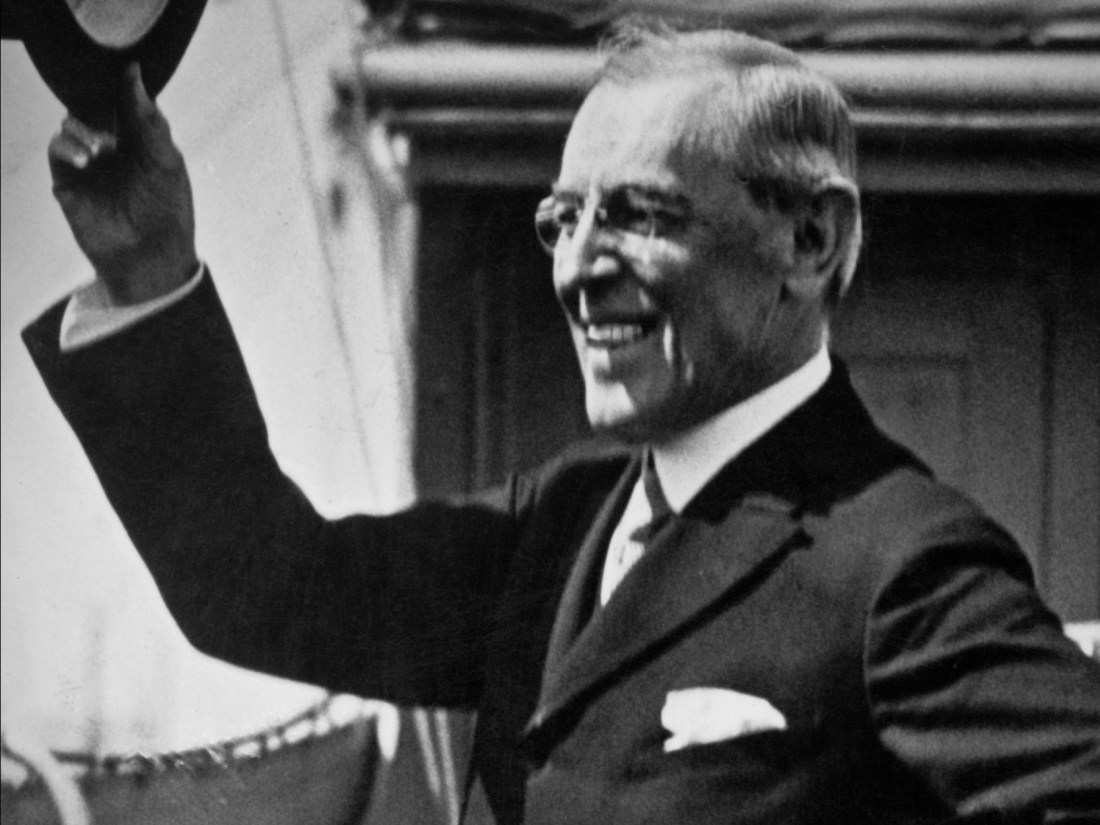
In 1916, the United States held a presidential election. In Europe at that time, World War 1 had been raging for two years. Millions of people had been killed and millions more had their lives and homes completely destroyed. The US had not entered the conflict because, in part, up until that time, the American tradition was to not get involved in European conflicts and affairs.

The Americans thought of themselves as being above being tainted by the “old world” and their issues. However, the war was having a major negative impact on the US economy. Trade was restricted. Investment money was not being used. And, in the minds of many Americans, the threat of what they believed was an aggressive Imperial Germany to the democracies of Britain and France seemed to possibly threaten the US as well.

And so the election that year revolved around the idea of whether or not the US should get involved in a war that had clearly become a meatgrinder, a veritable slaughterhouse, for the troops involved on both sides. The incumbent, President Woodrow Wilson, the Democrat, campaigned on the issue that, “He kept us out of the war.” His opponent, US Supreme Court Justice Charles Evans Hughes, the Republican, was for the entry into the war on the side of the Allied Powers (Britain, France, Italy, and Russia), but he, too, urged caution.

Wilson’s victory in 1912 had been something of a fluke. He was only the second Democrat elected since the Civil War (Grover Cleveland was the other), and it took the splitting of the Republican Party to make him president (Teddy Roosevelt ran against his former VP, William Howard Taft, as a third party candidate in 1912). So, it seemed a foregone conclusion that Wilson would probably lose to whomever the GOP candidate would be. And, so, realizing that the Republicans would probably win the election, Wilson hatched a plan that seems like something out of a movie rather than real life.

Now, I am not now nor have I ever been a Woodrow Wilson fan. He had a messiah complex as big as Texas, and he was an incurable racist. His stubbornness may have even led to the rise of Hitler 13 years after he left office and then, of course, World War 2. But in regards to the election of 1916, Wilson’s plan to make sure America and American interests would be safe in case of a Republican victory , Woodrow Wilson did an incredibly valiant and self-less thing: He planned to resign the presidency.

You see, at that time and until 1937, the incoming president wasn’t sworn in until the March following the election the previous November unlike today when the new president is sworn in only two months later. That original plan called for four months of lame duck-ness that, in times of great national crisis like the war in Europe or later, the Great Depression, can be an extremely long and costly time. So, here was Wilson’s plan. It was actually suggested to him by one of his close advisors. When Hughes won, Wilson would immediately ask for the resignation of both the vice-president and the Secretary of State. He would appoint Hughes to head the State Department, and then he himself would resign. Hughes would be then raised to the presidency as the next in line of succession immediately, thus bypassing the crucial four month waiting period.

But that didn’t have to happen. Wilson surged in the polls in the last few weeks of the campaign. Hughes, thinking that California was his for the taking, really didn’t campaign there much. But it was California that gave the extremely narrow victory to Wilson.

In fact, so confident was Hughes in his electoral victory that he went to bed on election night thinking that he was the next President of the United States. The next morning, when the phone rang in his house, one of his children answered. A reporter asked to speak to Hughes. The child is supposed to have said, “The president is sleeping.” The reporter’s reply was, “Well, wake him and tell him he lost.”

On a Funny Face

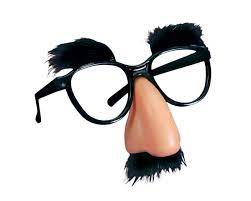
The old “sticks and stones” saying is true but only to a point. Words can hurt, especially when someone is commenting on your physical appearance. That was the case for one man who was born over 200 years ago in the United States. One of the first descriptions of him was “homely and haggard,” and that description was one of the kind ones.

Harsher criticisms included “horrid…ugly and repellent.” Well. That’s blunt. And it seems to have been the general consensus. He looked, one said, like someone drew an overly-exaggerated caricature of a human. Other said that he was “too ugly” to even appear in public. Still others said that the sight of the man’s face was the “object of mirth” and “foolishly comical.”

Add to these descriptions of the man’s face was the fact that he was incredibly awkward in public. His arms and hands seemed to belong to someone else because they were overly large and seemed too long for his body. That made him appear “ape-like” and inhuman. One of the most kind reactions was that of a British man who said he “lacked all that we consider to be debonaire or desirable.”

Now, you’d think such descriptions would cause the poor man to suffer from insecurity and self-doubt, and it did, to a point. However, to his credit, he developed a good sense of humor that fought against those who derided his physical appearance. Someone once accused him of being two-faced, and he is supposed to have responded, “If I had two faces, do you think I’d wear this one?” And another time, he joked that a man once pulled a gun on him and said, “If I ever met a man uglier than me, I’d shoot him.” His reply? “If I’m uglier that you, fire away.”

Yet, the abuse about his appearance never seemed to wane. One friend–yes, friend–said that his head was shaped like a coconut with hair on the top just as uncontrollable as coconut hair. His ears were said to be from someone twice his size. The lips were described as being non-existent. Scraggly sprigs of twine appeared where a normal person’s beard should be. Add to this already funny picture the fact that the man seemed to be covered with moles and warts. His nose was also too big. To complete the picture, a kick from a horse when he was a young man caused one of his eyes to rove independently of the other.

Yet, we don’t remember these descriptions of this man today. In fact, many people today consider this funny face to be the depiction of the prototypical American.

No, we only remember the beautiful heart, the generous nature, and the wonderful leadership of Abraham Lincoln.

On an Uncivil Servant

Manninagh KateDhu was born on the Isle of Man in 1963. From a young age, she was doing her part to help her community. Her first job in government came through an appointment to Board of Agriculture and Fisheries on the Isle of Man. Apparently, she was competent enough in that position that the Lieutenant Governor of the Isle of Man recommended her to a post in the Prime Minister’s offices at No. 10 Downing Street in London. Manninagh flew to London and was received formally by the Home Secretary at the time and began working at the offices.

However, from the start, there was trouble. No one in London could pronounce her name (much less spell it), so they all called her Peta because the previous holder of her office was named Peter. That didn’t seem to sit to well with her. And despite receiving pay for the work, “Peta” seemed to actually do little. Her disposition wasn’t the best, you see, and her personality rubbed many people at No. 10 the wrong way. Job performance reviews from the time said that she was lazy, she was loud, and uncouth as well as lacking in proper hygiene. You would think that such a review would warrant a dismissal from such an important office in the British Government, but, well, that never happened.

Word of this uncivil servant in the cabinet offices soon spread. Newspapers spoke of the ill-tempered worker from the Isle of Man, and the public became interested in the story. Interestingly, people began writing letters to Peta. They told her things such as keep up the good work of being someone who was more like them–just a commoner in the halls of power. The public somehow related to someone who didn’t like her job and did the bare minimum to keep from being fired. In many ways, Peta became a sort of folk hero, a typical Britisher in and among the elite and mostly upper and upper middle class government of the United Kingdom.

Meanwhile, Peta gained a reputation for spending inordinate amounts of time in the area of Trafalgar Square pubs and restaurants where, trading on her new-found fame, she ate her fill several times over. She never seemed to date or have companionship on these outings. And people at the office began to notice that she was becoming, well, morbid obese. And, with the weight gain, Peta also became testier if anything. A spat with a member of the Prime Minister’s household didn’t help matters. There were reports of her starting fights with other staff members. And a movement began to have her sent back to the Isle of Man.

However, that was almost impossible to do. You see, the Isle of Man enjoys special status in the United Kingdom.

To send an appointee back to the island would be considered a slap in the face of that semi-self-governing island. There was also the potential public backlash if this “commoner’s heroine” was let go. So, the Prime Minister’s office found that they were forced to make do with this most uncivil servant.

Peta managed to work for three Prime Ministers of the United Kingdom over her career. The way the office got rid of her finally was that she retired and moved in with another civil servant in her dotage. Never married, she passed away in 1980 at the ripe old age of 17.

Not a bad life for a Manx cat that was a really bad mouser, eh?

On a Fool

In more recent years, what defines a disability has changed dramatically. The standard used to be that the world was almost divided into those who were “able” and those who were “disabled.” That distinction, that line, was something most people discerned visibly–that is, one could see the person with no leg or missing an arm or blind or whatever physical issue was obvious. That is what has changed. The behavioral and social disabilities have become more understood and identified through research and study.

Take, for example, someone who might be on the autism spectrum. In the past, people and even doctors might label such a person as crazy or mad; that person might be institutionalized in something resembling a prison, even if capable of functioning in day-to-day activities. Interestingly, that type of reaction to someone who had different abilities was not present in, of all places, the royal court of King Henry VIII. That king, known for his voracious appetite in food, drink, and wives, also had an interesting response to people who were who had special needs: He elevated them to his group of advisors.

Now, hear me out. While the fact that an autistic person would be installed at a king’s court may seem strange even to us, Henry (and many of the so-called professionals of his day) saw something beneficial in having such people around. You see, people in power often have aides and assistants who tell them what they want to hear; these people too often say what is expedient or even self-serving without regard to truth or even what is the best thing for the powerful person to know or do. However, that sense of guile or deception is often not present in someone who lives with different mental abilities. They are often forthright, direct, and completely honest. So, it behooved the king to have people in court who would tell him not what he wanted to hear, but, rather, what was the truth. And, because there was no secret agenda in the hearts of these people, the king could trust what they said for the most part.

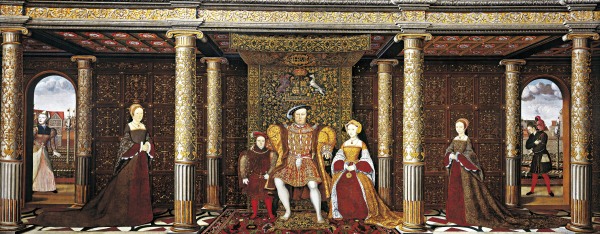
And, according to at least one article on the subject, the Tudors took great care of such people, assigning others to watch for them, help them with daily tasks, and insure that they were safe. They were also given clothing befitting someone who was in the presence of the King of England, items made of silks and other fine cloth. In fact, there is a painting of Henry and his court, and in the artwork are two people on the sides. On the right side is depicted a man named Will Somer. And on the left is a woman known as Jane, but we don’t know her last name. These two are examples of this type of courtier who had special needs.

However, despite their elevated status, the Tudors weren’t so politically correct when it came to labeling these folks. While not purposefully making people in court laugh like court jester would, they received a label nonetheless that reflects how that time period perceived their innocence and lack of guile.

They were known as Fools.

On The New Mayor

We all know that the period after the Civil War in the American South is called Reconstruction. The idea for that time was to try to change the racist system of keeping minority Americans from equal justice under the law. Laws in the former Confederate states that had kept former slaves from voting, for instance, were struck down by the federal government, for example. And the result was the election of many African-American candidates to such positions as senator and representative on both the state and federal levels.

And, as we are aware, when the occupying federal troops left the south in 1877, the majority white citizenry of the various states brazenly took away the rights the minority citizens had through such methods as new discriminatory laws (so-called Jim Crow laws) and intimidation (such organizations as the KKK). And, slowly, the elected African-American office=holders were replaced.

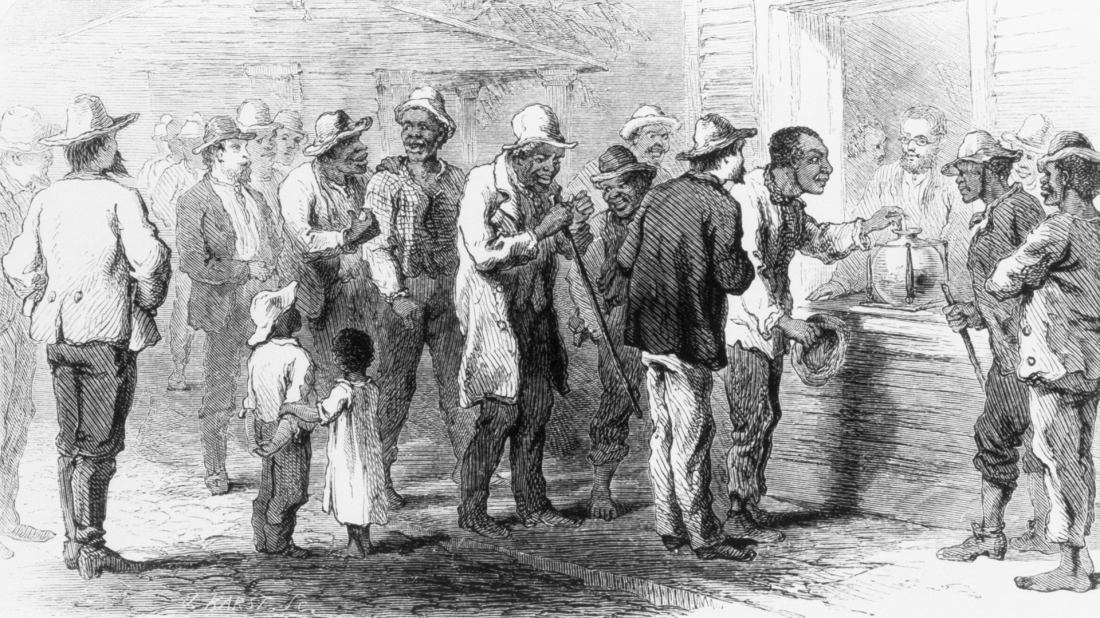
I said all of that to speak about the Alabama town of Newbern. In a story that reflects that racist mentality of the Jim Crow era, it seems that Newbern, a majority African-American town of fewer than 300 souls, had elected its first African-American mayor ever. Up until that time, the little burg had been managed and run by the minority white population despite the fact that the town is over 80% African-American. But, it seemed that for the first time, a non-white mayor had been elected despite white attempts to stifle and intimidate the non-white voters.

One of the ways that the white folks in Newbern kept power was to simply not publicize elections. Over the years, the mayor and town council would hold private meetings where they and they alone would decide who would hold the different positions in town. But then, an African-American citizen named Patrick Braxton filed paperwork to run for the office of mayor in Newbern. Since the white power structure never submitted paperwork and never officially entered the race for mayor in the election, Braxton won the race by default as the only candidate to qualify.

It had never dawned on those in power that anyone would dare to run for mayor in an election. They were shocked when, they woke up one morning, and this man who was not “one of them” was now the duly and legally elected mayor of the town. And, in his role and using his power as the new mayor, Braxton appointed a new town council (made up, interestingly, of people from both races). By the way, there had only been one non-white member of the town council before then.

Well, that’s when the old mayor and town council took action. They simply changed the locks on the mayor’s office and on the council chamber room, effectively keeping Braxton and his new council from their work. They told the newspaper that there was a mix-up, that they had simply forgotten to file paperwork for the election, and that they had held a “private” election where (surprise!) they re-elected themselves and the mayor to new terms in office.

Of course, Braxton sued. But guess who controlled the courts in that part of Alabama–and across much of the old Confederacy? As can imagine, Braxton’s efforts produced no change in Newbern…yet.

You see, this didn’t happen over 100 years ago or even 50 years ago. No, Patrick Braxton, the rightful mayor of Newbern, Alabama, was elected in 2020.

On a Massive Construction Project

When a city wants a pro sports team, it is often up to the taxpayers to foot the bill for constructing the arena where the city’s team will play. Many of these massive projects have been huge boondoggles in the past, with shoddy construction and illegal kickbacks resulting in a lousy building that has a short span of usefulness. As a result, many cities are almost forced to build new stadiums every decade or so to accommodate the sports franchises.

There was one city, however, that seems to have been on top of its game when it comes to building a sports arena.

First of all, the contract wasn’t put out to bid; the city merely appointed the builders and contractors they wanted (that caused a minor scandal at the time but proved to be wise later). There were four different firms hired to build 1/4 of the facility each. These four companies were almost competing to finish their sections on time and under budget–and those that did received an incentive bonus. The beautiful design of arches and tall columns gave the whole place an idea of lightness and airiness. That perception was interesting considering that, at the time it was built, it was the largest sports arena in the country, with a capacity of over 50,000 (that was a large arena at the time).

The politicians and magistrates in charge of the project were onsite daily. There wasn’t going to be any malfeasance of funds, no shortcuts would be taken on this project. And all that oversight paid off. When the public facility was opened, the city pulled out all the stops at the ribbon cutting. Bands played, parades were held, and several events were scheduled back to back to back over several days so that the public could have plenty of time to see where all their tax money went. And they were thrilled. The overwhelming consensus was that the facility was the best public arena ever built. People raved. And they marveled that it wasn’t only a sports arena. They applauded the builders and the government that oversaw the grand, massive project.

The result was a glorious, almost classical building, one that was used over the years as a multi-purpose stadium. However, as time passed, the city found that the stadium had outlived its purposes. So, it spent some time being used as a city garbage dump. That makes sense in one way, because it was a large, confined space, that would keep the trash out of the public’s view or interaction. And, over time, some people began looting the grand old structure. Luckily, the city realized the facility’s potential and took great pains to try to restore the grand old building.

And it is still in use today, at least occasionally. Today, you can still see it. In fact, millions of tourists flock to Rome today to see the Colosseum.

On a Rejected Proposal

We take it for granted that we can go into a grocery store and choose the items we want. That wasn’t always the case. Before a chain of stores known as Piggly Wiggly, a shopper would come into a shop and have to ask a clerk behind the counter for the items the shopper wanted. It was a slow process, and it made the shopper be at the mercy of what the clerk chose for them.

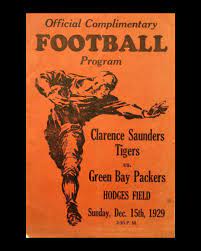
Piggly Wiggly changed all that. Giving shoppers direct contact with the products–and a much wider variety of choices in items–the stores revolutionized grocery shopping. All of this was the brainchild of company owner, Clarence Saunders. The success of the stores led to Saunders opening over 2,500 stores in a few short years. And, with the success, came great wealth to Saunders. The Memphis, Tennessee resident built a large house in a wealthy neighborhood, a house known as the Pink Palace because of the reddish hue of the stone used in construction. He cashed out of the Piggly Wiggly stores and started another chain. It, too, was a success. And, almost on a whim but also as a way of generating publicity for his new chain of stores, Saunders created–are you ready for this?–his own professional football team.

Yes, the Clarence Saunders Tigers were a real thing. Saunders bought many of the best players money could buy. The Tigers were a juggernaut. They played any and all comers all across the United States, and they beat almost all of them to a pulp. Now, this was a time in the 1920s when the National Football League was only then getting started. Some of those early teams such as the Bears and Cardinals and Packers are still in the league today. But the new league was struggling, and they needed wealthy owners who had ready cash–men like Clarence Saunders. After Saunders’s Tigers beat the reigning NFL champion Green Bay Packers in an exhibition game, the owners of the league’s teams extended an invitation to the Memphis team to join the league as a full-fledged member.

But Saunders balked at the proposal. He felt he could make more money as an independent team. His rebuff stung the NFL at a time the league needed cash. But the joke was on Saunders. A year or so later, the Great Depression bankrupted him and his stores–and his team.

Fast-forward to the 1970s. Memphis wanted to join the big leagues both as a city and as the home of a big-league sports franchise. It entered the World Football League, a rival to the NFL, as an attempt to show the NFL that the city could support such a franchise. It built the Liberty Bowl, a pro football-quality stadium to accommodate such a franchise. The Memphis WFL team performed well on the field and at the gate. Surely, such success would show that Memphis would be an attractive NFL city. But the WFL folded due to other weak owners, and Memphis’s attempt to gain a pro sports franchise folded with it.

Then, in the 1980s, Memphis joined a new pro football league, the United States Football League. Again, the Memphis team outperformed most of the other franchises in play and in local support. And the USFL, led by one of the other team owners, a man named Donald Trump, sued the NFL for violating anti-monopoly statutes. The lawsuit seemed to be going well. In fact, it was announced that the NFL would settle out of court and part of the settlement would be that Memphis and three other teams would be allowed into the league. But the lawsuit reached a conclusion with a jury. And the jury award for damages was…$3.76. Again, Memphis was rebuffed by the NFL. Then, the city applied to be an expansion franchise in the 1990s, and it had the wealthiest ownership group of all the applicants, but the NFL chose Carolina and Jacksonville instead. It the city and its sports fans watched in shock and horror as the Houston Oilers franchise moved to Nashville, Tennessee instead of Memphis.

Why was Memphis rebuffed so often by the NFL?

Well, rumor has it that the NFL owners have a long memory. It’s said that the being an NFL owner is the most exclusive club in the world. Memphis longed to join that club.

But it appears that they never forgave Clarence Saunders for saying “No” to their proposal 70 years earlier.

On a Famous Epicure

It’s no secret–I love food. Now, you’d think that someone who loves food has a finely developed sense of taste as to quality and class, but, in my case, you’d be wrong. My tastes are decidedly “of the people” and not refined in any way. An epicure, on the other hand, has refined taste. This type of person knows what wine goes with what course, what cheeses and fruits pair well, and how to appreciate a good meal. Think of someone who really knows fine art and apply that principle to food and you have a decent definition of an epicure.

The epicure in question here is one Edward Dando. He lived in London in the early part of the 1800s. The man was known for frequenting the finest restaurants in the city and leaving his appreciation for his food with the proprietors and chefs. Dando’s life was cut short, sadly, when he caught Cholera during an outbreak and died at the early age of about 30. However, Dando crammed as much living as he could in those 30 years. But part of that life of great food and incredible sensations of his refined palate included a taste for good clothes as well. In fact, Dando was heard to say that his reception at the good restaurants was much better because he dressed as well as he could. The food was somehow better, he argued, because the restaurants thought he was richer because of his clothing.

But that’s the thing. Edward Dando wasn’t wealthy. And that’s the interesting thing about him. And don’t assume that Dando only ate at the poshest places; no, he allowed his taste buds to lead him to even the most common establishments because they, too, can prepare good food even if the upper crust turns their noses up at the locale. So, Dando often ate his way across the spectrum from low brow to high brow establishments.

And he had a special gustatorial affection for oysters. Oysters were consumed by people in England by the millions. It was the one food that all social classes ate with gusto. And Dando ate them by the dozen…dozens. He washed them down with ginger beer and bread with copious helpings of butter. And despite eating more than two or three men at one sitting, Dando remained a thin man all of his short life.

But his reputation as a gourmand grew so large that songs were written about him. Newspapers followed his exploits. He became somewhat of a folk hero in his time. Famous writers like Thackery and even Charles Dickens penned stories and letters describing his eating exploits. Dickens even compared the man to Alexander the Great; he joked that, one day, Dando will cry because he will have eaten the last oyster in the world, and, like the Macedonian when he came to the end of the known world, he will weep because there will be no more oysters to conquer.

As I said, Dando died at age 30. You may wonder how he paid for such extravagant dinners, how he could afford to eat at the best (and sometimes the worst) restaurants in London. Well, wonder no more. The answer is simply that Edward Dando simply didn’t pay for his food. And it wasn’t that the restaurants allowed him to eat his fill for free. No. In fact, the opposite. It seems that Dando was able to go from one restaurant to another, eat more than would kill a normal man, and then simply refuse to pay the bill.

On A Dangerous Substance

When this product arrived in the US in the 1870s, the farmers of much of America were outraged.

How could the US government allow the sale of something that not only hurt their profits but also was so obviously bad for people? The product was a threat to the American Farm, they argued. The sale of it flew in the face of the moral fabric of the country! What type of world would allow such an evil to be for use by any right-thinking American? Even the governor of the state of Minnesota joined their campaign against this product; he labeled it an “abomination” created by “depraved minds” who had designs of killing the American farmer’s way of life. The politician bemoaned the product while he heaped praise upon the “wholesome” and “sweet” products of the farm.

Something had to be done, obviously. Yet, the poor people of the cities absolutely loved the product; they couldn’t get enough of it. And there you have it, in many ways. The divide between a rural perspective verses an urban outlook has long been a staple of American culture and politics and remains one to this day. You hear about the depravity of the cities–filled with the “evils” of foreigners, those Americans of color, and the allure of “sin”–verses the sanctity, the almost sacred nature, of the image of rural America. The divide over this product was part of that ongoing urban/rural split.

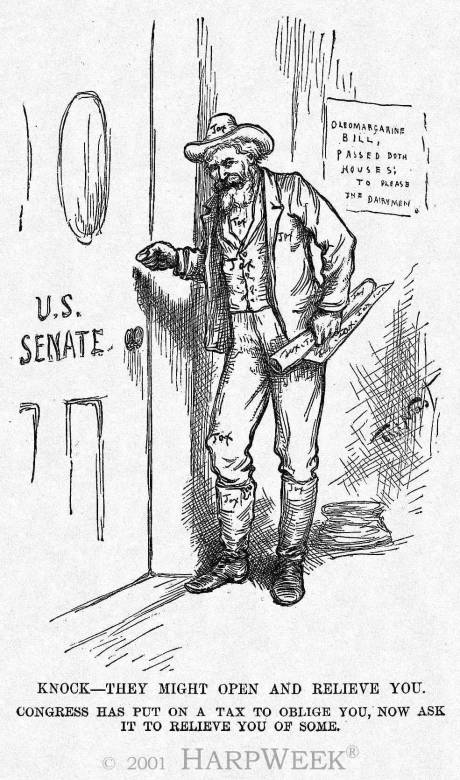
So, in order to combat the evils of this product (and since the rural establishment couldn’t outright ban it legally), they tried to tax the hell out of it in an effort to limit the city dwellers’ access to it. The sponsor of the tax bill in congress, a senator from Wisconsin, said that the product he was targeting was the product of “death” and lacked the “natural aroma of life and health” and filled with “chemical tricks” designed to hurt all right-thinking (read: rural) Americans. But it didn’t slow the purchase and consumption of the product by those in the cities. In fact, within a few years of being introduced into the US, this item was produced by over 40 different companies in an effort to meet demand. And, as the 1800s drew to a close, the cities began to have more and more residents, scaring the rural bloc even more.

A public relations effort began designed to scare people away from the product. Cartoons were commissioned by rural groups that portrayed the manufacturing process for the product and showed “foreign elements” dropping poison, garbage, and even rats into the vats in which the product was made. According to an article in one magazine, this disinformation campaign strongly hinted that users of the product would come down with diseases and cancer and even mental illnesses.

Some states with a majority rural (meaning mostly farmers) population even passed laws either outlawing the use of the product or at least imposing clear labeling on the packaging of the product detailing its potential dangers. Wisconsin, for example, had such laws on their books until the late 1960s, laws that provided for stringent restrictions on how the product would be sold. But, time changes things. Shortages in farm products caused by the first world war, then the Great Depression, and then World War 2 all served to make this product not only acceptable to all Americans but also preferred by most–even most rural Americans as well.

Who could’ve guessed that the introduction of margarine in the US would have caused such a dramatic reaction?