On a Respected Comedian

Jacob Cohen isn’t a name you’ll recognize, but odd are that you know this comedian. Jacob was born to a Jewish family in Deer Park, New York, in 1921. His dad, Phillip, was a vaudevillian, so Jacob entering show business was almost like him joining the family concern. His mom, Dottie, was an immigrant from the old Austria-Hungary Empire. But Jacob’s home life while growing up was odd and sad; his dad, on the road most of the year, only came home about twice a year. Jacob’s mom, he said later, was cold and distant; he said he never remembered receiving a hug from her–ever.

So, it made sense in a way that the young man would leave home and begin a life as a comedian in his teens. At the tender age of 15, using some connections though his father, Jacob began writing jokes for comedians as well as starting to do some stand-up routines in the Catskill Mountain resorts during the summer season. But success didn’t find him early; he sank deeply in debt. He later joked that one gig he did was so far off the beaten path that the review of his show was only covered by Field and Stream magazine. What Jacob realized was that his comedic identification was missing. Audiences, he said, wanted to be able to identify with the person speaking. They should come into a show with an expectation of who the comedian was.

In short, Jacob needed a schtick.

Jack Benny was a tightwad. Charlie Chaplin was The Little Tramp. Rich Little was a master impressionist. Jonathan Winters was a top-notch improv comic.

And Jacob Cohen, building off his childhood where he was largely ignored by both parents, decided to make his character self-deprecating.

And, by adopting this persona, Jacob found success and great respect. His shows became sellouts. He managed to open a comedy club that provided a steady income. He was a featured comedian in the 1960s on the Ed Sullivan Show. He became a respected mentor for modern comedians like Jim Carrey and Adam Sandler. He starred in some of the biggest comedy films of all time and has dozens of film and television credits to his name. One of his comedy albums won a Grammy Award. He became a fixture on late-night talk shows–Jay Leno credited Jacob with inspiring him to adopt the same style of self-deprecating humor. The Smithsonian opened a display containing some of Jacob’s personal items. In Los Angeles, there’s a comedy school that bears his name. Jacob was also the first–the first–comedian to have a website where he posted information about his career and interacted with his fans. He has a star on the Hollywood Walk of Fame. He had a song that was in the Billboard Top 100. A college granted him an honorary doctorate degree. Not a bad career for someone who made fun of his own foibles. And, when he died in 2004 at age 82, the world–not only the comedy world–mourned his passing.

And that’s how Jacob Cohen–you know him as Rodney Dangerfield–got respect.

On a Bad First Impression

First impressions are hard to get over for good or ill. Sometimes, when you meet a person, something about that person bothers you or makes you feel uncomfortable; that person somehow sets off alarm bells in your psyche. That’s what happened in September, 1918, at a dinner in London, England. World War 1 was winding down; the Allies, led by the United States, Britain, and France, were pushing Germany back on the Western Front after over four years of stalemate in the trenches. By November 11, 1918, the war would be over.

A young American government administrator in the Department of the Navy had come across the Atlantic to assist in the final preparations for the end of the war. He had taken a tour of the areas in England where staging bases were located. Then, donning a steel helmet, he was given a tour of the areas behind the constantly moving front lines near Verdun, in France. There, he saw the huge piles of ammunition, bombs, materiel, and food supplies–and also the piles and piles of coffins and dead bodies produced by the war. While he never came under fire, he got enough of an idea of the logistical nightmare that not only prosecuting the war was but also how difficult ending it would be.

He had been sent there on orders of the White House. President Woodrow Wilson needed someone to be his eyes and ears in Europe, someone he trusted. And the young administrator had put together quite the dossier of what it would take for the demobilization of the war effort and the re-establishment of peacetime order and daily life (later on, a man named Herbert Hoover would be in charge of one part of this post-war plan by organizing food relief for Europe after years of having almost no farm harvests because of the war).

Upon his return to London after his tour of the front, this American official had been staying at one of the city’s swankiest hotels, the Ritz. Among the meetings that had been scheduled for him there were appointments with the head of the British Navy and even had some time with King George V, a meeting at which he expressed President Wilson’s admiration for the king. One of the last meetings on the administrator’s agenda before returning to the United States was to meet with one of Britain’s chief war administrators, another navy appointee like himself. The meeting was to be conducted over a supper at the famous Grey’s Inn in London.

The dinner didn’t go well. To begin with the Englishman was late. When he finally arrived for the meeting and supper, it appeared that he had been drinking. The American was underwhelmed. In a diary entry, he later wrote that the Englishman was, in his words, “a stinker…[who] was lording over all of us.” The Englishman seemed to give the impression that the Americans, and this American in particular, were somehow beneath him. And that chagrined the American no end.

So, it’s important what first impressions can do to relationships. Funny, that. In this case the two men later became close friends. The American man later told the Englishman, “You know, I didn’t like you at all when we first met.” That surprised the Englishman because his first impression of the American wasn’t negative.

In fact, years later, Winston Churchill told Franklin Roosevelt that he didn’t remember the meeting at all.

On a Job Transfer

Charles James Stuart was born in Edinburgh, Scotland, the first son of Mary and Henry Stuart. He was raised in Stirling, Scotland, and entered the business of his family at a young age. However, due to circumstances beyond his control, he got swept up in a political plot against some powerful people in Scotland, and Jim was imprisoned for a time. Eventually, he managed to get out of jail, and, with the financial assistance of a wealthy relative down in England who had taken a liking to him, he was able to continue working in Scotland in the family trade for some years.

Then, upon the death of his benefactress, Jim learned that he had been chosen to become the sole heir to her large estates and her position. However, he knew that with great wealth and position came great responsibility. And–and this was a big “and”–it also meant that he would have to move to London to oversee things there. And that was a large ask. Jim loved Scotland, and he knew that he would miss it if he had to spend most of his time in the English capital city. Besides, Jim had managed to fall for a Danish girl named Anne, and the couple were married. Jim even traveled from Leith over to Norway to get Anne and bring her home. The couple’s marriage was not terrible by most accounts, and three children were produced by the pair.

Meanwhile, Jim still had to decide if he would accept the transfer to the work of his deceased relative in London. He said that he would try it; after all, he could always return to Scotland if things didn’t quite work out, right? When he and Anne arrived in London, Jim decided that it was the right move. He told a friend that, in a sense, he’d traded a stone chair for a feather bed, meaning that his life in London was easier because of the wealth he’d inherited and the power that came with the wealth.

But not everything was roses in his new job. Jim soon found that, along with the money, there were some issues. While the woman herself had been wealthy, her businesses had debts, and he had to work hard to address those. And then there were those workers and advisors who had been around and been close to Jim’s dead relative. Some of them questioned whether or not this Scottish “rube” could handle all the affairs he had taken on in the inheritance. Two of the old hands at the job pretty much handled the day-to-day, and that left Jim free to deal with the big-picture stuff. People wondered if Jim could do that, because, while he had experience in the family business, he’d never run an operation this large before.

But Jim was wise for his years. He knew better than to come into a situation and make radical changes from the first. He was careful to learn who did what and how, and, once he found out who was capable and who was not, Jim dismissed the baggage and promoted the ones who were capable. He oversaw some trade agreements, arranged for the sale of some assets that weren’t producing and the acquisition of some that became good producers for him. Soon, the debt was erased. The people who worked for him largely loved his oversight.

Sadly, Jim’s health wasn’t great. He complained sometimes, wistfully, that he would feel better “back home” in Scotland, although by this time, Jim had been in the south for over two decades. He kept his Scottish accent throughout his life, although his children spoke with a London one. Jim had a stroke and died at the young age of 58. And, when he died, people in both Scotland and England mourned him. And you know about Jim Stuart because your house probably has something in it that was commissioned by him.

The King James Bible.

On a Phone Call

We’ve spoken before about how some historians argue that the modern world largely began in the period between 1820 and 1850. The use of steam engines to power factories, the creation of the railroad, and the invention of the telegraph occurred during those thirty years. It can be argued that almost all modern conveniences are merely modifications or improvements over these technologies. For example, the telephone is simply a better and more convenient telegraph, cars are trains for individuals that don’t run on tracks, and so on. Few inventions had an impact on society as the telephone, however.

We are all familiar with the story of how Scottish inventor, Alexander Graham Bell, and his assistant, Thomas Watson, were working on their telephone device one day when the first phone message was transmitted. The story goes that one day in 1875, Bell had spilled something toxic and needed Watson’s help, so he said something like, “Mr. Watson, come here–I need you,” and Watson heard the message through the machine as he was in the next room. Soon, the nation’s cities were crisscrossed with telephone wires tying people together instantly.

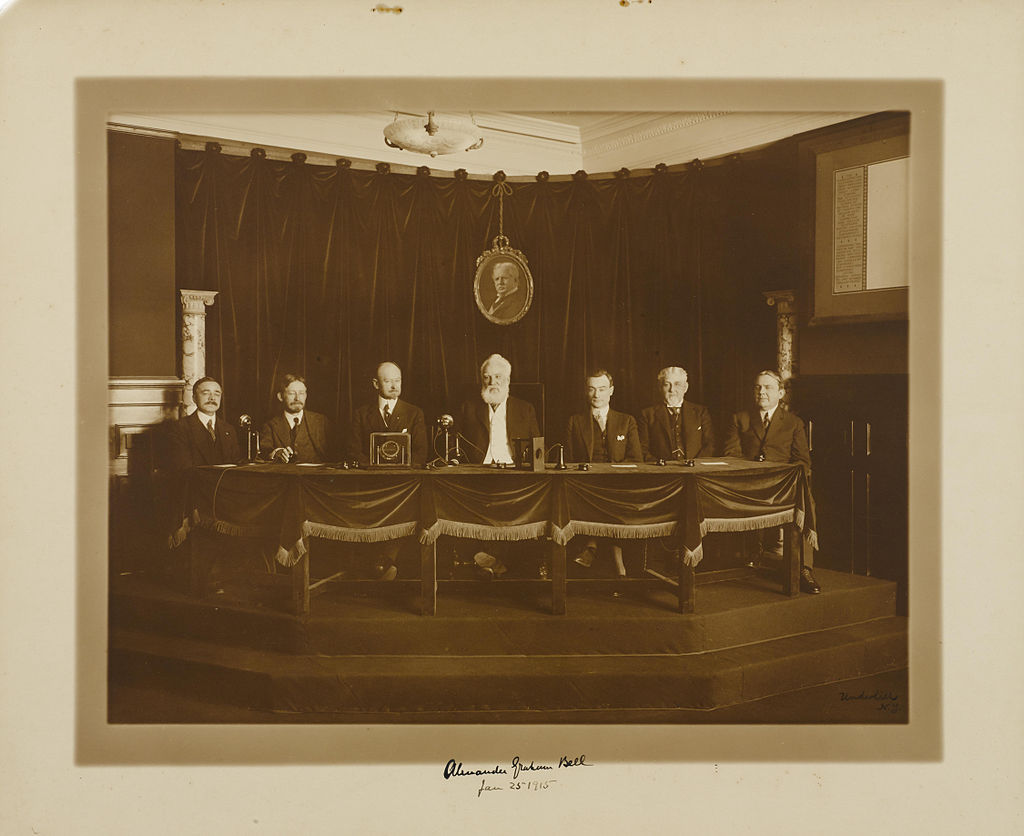
But there was no transcontinental phone system in place. The railroad had connected east to west in 1869. Paved highways from one ocean to the other were finished by 1913. It would be another two years later when phone wires were finally hung across the United States so that a phone call could be placed in New York and received in San Francisco. And to mark that historic milestone, a celebration and many commemorative events were planned. Now, phone lines had been connected from New York City to Chicago by 1892; that network had been expanded to Denver by 1911. And the final section across the Rocky Mountains to California was finished by late 1914. The president of American Telephone and Telegraph (AT&T) at the time, Theodore Vail, had tested the system that year, and it worked, but that first call was kept secret so that the event could be properly celebrated and marked. That’s why the first “official” call was scheduled for January of 1915.

Several dignitaries were to be involved in the call. Vail would be listening in from his winter home in Georgia. The mayors of both New York and San Francisco were also listening in on the line. And President Woodrow Wilson himself later spoke live from the White House to an audience assembled in San Francisco. In his remarks, Wilson noted that it boggled the imagination that a voice from thousands of miles away could be heard almost instantly by the people there. He mentioned the thousands of workers over the years since the invention of the device, the mostly anonymous men and women who manned the operator stations, erected the telephone poles, buried or strung the wires, and did the maintenance on the lines that made all of that possible. That part rubbed Vail the wrong way a little, because he wanted the celebration to recognize the power of AT&T and not the “little people” who were involved.

But the first call that day in January was placed from New York. Telephones had come a long way since Bell had first spoken to Watson 40 years earlier. To honor that event, the first official intercontinental telephone call repeated the words that Bell had said, too: “Mr. Watson, come here. I need you.” And, to make the call even more memorable, those words were spoken by the inventor himself, Alexander Graham Bell, on that January day in 1915.

And, on the other end of the line in San Francisco, when he clearly heard the same message that Bell had said to him 40 years earlier, Thomas Watson smiled.

On a Liberal Education

Schools, for good or ill, form the primary influence on the formative years of children. Teachers spend more time with children than their parents do in most cases. Studies show that young people are far more likely to listen to and believe the opinions of their peers in school than they do those of their parents. And the curriculum of the schooling that children are exposed to can shape not only the individual child but also generations to come. Even a single teacher can make a world of difference–literally.

Take the case of a high school in Germany, the city of Trier to be precise. That school’s principal, a man named Hugo Wyttenbach, was a product of the philosophical movement known as the Enlightenment. In Germany at that time, society was incredibly conservative; the Catholic Church set the public agenda for morality and mores, logic and learning. Wyttenbach, being a Humanist, disagreed. He took his responsibility as a molder of children seriously, and he wanted to teach his young charges that logic and science trumped tradition and superstition. At the same time, he strongly believed that people had a right to choose what they believed, but he also and equally felt that those people had no right to impose their beliefs on others in the form of laws and public strictures.

The school principal therefore sought out teachers to hire who shared his humanist philosophies. Most of those he chose were young, recently graduated teachers who had youthful zeal for teaching lessons that ran counter to the oppressive and outdated lessons of the traditional German religious educational system. The liberal teachers and staff at Wyttenbach’s school soon found that their pupils were eager to learn what they were being presented. The young people could hardly wait to get to school to see what other social or traditional straw man would be skewered by that day’s lesson.

Well, you can imagine that rumors began to spread rather quickly about what was going on at the Trier Gymnasium. Parents began to protest when their children started to question the authority of the Church to impose behavioral expectations on people who had natural free will. Soon, the local conservative city government of Trier got involved. Such was the outrage over what was happening at the school that the Burgermeister of Trier decided to take action.

Upon the mayor’s order, the local police conducted a surprise raid on the school after hours. During this raid, the police found books, pamphlets, and other literature that taught about Humanism and what was dubbed “liberalism.” The police determined that this “seditious” literature was being given to students. Using this as evidence, charges were brought against Wyttenbach and several of the faculty of indoctrinating students in ways that countered the prevailing public mores and traditions of the Church and society. The faculty was dismissed. Wyttenbach was also fired. Because the local population was reassured and content that, with a new staff in place, the teaching would not longer go on in the high school, charges were dismissed and no prosecution proceeded.

But the genie had been let out of the bottle at that point. The students who had been exposed to weeks of liberal political thought and teaching never forgot the lessons they learned during those classes. One of them, so inspired by what he had learned and so shocked at the way the authorities had reacted to the lessons, decided at the tender age of 16 to devote his life to liberal political teachings. He went on to get a law degree and to embark on a life of writing, speaking, and agitating for those causes.

You know him as Karl Marx.

On Getting Away from It All

Ever want to get away from it all? For those who may not know, that’s pretty much what I did more than 2 years ago. Best decision I’ve made in decades. Following the prompting of poet Philip Larkin, I “walked out on the whole crowd” for many of the same reason most people do. A few years ago, another man, a man named Simeon, wanted to follow suit. You see, Simeon was tired of the rat race. He detested crowds and the hustle and bustle of daily life. So, he decided to get away, also.

He was born on what is now the border area between Turkey and Syria, born to a simple but relatively well off shepherding family. At the age of 13, Simeon became obsessed with Christianity. Now, that particular religion was not the one most people followed in that area, and it was relatively easy for Simeon to rise in the ranks of the church. His dedication and asceticism were so extreme that even his fellow monks at the monastery he was studying in asked him to leave. When monks think you’re too radical for them, well, you’re pretty radical. Any way, Simeon sought to clear his mind. So, he found a place in a small cliff facing where he could live out of the elements. It was barely large enough for him to turn around in.

Simeon stayed there in the defile throughout the Lenten season one year, and, when he emerged, people began to believe that he had been sustained during that time somehow supernaturally. He became a local religious celebrity. And that formed much of the problem for Simeon. He didn’t like the crowds who began to follow his every move, reaching out to him to teach them how to live a pious, godly life. And the more people sought him out, the more Simeon wished to retreat in order to continue his religious mediation and prayers. But the more time he spent in dedication to God, the more people sought him out.

Where could he go to escape the growing, burgeoning throngs that were clamoring for words of wisdom from the holy man? It seemed that no matter where Simeon went and hid, people would find him. Finally, Simeon found a solution. There was one place where people couldn’t reach him, one place where the crowds couldn’t bother him with their inanities and their silly questions and their please for his pearls of wisdom.

The place he found was among the ruins of an ancient city in what is now Syria, near the present day town of Taladah. It was in these ruins that Simeon found his happy place, that space that would allow him to be alone with his God and with his thoughts. And it was there he stayed for thirty years. The space he occupied for all that time was not much more than 1 square yard (1 square meter) in area. Boys from the area were dispatched to bring him food and goat’s milk to the isolated retreat so that he didn’t have to venture out to get the basics for himself. Now, to be fair, people still came to see Simeon, but he was able to keep himself separate, above, and beyond their direct reach. They could see him, but interacting with the holy man was not possible for the crowds.

You see, the place Simeon had found to escape to, the safe space he found, was atop the ruins of a temple, on top of one of the ancient pillars left from the old civilzation.

Fifty feet in the air.

On an Urban Legend

Today marks the 60th year since Lee Harvey Oswald shot and killed President John F. Kennedy in Dallas. The history of the world, arguably, changed in those few moments when three shots were fired in Dealey Plaza on that November morning. In the intervening years, our culture has parsed and picked and delved into every nook and cranny of the event in an effort to make sense of something so absolutely senseless.

The purpose of this post isn’t to argue any of the theories about who actually pulled the trigger (There are certainly several red flags about the whole affair and about Oswald himself). Rather let’s compare the shooting of Kennedy in 1963 with the shooting of Abraham Lincoln 98 years prior, because the similarities between the two events have become the stuff of an urban legend.

Let’s start with the men themselves. Kennedy was elected in 1960, while Lincoln first was elected in 1860. But when they first ran for congress, both men were elected in ’46–one hundred years apart. They both were military veterans. Both men were heavily invested in civil rights. Each one was in his 30s when he married a woman in her 20s. Both lost a son while serving as president. Same number of letters in their last names. Both were shot on a Friday. Each was seated next to his wife. The presidential couples were with another couple at the time of the shooting (The Kennedys with Gov. and Mrs. John Connelly, the Lincolns with Major John Rathbone and his fiancé). The other man of the two couples was also injured in both attacks.

The vice-presidents who assumed the office after the shootings also have some things in common according to the legend. Both men were named Johnson. Both were from southern states starting with a “T”–Texas for Lyndon Johnson and Tennessee for Andrew Johnson. Both Johnsons were born 100 years apart, 1808 for Andrew and 1908 for Lyndon. Both men have the same number of letters in their names. They served in the House of Representatives and in the Senate as well before becoming vice-presidents.

The circumstances of each assassination also reveal some urban-legendary coincidences. They were both shot in public view, from behind, and both died from shots to the head. Lincoln was shot in Ford’s Theater, while Kennedy was shot in a car made by the Ford Motor Company, in a model called a Lincoln. Both shooters carried out their dastardly deeds from places where they worked (John Wilkes Booth worked as an actor often at Ford’s Theater). Oswald shot Kennedy from a warehouse and was later apprehended in a theater; Booth shot Lincoln in a theater and was apprehended in a storehouse barn.

Finally, the assassins themselves have some shared characteristics or events. For example, each one has the same number of letters in their full names (15 letters each). They were both shot and killed before they could stand trial for the murders they committed. They were both southerners. Each was living in a boarding house when they shot the president.

Of course, like most urban legends, coincidences are just that–coincidence. One historian, to prove this point, made connections between Kennedy’s tragic death and the assassination of Mexican President Alvaro Obregon in 1928, for example. And some can argue that the trivialization of presidential murder dishonors the men who died and the lives which were forever altered by the heinous acts of violence.

But, 60 years on, perhaps the deep angst that still hangs around the death of John F. Kennedy might lead us to look for something less tragic, less disastrous, and, well, less sad to divert our gaze from that moment. And you have to admit that this particular urban legend has plenty to distract.

And, sometimes, especially on days like these, we desperately need distraction.

On a First Kiss

Eleanor Smith came of age during the Great Depression and World War 2 in the southern state of Georgia in the United States. Her family, she later said, was poor, “but we didn’t know it because everybody was poor like we were.” As the war was ending in 1945, the 18 year old dark haired girl had graduated high school and wanted to attend Georgia State College and study interior design. She had matriculated as the class salutatorian and was a bright student. That’s when she saw the photograph of Earl. And the rest, as they say, was history.

Some people fall in love with a photograph, and that’s what Eleanor did. Of course, it helped that boy in the photo looked so dashing in his US Navy uniform. She couldn’t stop thinking about him. His name was Earl, and he was from the same town in Georgia that Eleanor was from. While he was somewhat older and the two young people didn’t know each other, their families were acquainted. In later years, the couple wondered how it was that their paths never directly crossed in a town so small.

As you might be aware, at that time and in that culture, girls didn’t pursue boys. However, Eleanor wasn’t the typical girl. She knew that she wanted to get to know Earl better. He didn’t seem like the silly boys who were in her grade at high school, the boys who went to the town soda fountain and combed their slick hair back and wore rolled up jeans and sped around the small town in their hot rod jalopies. She could tell, she later said, that the dashing sailor in the photo had a dignity, a class, a certain carriage of character about him that boys her own age lacked. So, through friends, Eleanor arranged to meet Earl when he was home on a leave.

Earl grinned a toothsome smile when he first met Eleanor. He, too, was looking for someone who was more serious about life than most girls of that time. And Eleanor, who seemed cheerful and even playful to a degree, had a seriousness about her that said that she, too, was someone of character and backbone. The couple’s first date was a double date with Earl’s sister and her boyfriend. Eleanor and Earl were in the back seat of the boyfriend’s car when it happened.

Earl leaned over and kissed her.

Well, that had never happened before. Oh, boys had tried to kiss Eleanor before, surely, but she had politely refused. Yet, here was this sailor kissing her on their first date. And in the back seat of a car! But Eleanor had never felt the rush of emotions she felt at that moment when Earl’s lips touched hers. She knew, she said later. She knew he was the one at that moment and in that one audacious kiss.

Well, the couple quickly agreed to get married in early 1946, although they kept the engagement a secret. Eleanor didn’t want to upset her mother with the news that her college education would be put on hold while she and Earl began their lives together. They married in their hometown, in the town’s Methodist Church that was her family’s home congregation. And when Eleanor’s mother heard the news that the couple were to wed, she wept with pride and joy rather than disappointment.

To say that the marriage was a good one would be a gross understatement. Four children were born, three boys and a girl. It lasted over 75 years. It ended only when Eleanor died this week at age 96 in her hometown, the place where she and Earl retired to after lives filled with service to others. And you know her and her husband better by the names their families called them. For most of her life, Eleanor went by her middle name. Earl’s family always called him by his first name. And no one can say that first sudden kiss didn’t turn out to be anything but the beginning of a wonderful partnership between the pair.

I wish all marriages were as happy and successful as that of Jimmy and Rosalynn Carter.

On a Loyal Companion

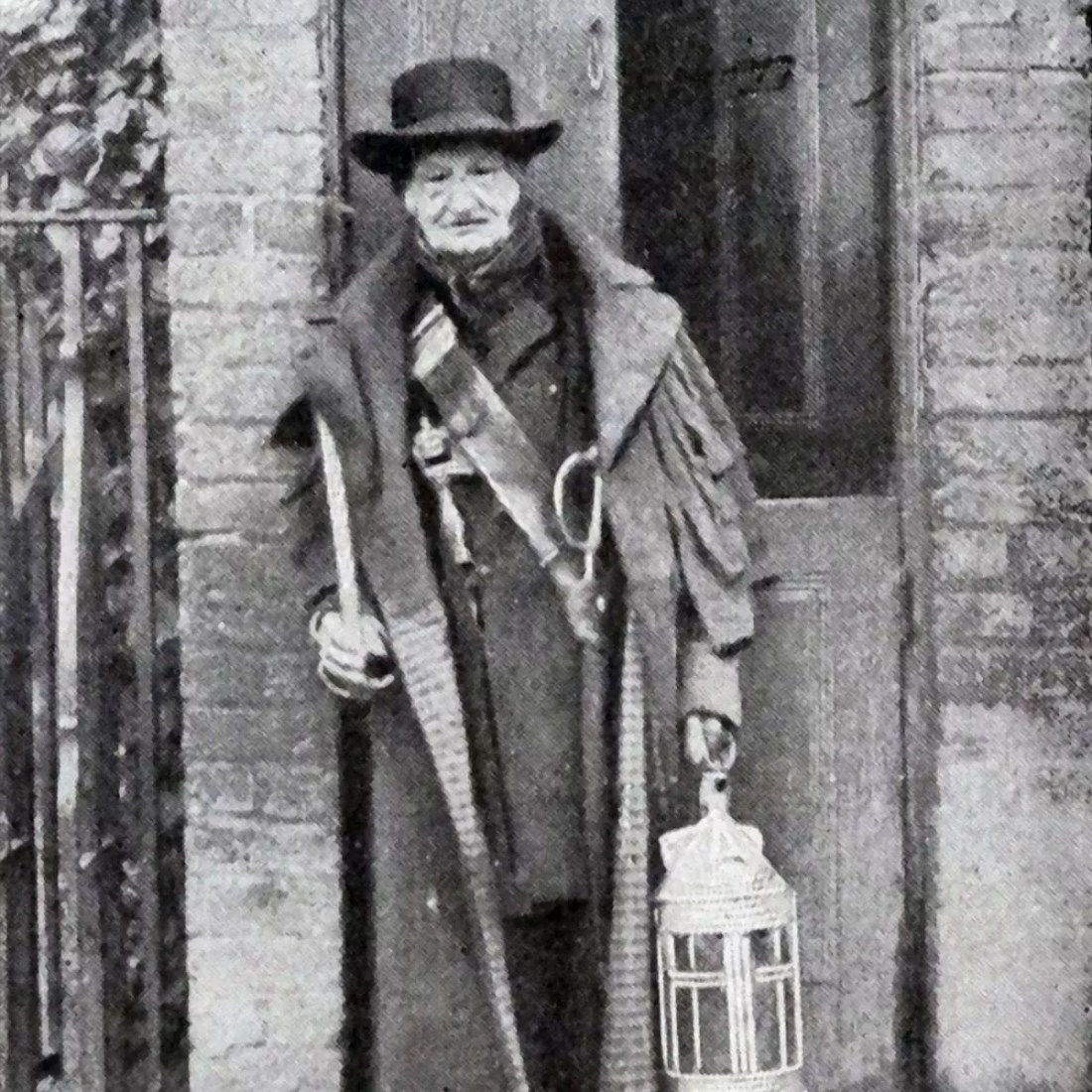
John Gray moved from the countryside of Scotland into the city of Edinburgh in 1850. With him came his wife, Jessica (Jess) and his son, John Junior. While the easy job to get would have been to get work in a factory or workhouse, John opted for less money but, to him, a better job by joining the Edinburgh City Police. He was made a nightwatchman. Now, a nightwatchman’s job, as you probably know, is to walk a route that would take the person around to various businesses and streets where the nightwatchman would check to see if doors were locked, properties secured, and the streets as safe as they could be. If there were any trouble, he would sound the alarm and summon policemen to come investigate or deal with any disturbances.

Sure, it was an entry-level job, but it was one that John enjoyed. Like most who come to Edinburgh, he loved the city. It was the place that birth a cultural revolution, with new ideas and architecture and art being produced in what is now known as the Scottish Enlightenment. New buildings and infrastructure were changing the city from a medieval one known as Auld Reekie because of the close, foul-smelling town into a modern, cleaner, more open and safer city. And John felt that his job was to help, even in a small way, to make the city better. He took pride in the work. Besides, he liked walking the empty streets at night; it gave him the chance to truly appreciate the beauty of both the old town and the newer parts that were undergoing change. A tall man, he strode around the neighborhood purposefully but with a slight and friendly smile on his face, keeping things in order and keeping it safe. He took pride in that.

John’s assignment put him in the neighborhood where he lived, mostly, the area that surrounds the Greyfriars Church and not far at all from the New College, the University of Edinburgh campus. Part of his watch area was Candlemakers Row and what once was the edge of the old town, but now, the area was being rebuild and built up into a bustling section of the town south of the Royal Mile. The George IV Bridge road had leveled the old, sloping and narrow closes that ran off the Royal Mile and replaced them with a new, wide, open, and efficient street. So, John worked this job for almost a decade.

Now, many nightwatchmen had canine companions with them on their rounds. The dogs acted as both protection of a sort and also somewhat of an alarm in case something was amiss as the watchmen made their rounds. John’s “co-worker” wasn’t the usual working dog, however. John chose the family pet as his assistant, a Scottish Skye Terrier named Bobby. Bobby would trot beside John as they went around during the night trying door knobs and peering down side streets. The pair made an almost comical sight as they walked–the tall, angular nightwatchman and the little terrier–and the locals who saw them would smile and nod as the passed the pair. Clearly, the two were connected.

Well, sometime in early 1858, John contracted tuberculosis. Scotland, as you know, is a wet place. Tuberculosis was a common issue among the population. In any case, John died in February of that year. He was buried in the Greyfriars Churchyard, not too far inside the gates of the old cemetery. Soon, people in the neighborhood began to notice that John’s dog, Bobby, began to show up at the cemetery. Bobby would lie on John’s grave as if to say that he was still keeping his job, still watching over his master in some fashion. Now, that’s not too unusual. Dogs often grieve over an owner’s departure. But Bobby was different. It’s not that he stayed at John’s grave. It’s how long he stayed there. Locals began to feed him and try to care for him. One local barkeeper would take him in at night, but he would let him out in the mornings to go back to his place at John’s grave.

In fact, Bobby stayed at John’s grave until he died.

For the next 14 years.

On a Mistaken Murder

There’s no doubt that Christer Pettersson lived a difficult life filled with the results of mental issues. Born to a middle class Swedish family in a suburb of Stockholm in 1947, Christer had a fairly average childhood. He wanted to be an actor, so he attended a high school that emphasized the performance arts. Unfortunately, and for reasons we still aren’t quite sure about, Christer suffered a head injury. To fast-forward to the end of his sad life, Christer died from a brain injury he suffered as a result of a seizure in 2004. The question is: Did a seizure cause the original brain trauma or did it result from it? We don’t know. What we do know is that this once-promising acting student completely changed personalities after the first head injury. He became sullen, withdrawn, and began taking hard drugs. His family had to separate themselves from him because of his sudden outbursts of anger and sometimes, violence.

Those outbursts became more frequent the older Christer became. In 1970, he stabbed to death another drug user, a man who, like Christer, had taken to living on the streets of the Swedish capital city. The part of the city where these men lived was an area where several film and stage theaters were located. The authorities knew that the area wasn’t safe and that most of the homeless population suffered (and still suffer) from emotional and mental challenges. As a result of his mental issues, Christer received a manslaughter charge and was forced to undergo psychiatric care as a result of the killing. Two years after his conviction, Christer was released. He returned to the theater district and to living on the street. He began a life of petty crimes and burglaries to finance his drug use. The violent episodes continued, and he was in and out of police custody.

Then in 1986, Christer later said he had a dispute with a drug dealer who had cheated him in a drug deal. He vowed revenge and told the man to watch his back. Now, we don’t know if this was the case or not. Christer often imagined that people had wronged him when they didn’t. However, given that the man was a drug dealer and that Christer was a drug user, the likelihood that something bad one way or another had indeed occurred between the two is high. And Christer made good on his promise to get the guy who had wronged him.

He saw the drug dealer and a woman walking on the street at the corner not too far from a movie theater late one night. The couple was holding hands as they walked, and, to hear Christer tell it, this angered him even more for some reason. Taking a gun he had gotten illegally and kept on him for protection on the streets, Christer quickly walked up behind the pair and shot twice. He hit the man in the upper back and only grazed the woman. Christer then jogged off ahead of the couple while bystanders ran to help the victims. Within 30 minutes of the shooting, the man was declared dead. The woman’s injuries were superficial and she made a quick recovery. From some general eyewitness accounts, Christer Pettersson was taken into custody as the prime suspect. However, by that time, there was no gun found on him.

Yet, despite the lack of physical evidence tying him to the murder of the man, Christer was picked out of a ten person lineup by the woman who was also shot. He was convicted of the murder of the man largely based on her testimony. However, upon appeal, the lack of a murder weapon and any physical evidence weighed heavily. Besides, the woman’s ID of Christer in the lineup had been somewhat tainted because the other nine men in the lineup were well-dressed and clean, while Christer was presented as he was picked up from the street–dirty, messy, unshaven, an still a little bit high from having gotten some drugs the night before. As a result, his conviction was reversed on appeal, and he was released.

And, as we saw, Christer died from head trauma suffered when he fell after having a seizure in 2004. Many people still think he was the one who killed that man on the street corner that late night in 1986. We still don’t know for sure, despite some talk that he had confessed to some others that he did the shooting. But it turns out that Christer also said that he was so high that he mistook the man for the drug dealer he had his disagreement with. That means, of course, that the man Christer shot wasn’t the drug dealer at all.

No, the man who was murdered on that street corner that night–maybe by Christer Pettersson–was Olof Palme, the Prime Minister of Sweden.