On an Intuitive Child

The man sat in the dingy, smoky, kitchen room of the simple and uncluttered house. He called the small boy to him. The boy bowed quickly, straightened, looked at the man in the eyes, and said, “Sir, may I have those?” and pointed to a strand of prayer beads the man held in his hand. The man was surprised. “Well,” he began, if you know who I am, then you may have these, yes.” The child answered, “Yes, I know,” and told the man who he was. This received a smile from the man. “Then you know whose prayer beads these were,” the man said. Again, the child told the man the correct answer, and the man gave the child the beads. He received in return a polite thanks from the boy.

Then the man took a package from beneath the table and unwrapped it. Inside were several objects, some personal, some of the small household variety, a few tchotchkes. The man spread the items across the table, taking the time to space each item apart at an equal distance.

“Now,” the man said, motioning for the boy to step closer and examine the items, “which of these things also belonged to him?” The boy bit his lower lip and narrowed his eyes as he looked across the table at the arranged things. The man ran his hands over the table. The man then explained what he wanted the boy to do. He would stop, touch an object, and the boy would tell him “yes” or “no.”

As the exercise began the mother of the child watched from the doorway to the kitchen. She was shocked. She heard her small son speaking in a dialect that she did not understand and one in which she had no idea how he could possibly know.

As the little test came to an end, the man allowed himself a small smile. The boy had chosen correctly in every case. “What is your name, child?” the man asked. “Lhamo,” the boy answered. The man looked up at the mother. “Age?” he asked her. The boy’s mom, still recovering from the shock of hearing her son use words she didn’t understand, crossed her arms across her chest. “He’s only 2 years,” she answered. The man nodded. He had all the information he needed.

“What are those things?” the mother asked. The boy looked from the man to his mother and back to the man. “They belonged to the Dalai Lama,” the man explained, “at least the ones your son identified did.”

“What does that mean?” the mother asked.

The man said, “It means that your son is the next one.”

On an Agriculturalist

The myth of the Small American Farmer has been such for at least the past 70 years or so. Corporate farms–large plant or meat-growing facilities, owned and operated at the lowest cost and highest profit possible–have been the norm since the end of World War 2. But that’s not the case in much of the world in Africa and parts of Asia and the India subcontinent.

There, and, to be fair, in parts of South America as well, subsistence farming or small-profit farming is the norm. We in the west can’t relate to the cycle of plant/pray/harvest that much of the world endures yearly. Add to this fact that the world climate is changing, that African rainfall amounts that were stingy to begin with are now even more capricious and precious, that soils that were sandy are becoming even more so, that what remains of African forests (forests that are key to producing rainfall) are being destroyed at an exponentially astounding rate.

Enter into this bleak picture one Monty Jones. Monty Jones was born in the east African nation of Sierra Leone in 1951, and he received university degrees in agriculture and plant genetics from universities across the continent culminating with a doctorate from a university in the UK. Monty grew up with the realization that African agriculture was inadequate for meeting the needs of the population and would, over time, become more so. He’s one of those visionaries who can see a situation and size it up quickly and then look for possible options that would serve as solutions. And he applied this gift to the food crisis on his native continent.

Monty realized that there were some things that he/we could realistically control and many that we could not. He knew that he would be unable to apply political or economic pressure to those who were destroying the forests and changing the planet’s temperature. So, Monty set himself to deal with those factors he could control as much as national/regional politics, economics, and climate would allow him. To organize this large-scale venture, Monty set up an organization called NERICA–New Rice for Africa. It would be not only the group that would work with governments but also be the fundraising, education, and implementation arm of the work. Monty knew that such a large task as working to transform the agriculture of a goodly chunk of a continent required a good organization, and that’s what NERICA is.

Here was the issue as Monty saw it. How could he get African rice, which is drought resistant, pest resistant, and grows well in sandy soil, to be as productive as Asian rice, which produces much higher yields with a much higher nutrition content? Monty developed the method of creating a hybrid of the two types, and, interestingly, he actually improved both strands of the crop. His hybrid rice achieved all he hoped it would, but it also created a strand that increased yield in a shorter growing cycle. Now, the spread of Monty’s strain of rice is still going on across Africa as he and NERICA face political, cultural, and traditional barriers, but the potential of the hybrid to at least begin to address the African food crisis is astounding and promising. Time magazine recognized Monty as one of the 100 most influential people in the world.

And that solution of a hybrid rice strain is the reason much of the world knows who Monty Jones is.

And because you can simply go to the store and get anything you wish without having to consider how or when or why it was produced–that’s the reason you don’t.

On the Elephant in the Room

If you follow this space, you know by now that Edinburgh is one of my favorite places in the world. At the heart of this beautiful and historic city sits Edinburgh Castle, perched atop a large rock stopper on a dormant volcano. That prominence lords over the city, and all life radiates from its epicenter. Over the centuries, the castle has been host to kings, queens, foreign dignitaries, and even captives and prisoners. This tale is about one of those prisoners.

In the early 1800s, Britain was ramping up its systematic colonization of what is now Sri Lanka and was then Ceylon. While the British wrestled control over the territory from the Dutch, the people there were loyal to their local king, a man whom the British eventually replace. Land, economic, and infrastructure reform soon followed. The rich soil of the island provided resources for Britain for decades as a plantation system was imposed.

When the 78th Highlander Regiment returned from their posting in Ceylon, they arrived in Edinburgh with a prisoner in their custody. He was placed in confinement in Edinburgh Castle as it was seen to be the most secure facility to hold him. Now, several mysteries surround this prisoner. To begin with, no history records his name. We don’t know his age. We are not even sure why he was being held; we don’t know why the regiment brought him to Edinburgh in the first place.

Here’s what we do know for sure. This Ceylonese native had a personal jailer. And, because the victors usually write the histories, we even know the jailer’s name: Private McIntosh–can you get more Scottish than that? And we know that the regiment regarded their prisoner as a sort of regimental mascot. When the regiment was on parade in the large courtyard in front of the castle, they put this poor guy at the front of the marching soldiers and made him march with them. And, to further add insult to injury, the soldiers often thought it funny to ply the captive with beer until he could not stand.

We also know that, after a few years in jail, the prisoner died in the castle. He never saw his native land again. Today, you can see wonderful things in Edinburgh Castle. The Stone of Destiny is there. The Scottish Crown Jewels call it home. Wonderful art and architecture can be viewed all around. And, in a small corner sit the feet of this former prisoner. Yes, his feet are on display there.

At this point, you might be wondering what the elephant in the room is that is referred to in the title. Well, the title refers to the fact that the prisoner who lived for a time in Edinburgh Castle was actually an elephant.

On a Big Game Hunter

Holt Collier lived an amazing life. He was born in slavery in the United States in 1848 in Mississippi, and the man who owned the land where Collier was enslaved had been a veteran of the War of 1812 and personally knew Andrew Jackson. Collier showed exemplary skill at shooting even before he reached the age of 10. In the mid-1800s, bears and other dangerous predators still roamed the Mississippi backwoods where he lived. He “killed him a bar” as the song says shortly after he turned 10 years old. From that point on, Collier’s job on the farm was to provide wild game for the landowner’s table.

By the beginning of the American Civil War in 1861, the son of the original landowner now owned the farm. His name was Thomas Hinds, and he became an officer in the mounted troops of the Confederate Army. When he left the farm for the war, he took Holt Collier with him as a camp servant. Here’s where Collier’s story gets a bit murky. The legend says that Collier actually fought in the cavalry unit commanded by Hinds, thus becoming a Confederate soldier himself. If that is true–and some records say that Collier received a pension for his service at one point–then it is unusual to say the least.

After the war and upon his return to the farm in Mississippi, Holt Collier continued to work for the Hinds family as many former slaves did across the southern United States. He also began to lead hunts for bears in the Mississippi hinterlands. According to one source, Collier was personally responsible for hunting over 2,000 bears across the years. His prowess as tracking and hunting drew big game hunters to Mississippi so that Holt Collier could lead them on a bear hunt. When he died in Mississippi in 1936, he was a national legend.

In 1902, Mississippi state Governor Andrew Longino brought some dignitaries with him and hired Collier to lead the group on a bear hunt. Collier agreed. It was only another day of hunting to him. The hunt was largely successful, and all of the hunters had killed a bear except one. Collier had tracked and found a bear for the man to kill, and he led the man up to the bear. Some witnesses who were there said that Collier had tied up the bear so the man could get his kill and then go home, but others said that Collier had simply treed the bear with dogs and brought the man there. Either way, it should have been an easy kill.

Now, I’m not a hunter. I’ve shot guns, but they’re really loud and they make bullets go really fast. Some of my friends are serious hunters; one of them tells me that white-tailed deer are so prevalent in Tennessee that they have become a pest. He sees hunting as ridding the area of a nuisance with his yearly kill quota. I will say that he either uses the deer he kills for meat or gives it to someone who does. And, since I eat meat, perhaps there’s really little difference.

But to kill a bear that was tied up or was merely sitting up in a tree within easy range seems a bit, well, unsporting. To his credit the hunter said as much, and Holt Collier told him that he understood and, in fact, agreed with that sentiment as well. The man returned home having not killed a bear on the hunt despite being a fairly well know big game hunter himself.

The newspapers around the country got wind of the story of this famous bear hunter, Holt Collier, and the other famous hunter who showed mercy to the helpless bear. The public’s imagination was taken up with the story, and one Michigan toy maker decided to cash in on the popularity of the story. That toymaker created a toy that is in almost every house in the western world today.

Of course, you know the merciful hunter as President Teddy Roosevelt and the toy as the Teddy Bear.

On a Heresy

The issue with using religion as a base to write and enforce laws is that religion is man-made and subjective. Your religious beliefs, even if they are different from mine, are no more or less right or good. And the same is true for my religious beliefs. Two people can look at the same thing or idea or work of “scripture,” express our individual interpretations about it, and suddenly my orthodoxy becomes your heresy. And so laws based on these opinions–and that’s all that they are–are not only wrong on their faces, but they also go against basic human freedoms of liberty, justice, and equality (none of which are so-called Biblical principles, by the way).

And all of that that takes us to a case of heresy that was brought against a man in the 17th Century. At this time in what is now Italy, the Catholic Church held political as well as religious power. They prosecuted and persecuted people who did not follow the letter of the Catholic ordinances and beliefs to their interpretation of religious perfection. In this particular situation, a man simply did not agree with the church that the earth was the center of the universe, that all objects circled around our globe.

Nicolaus Copernicus, the Polish astronomer and thinker, had posited a different idea, that the earth revolved around the sun instead of the Catholic model of the opposite. Now, Copernicus wasn’t the first to hold this belief; Greek astronomers and others had made the same claims centuries earlier including the concept that the earth rotated on its axis. Islamic astronomers confirmed these Greek ideas. However, it was the Copernicus proposal that this man had espoused, and it’s what the Catholic church prosecuted him for. One major reason for their prosecution at this time was because Copernicus had published his findings a century before; he drew the known planets in correct order radiating out from the heliocentric system. Many people began listening to the theory, and the Catholic Church saw this as a threat to their ways of belief and their control over what people believed.

So, they put this poor man on trial for agreeing with Copernicus. During his cross examination by the Church’s prosecutor, the man walked back his belief out of a sense that he knew the punishment for his “crime” could be severe. He said that, after careful consideration, that rather than a “belief” in the heliocentric idea, he wanted merely to use that concept as merely a starting point for scientific discussion.

We must remember that this period saw the Catholic Church under attack from the surging Protestant movement. Printing presses published ideas that countered the Church. The Renaissance and the early beginnings of the Age of Enlightenment further challenged the orthodox and monolithic Catholic faith and power. That is why trials such as this one, while seemingly over a trivial matter, were so important to the Catholic hierarchy. While this doesn’t excuse the severe abuses the Catholic Church committed during this period of the rise of heterodoxy in Europe, it does help to explain it. Sadly, similar behavior is occurring across the globe as extremists in all nations are demanding that laws be passed that match their beliefs and not that protect basic freedom of thought and belief.

The argument of the man that he didn’t actually believe Copernicus but only wanted to use his ideas as discussion points did not sway the Catholic court. They found him guilty of crimes against the Church and against God. His sentence was to be under house arrest for the remainder of his life. And that’s what happened to him.

It would take the Catholic Church 300 years before it admitted it was wrong and exonerated Galileo for his “crime.”

On an Influential Teacher

My mother was my first teacher. She instilled a love of telling history stories in a way that captured a young boy’s interest and attention. Mrs. McConatha, an English teacher of mine in Alabama, taught me to love words and how to best use them to tell the stories my mother inspired. And there are others. You probably have teachers who influenced you as well. This is the story of a physics teacher who taught over 150 years ago named Martin Sekulic.

Sekulic not only taught physics, but he also taught Math in several high schools across the Austria-Hungarian Empire. He himself was Croatian, and, like many people in Austria-Hungary, he was a polyglot out of necessity. He could speak and read German, Hungarian, and other languages as well as Croatian. He published scientific articles in several journals over the years, many of them demonstrating the successful testing of theories about light refraction and electromagnet oscillation.

Like many effective teachers, Sekulic brought demonstrations into the classroom. He wowed his students with hands-on experiments in a time when such lab-type work was fairly rare in high school. He paid for apparatuses to be constructed that would allow his students to see the direct application of his lectures for themselves. Imagine a student in the late 1800s not only seeing electromagnetic experiments but also being able to perform them for themselves. By the time he retired, Sekulic had managed to assemble a collection of almost 300 machines that demonstrated physics principles for his eager pupils.

One of Sekulic’s students wrote about him after his death, and the description of the pedagogic methods of the teacher shows how influential he truly was. “He made me want to know more about these wonderful forces,” the former student recalled. For this man, Sekulic’s demonstrations pulled back the curtain on physics and revealed the wonder behind what he called “these mysterious phenomena.”

In fact, this particular student decided to dedicate his life to pursing physics and electro-magnetic experiments and projects, and he invented and patented many important machines and concepts that are still in use today.

Yes, it’s not a stretch to say that, without the considerable influence of professor Martin Sekulic’s lessons, Nikola Tesla wouldn’t have help to create the modern world.

On a Weird Pair of Pants

Iceland is a weird place. First of all, many people don’t have last names–seriously. They take the first name of their fathers and add -son or -daughter (-son/-dottir). So, you’ll have a different last name than your dad (if his dad didn’t have his same first name). So, yeah. They eat strange things, get all their energy from the earth (not a bad thing!), and let’s not even begin to talk about the language and grammar. But the Icelandic folklore is perhaps the most odd thing about this interesting and odd nation of fewer than 375,000 people.

The isolation of the place helped to foster a rich if sometimes oddly twisted culture of strange practices and stories. The Christianity that the island nation practiced a few hundred years ago had not quite shed some of its Danish pre-Christian rituals, and even witchcraft was known to be practiced. For example, if prayer couldn’t heal you or your loved one from whatever ailment you or they had, you would turn to the local practitioner of folk medicine or traditional healing rituals for help. This practice also applied to such things as casting spells on ones enemies to seek revenge or asking for a spell or talisman to help you get lucky and/or fall into some money. And if you think that this is weird, remember that they were killing witches over in Salem, Massachusetts many years after this time period.

That’s where the pants come in. Icelandic folklore has a story that if you wore the pants of your enemy (or friend, even) after their death, you would get all the money that they would have gotten had they been alive. You’d put on the pants, and then you would have to place a coin in the crotch of the pants. The coin would have to have been somehow stolen or surreptitiously taken from the man’s widow without her knowledge. Having done this, the pants would then fill with money as long as you didn’t remove the first coin. And when you died, you would have to pass the pants on to your closest male relative so the endless supply of money would continue for the next generation. If you don’t believe me, it’s all chronicled in the Icelandic Museum of Sorcery and Witchcraft–for real.

And when I say that you had to wear the pants of the person after they were dead, I mean exactly that. The pants, you see, had to be made from the actual person–the skin of the dead person–that you would flay from the waist down, take the skin, dry it, and then make the skin into pants. By wearing them, the folklore said you were, in effect, becoming that person, and that would therefore allow you to fall heir to all their money.

The Icelandic word for these “death pants” is Nabrok.

Told you it was a weird place.

On the Capture of a Radical

John Brown led a small insurrection against the United States in 1859 in what is now West Virginia. Brown’s intent was to raid a federal gun depository–the armory at Harper’s Ferry, in what was then Virginia–and arm slaves with guns so that they revolt against their masters. He and his fellow ultra-radical abolitionists thought that the slave population would rise to answer their call of armed insurrection against the evil of what many Americans referred to as The Peculiar Institution. Abolitionists like Brown felt that they were the hands and feet of God’s freedom and were put on earth to end slavery.

So, with a small “army” of about two dozen men, both black and white, Brown truly believed that he and his men would soon be joined by hundreds of armed newly-freed slaves. These slaves would then turn their guns on their masters, punishing the slaveowners for what Brown felt was a terrible sin in the eyes of God. But, after he and his men took the armory, he realize that he had no way to let the enslaved people know about his plan without raising an alarm that would bring state and federal militias against him and his cohorts. So, to make sure the outside world wouldn’t hear of the capture of the armory, Brown ordered the telegraph lines to be cut.

But he forgot about the train. Some of his men shot at a train that pulled through Harper’s Ferry, and the train managed to make its way down the tracks to a station that had a working telegraph. The train crew sent out word about the situation in Harper’s Ferry, and, soon, a detachment of marines were dispatched to recapture the armory and arrest the insurrectionists. Within seven hours, Brown and his men found themselves surrounded by the marines and other various militia groups who had come on their own accord.

The colonel in charge of the marines sent a message under a flag of truce into the armory, telling Brown and his fellow rebels that they would be protected if they surrendered and gave up all their arms. Brown refused the terms. That led the colonel to order a full assault on the armory. Inside the building, a short but bloody skirmish took place that saw the marines quickly regain control. Afterward, Brown lay seriously injured by a saber blow and several of his men, a few marines, and some civilians Brown had taken hostage were either hurt or killed.

Brown’s actions were first seen as being terrible and radical, especially in the south. Pro-slavery proponents pointed out that his actions were the natural result of uninhibited and dangerous abolitionist rhetoric. After the initial shock of the violence, people in the north began to speak of Brown in glowing terms, began to see him as a shining example of liberty and freedom as defined in the American founding documents. Many today see Brown’s attempted rebellion as the first shots of the American Civil War.

After Brown was finally executed by hanging for his insurrection, people began eulogizing him in literature and song. John Brown’s Body became a refrain sung by Union troops as the Civil War began two years later. In part, it said, “John Brown’s body lies a-moldering in the grave, but his truth is marching on.” Julia Ward Howe changed those words to what we now know as the Battle Hymn of the Republic–leaving out references to Brown but keeping the ideas of the ware being a blow for freedom against slavery.

Oh, and remember that colonel who led the marines in the recapture of the armory at Harper’s Ferry? The one who penned the surrender terms to Brown?

He was offered the command of the Union Army by President Lincoln as the Civil War began.

But, as we know, Robert E. Lee turned down that offer.

On an Exoneration

We’re probably all familiar with pardons. A pardon says that you committed the offense, but you do not have to serve the punishment or pay the penalty for what you did. An exoneration on the other hand is different; it says you did nothing wrong in the first place. In this case, the person exonerated is named Elizabeth Johnson, and her story is quite phenomenal. You see, Elizabeth had been wrongly sentenced to death by a jury of her peers for crimes that we will look into in a moment.

It seems that a middle school class in Andover, Massachusetts, heard about Elizabeth’s case, and their teacher helped them research her situation. After looking at all aspects of Elizabeth’s evidence and the testimony both for and against her, the kids decided that she was completely innocent of the crimes she was convicted of. These amazing young people took the case of Elizabeth Johnson to heart and set out to learn as much as they could about her.

Elizabeth was born in North Andover, and she never married and never had children. Her family was fairly well-known; she was the granddaughter of a prominent minister in the area, and she was named after her mother (Elizabeth’s family referred to her as “Junior” because of this.). She was tried and convicted for her “crimes” when she was only 22 years old. While she had been sentenced to death, the death sentence had been commuted.

But the schoolkids wanted to prove that Elizabeth was completely innocent of the crimes and weren’t happy with a mere commutation of her death penalty. The kids were shocked to learn that not a small number people on death row today have been falsely convicted of their capital crimes. They researched the Massachusetts justice and legislative systems to determine exactly how to assemble the proper evidence, fill in the right forms, follow the correct procedure, and send all of that to the appropriate people to expedite Elizabeth’s exoneration. Their teacher noted that they become so obsessed with the case that almost all other schoolwork went by the wayside, but she could not help but admire their determination to make right what they saw to be a serious miscarriage of justice.

And it worked. In 2022, the Massachusetts State Legislature passed legislation that completely exonerated Elizabeth Johnson, Jr.

You’d think that Elizabeth would be grateful for the tireless work of these young people. You’d think that she would go to the school and thank these wonderful children in person. Of course, she didn’t, but that wasn’t because she was indifferent or ungrateful.

It’s because Elizabeth’s conviction for witchcraft in Salem happened 329 years ago.

On a Loyal Soldier

Major Yoshimi Taniguchi of the Japanese Imperial Army distinguished himself for bravery during World War 2. He and his command fought in the Philippines, occupying the nation for over 2 years before the Americans under General Douglas MacArthur retook much of the Philippines before the war ended in the summer of 1945. His tenacity and bravery in the face of overwhelming American firepower and personnel during the recapture endeared him to his men who said that they would follow Taniguchi to the ends of the earth if he so commanded. Stationed on an island off the northwest coast of the Philippines, Taniguchi told his men to hold out as long as they could as the Americans made their way across the island. He and his men were some of the last Japanese soldiers to surrender when the war ended.

Taniguchi returned home to a country not only devastated by the bombings (both conventional and atomic), but Japan also faced economic shortages of food and basic living necessities, and the embarrassment of having lost the war. Yet, he was praised by his men and his family for his war service to the Emperor and the nation. He took pride in this fact. Like the overwhelming majority of his fellow citizens, he set about the task of rebuilding Japanese society. By the early 1970s, the former army officer had been working as bookseller in his hometown. It was by no means glamorous, but it was good, honest work befitting a man of his character.

As the 30th anniversary of the end of the war approached, the Japanese government contacted Taniguchi and asked him if he would be willing to return to the Philippines to reunite with some of his former soldiers. The government promised to take care of all expenses. Now, Taniguchi hadn’t thought much about such reunions. He never really kept in contact with his fellow servicemen in the ensuing years. Yet, there was one soldier, a Lt. Onoda, whom he had often thought about in the previous 30 years and wondered what had happened to him. Onoda was as loyal a soldier as you could find, Taniguchi thought. The reunion promised to reunite him with this man. Taniguchi realized that it would be a good thing to see Onoda after such a long time, and so he agreed to the trip.

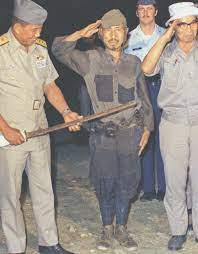
While so much had changed on the island since Taniguchi had left in 1945, the jungle and the heat and the mosquitoes had not changed, he noticed. And, on March 9, 1974, on a trail in the jungle, he was reunited with his former fellow soldier, Lt. Onoda. Interestingly, Onoda wore his old uniform to the meeting. As Major Taniguchi approached his old comrade, Onoda snapped to attention more out of habit than anything else. Taniguchi returned Onoda’s sharp salute, and told the man to stand at ease.

“Lieutenant,” Taniguchi began, “I honor your service to your Emperor, your nation, and your fellow soldiers.” And, surprisingly, Taniguchi bowed low before the man who had been his subordinate. Then he straightened and and continued, his eyes moist with tears.

“The war ended 30 years ago, Lieutenant. You have to face the facts about that. I order you to stand down.”

And, because his commanding officer ordered him to do so, after living in hiding in the jungles of the Philippines, Lieutenant Hiroo Onoda officially and ceremonially surrendered and turned over his gun to the Philippine army–almost 30 years after the war ended.