On an Imprisoned Presidential Candidate

What if I told you about a man who ran for the office of President of the United States from his jail cell?

And what if I told you that this man said he was wrongly imprisoned despite the fact that he supposedly “broke laws” that were “unjust” in the first place?

What if I said that this man had been sentenced to ten years in prison for urging a crowd to anarchy and for whipping them into a frenzy to launch an attack against the US Government?

What if I told you that this man’s speeches were filled with rhetoric where he told crowds that the rich and powerful were out to get them, that the rich were attacking them by attacking him?

And what if I said the man used the charges against him to raise funds that financed his campaign and that most of his raised money came from the poorest people in America?

And what if this man promised that, if he were elected president, that he would instantly pardon himself?

And what if he promised the poorest people of America that, if they supported him, that no longer would they be making products for the wealthy elite, and no longer would they be fighting the wars of the wealthy elite, and no longer would American dollars be spent on the international pet projects of the wealthy elite?

Well, what if I said this man ran for president in ’20…and lost?

Would you like to guess who this man might be?

Make that 1920.

His name was Eugene V. Debs, and, while serving a 10-year sentence for sedition, he won 1,000,000 votes for president while running as the candidate of the Socialist Party of America.

On a PE Advocate

When I attended East Elementary School in Alabama, we all loved our PE classes. Mr. Bradford was our PE teacher. He was the typical 1960s “coach” with the gray sweatshirt and the whistle around his neck and the obligatory flattop haircut. He led us in relay races, square dancing, parachute play, kickball, and (our favorite) dodgeball. All of this was in the name of getting us physically fit, with the concept that along with our minds, our growing bodies needed to work out as well.

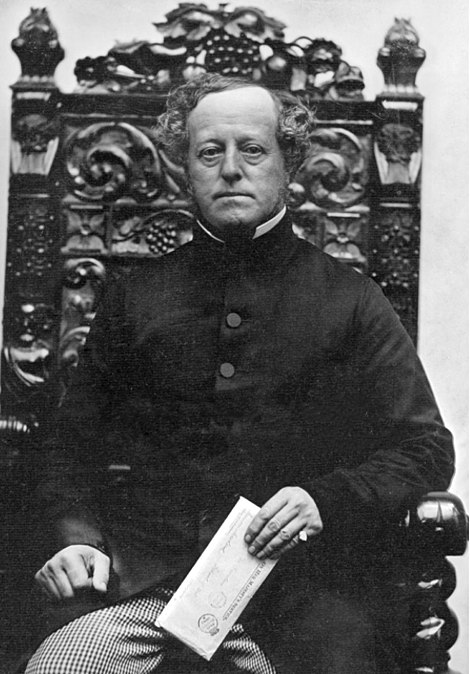
That concept was fairly new in education historically. One of the first and loudest advocates for the inclusion of physical education in school curricula was an Englishman with the wonderful name of William Penny Brooks. Brooks was a doctor, lecturer, and proponent of all kinds of sports. He was the primary cheerleader for adding a physical component to education in Britain in the mid-1800s.

Brooks believed strongly that getting children out in the open air, away from the confinement of soot and smoke-filled houses, would bring health benefits to the entire population. Thus, he championed all sorts of sporting events and competitions in his area of the West Midlands. He soon realized that the kids were absolutely starving for physical activity that was not work-related. Part of the joy of being young, Brooks came to believe, was the vim and vigor that youth produced more than any other age of life. Pouring that energy into physical activity made for healthier young people and therefore heathier adults. In fact, he said, the younger kids would engage in PE, the better not only their health but also their mental state would be throughout their lives.

These concepts can be traced directly to Britain adopting physical education as part of the daily school life in the nation. The United States and other nations soon followed. The idea that young people could be given the chance to have time set aside for nothing other than to play, to exercise, to enjoy the outdoors was seen as being on the cutting edge of educational reform. But the benefits were too obvious.

Brooks said he arrived at this concept in part from being somewhat of a classical history hobbyist. He greatly admired the ideals of the Greek and Roman philosophers who expounded a well-rounded person made for the best type of citizen.

His town of Much Wenlock became the host of a series of organized sporting events centering around and created to draw attention to Brooks’ theory of a healthier body meaning a healthier mind. He invited athletes from around the country to come and compete in his sporting extravaganza. One thing Brooks insisted upon was that common workingmen be allowed to take part in his events. This created quite a scandal among people of the upper middle class. That workingmen could be allowed to run and jump and engage in “gentlemen’s games” with others not of their social class was unheard of in that time. But, again, Brooks persisted, and his trust was rewarded. No outlandish behavior occurred, and his events continued for many years in the mid and late 1800s.

News of these events spread across Britain and even to Europe. A member of the French aristocracy heard of these PE concepts that Brooks propounded, and he traveled to Much Wenlock to see what Brooks was up to. What he witnessed was amazing. Kids and young people from all walks of life were enjoying exercise and simply being outside in the clean air. This aristocrat was so taken with the idea of these athletic competitions that he returned to France determined to do something with them.

Turns out, the Frenchman was Pierre de Coubertin, the man who would turn Brooks’ ideas into a revival of the Olympic Games.

On a Recognition

The recent post about Somaliland and the other nations that haven’t received international recognition as sovereign countries provoked some discussion and swapping of emails among friends. Someone asked why the United States would choose Somalia over Somaliland, especially since the whole Somalia pirate thing they have going on over there.

Much of the American choice to not recognize Somaliland has to do with the religious as well as political situation in the Middle East. Being around the seat of so much oil means the US must tread carefully in order to not anger or embarrass our petroleum-laden allies in that area. Somalia controls the Horn of Africa, a jutting piece of land that sticks out into the Gulf of Aden and dangerously close to the vital Persian Gulf. We can’t afford to anger them by recognizing what they see as a breakaway portion of their nation.

And then there’s America’s historically difficult history with Islam.

Despite the fact that the United States Constitution stipulates that there can be no religious “test” for office-holding, prejudice and distrust of any religion in the US that was not some variant of Protestant Christianity has been rife, historically. And one of the great mysteries of the American slave trade is that we don’t know what percentage of slaves brought to America against their will were Muslims. Some have said that as many as 1 in 3 were. More than likely, the real number is lower but only slightly.

Add in the fact that many American Muslims were darker-skinned compared to their fellow countrymen whose ancestry was Europe; this only fueled the racism that has been in the nation since before 1776. And this doesn’t even take into account the attacks on the United States on September 11, 2001 that significantly increased hatred of Muslims in the nation. So, it’s a gross understatement to say that the relationship between mostly Protestant America and Muslim nations of the Middle East is complicated.

All of that factors into the political reasons why we don’t recognize Somaliland as an independent country.

By the way, did you realize that it was the Kingdom of Morocco–a Muslim nation–that was the first to recognize the sovereignty of a new nation that called itself the United States way back in 1777?

On an Un-Nation

Yes, you read that title correctly. This story is about a place, Somaliland, that has an unknown future. It’s also about places like Somaliland who face similar uneasy and uncertain fates.

You see, the Republic of Somaliland is a nation in northeastern Africa, lying on the coast of the Gulf of Aden near Ethiopia. Its capital city is Hargeisa. It boasts a population of almost 6,000,000. It has a president and a legislature and a court system. For that part of Africa, the economy of Somaliland is actually quite robust.

What you probably thought was that I was speaking of Somalia. Nope. Not Somalia. Somaliland. It’s different. What most people think when they hear of Somalia is that it is the home of the Somali pirates who prowl the waters off the coast of northeastern Africa. But that nation is not Somaliland. No, Somaliland is incredibly peaceful by comparison (although they have recently began an effort to force Somalia into recognizing them by military action).

What’s more, the country has a rapidly increasing literacy rate, a lowering infant mortality rate, and a lower crime rate than many of their neighbors.

So, why is this significant?

Well, to 99% of the world, Somaliland simply doesn’t exist.

The United Nations does not recognize the sovereignty of the country. They say that Somaliland is squatting–has effectively stolen–land from Somalia to carve out their country. And, that’s true. They broke away from Somalia in the 1990s and set up their own government. Yet, they remain unrecognized. However, other nations sometimes break away and have no issues becoming recognized nations by the international community. South Sudan did that not too long ago. Yet, the US recognizes their right to exist as a sovereign nation.

The United States doesn’t acknowledge Somaliland, by the way.

It’s extremely difficult to travel if you are from there because other nations won’t recognize your passport because there is no such place in their minds. They have no access to international financial assistance because they aren’t “officially” a nation even thought the place is a better functioning nation than others in that area. They have a decent military, certainly, and, as of now, there is a wary cease-fire between them and Somalia.

Again, I said all of the above to add this: Somaliland is not alone. Have you ever heard of Transnistria? It’s in a similar political no-man’s land as Somaliland. It lies to the northeast of Moldova on the border with Ukraine. It broke away from Moldova after a bloody “civil war,” but it has yet to be acknowledged by anyone, really. Western Sahara, Kosovo, and, now, even Taiwan all share the same situation. There are several places around the globe in the same boat. No one wants to acknowledge their rights to exist.

As you can imagine there are many different reasons why the international community won’t recognize these functioning nations. Most of them have to do with not angering powerful neighbors or the place from which these places split.

So, where does that leave Somaliland?

They, like their other non-recognized colleagues, exist today in a sort of bizarre international Twilight Zone. And what will happen to them?

We–and they–don’t know.

On The Most Famous Ship You’ve Never Heard Of

It bears repeating that we take intercontinental travel for granted. In the days before long-haul commercial aviation, people and goods traveled by ship for millennia. It’s only been the last 80-ish years or so that flying from London to New York became almost routine, replacing days, weeks, and sometimes months of travel with mere hours. And that doesn’t even take into account the centuries of naval combat in wars across the vast stretches of oceans and seas.

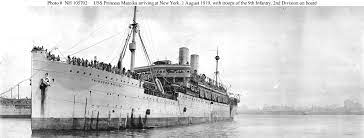
And even though the thought of traveling by boat is not on our agendas these days, the list of famous ships that most people recognize is still fairly long: The Mayflower, the Titanic, the Lusitania, the USS Enterprise, the USS Missouri, the HMS Beagle, the HMS Victory, the USS Maine, and so forth. But there’s one ship that you probably don’t recognize, and that’s a shame, because it broke a lot of “firsts” for a ship that’s relatively unknown. The name of this famously unknown ship is the USS Princess Matoika.

And the ship made history in a relatively short lifespan. She was built in 1900 in Hamburg, Germany, and christened the SS Kiautschou before being scrapped in China by 1933. She went through several name changes over the course of her lifespan, including bearing the monikers the President Arthur, the City of Honolulu, and the Princess Alice among others.

Let’s start by saying that she was built initially to take mail to the Far East in the days before airplanes much less airmail were commonplace. Then, she became a passenger liner in the days before World War 1. That’s when life became interesting. When the Americans entered the war, the ship was in United States territory (the Philippines), and, even though it was a German ship, the Americans claimed the ship as sort of a war prize.

Then, rechristened as the Princess Matoika (one of the names of the native girl Pocahontas), the US used it to transport American troops to Europe in 1918 to fight against the Germans. That alone is fairly interesting. When the war ended, the ship brought back many of the same soldiers she took over to Europe along with many of the bodies of the boys and even the coffins of some of the female nurses who gave their lives in the war to end all wars.

In 1920, her days of hauling soldiers over, the ship was pressed into service to take the United States Olympic Team to Belgium for the Antwerp Summer Olympics that year. But there was a problem on the voyage over to Belgium. Seems that the ship was still pretty much fitted out for carrying the rank and file of the typical American doughboy and not the sort of gentleman athlete of the post-war era. The Olympic Team lodged a formal protest about the living conditions on the ship and some even threatened to not compete because of how basic the ship’s accommodations were. In what became known as the Mutiny of the Matoika, 150 of the athletes signed and then presented a list of grievances and demands to the US Olympic Committee, and the list included the poor food and the fact that most of the male team was put in the hold of the ship with inadequate ventilation and space. However, after much cajoling by the Committee and appealing to patriotism and in the spirit of the first Olympics since 1912, a boycott was averted. Barely.

Things quieted down after that for a bit. The ship was upgraded significantly and returned to passenger service (but not returned to Germany, significantly) during the 1920s. But the sharp decrease in travel from Europe in the 20s and the increasing isolationism of the United States saw the ship fall upon hard times. Interestingly, on one of her transatlantic crossings, the ship hit an iceberg. The passengers, only a little more than a decade removed from the Titanic disaster, panicked, but no substantial damage was done and the lifeboats were not deployed.

The final chapter of the ship began when she was sold to a company that ran a route from New York to Naples to what was then Palestine. The company was owned by a consortium of Jewish businessmen. Renamed the President Arthur, the ship became the first on the seas to fly what is today the Star of David national flag of the State of Israel, even though Israel wouldn’t become a nation for another two decades.

And, in one more in a remarkable series of “firsts,” the open-minded company that ran the route into Palestine did something no other ship had done in history up to that point.

In 1922, the SS President Arthur became the first vessel that had women to serve as officers on a ship at sea.

On a Complex Occupation

Imagine stumbling upon a large complex of buildings, so vast and so beautiful, that words to describe it would fail you. Imagine architecture so complex and intricate that it surpassed anything you’d ever seen in your lifetime. Well, such a place exists in this world today. It’s visited by thousands each year, and all of the visitors come away from the encounter stunned and awed.

One of the first men from Europe to bear witness to such a place wrote of it saying, “The pen cannot describe what it is like; there is nothing like it in the world.” Another early European visitor said that something so vast and exquisite could only come from the hand of someone like Alexander the Great, or, he argued, perhaps the Romans could have conjured such grandeur but no one else.

Wrong on both counts.

Some Europeans saw it as something like an ethereal palace compound that was built for some special, holy king. Others insisted that the place was a palace constructed especially for one of the gods himself. In the early 1860s, a French explorer and naturalist said it was grander than anything designed by Europe’s greatest architects, decorated by painters and artists greater than Michelangelo, and that the entire place made all of the buildings in the rest of the world appear to be “barbaric.”

It was, and is, none of these things.

What we know for certain is that this complex was constructed using about 7,000,000 sandstone blocks. the largest of which weighs almost two tons. More stone was used in this place for construction than in all of the pyramids combined, while the area of the complex is larger than the area of modern-day Paris, France. What’s more, almost every square inch of this monstrous place features intricate carvings. It rises in parts to over 200 feet above its base, and, incredibly, records indicate that this amazing complex took place over 28 years to complete. We also know that it was constructed using rudimentary tools in the early 1100s A.D.

Yet, no one lived there. There’s not a trace of houses or household artifacts or anything used in daily living. And that is by design. The Europeans were largely clueless as to the complex complex’s purpose, the meanings of its decorations, and the intent of its planners. They didn’t realize that it was built first as a Hindu and then eventually turned into a Buddhist temple complex.

But Angkor Wat so captivated the French imagination that, under the pretext of saving the temple complex and its artistic treasures, the French government launched a military campaign that led to the occupation of Cambodia and Vietnam and the eventual establishment of French Indo-China.

On a War Memorial

It’s difficult for us today to realize the impact the French Revolution and then the Napoleonic Wars had on Europe, North America, and the trade around the entire globe. These wars that raged almost constantly from the late 1700s to almost the 1820s saw most of the world’s major powers take part in what could arguably be called a true World War because of how wide-ranging it was. As we know, the French side lost, Napoleon was exiled, and the British-led coalition emerged victorious.

One of the major heroes of that series of wars for Britain was Admiral Lord Horatio Nelson. While Nelson had won several victories in the wars, his major naval victory over Napoleon’s forces at the Battle of Trafalgar in 1805 was one of the most important turning points in the defeat of the French leader. Nelson died from a French gunshot that pierced his lung and back during the battle onboard his flagship, the HMS Victory. A wave of memorials to the fallen hero were constructed across Britain.

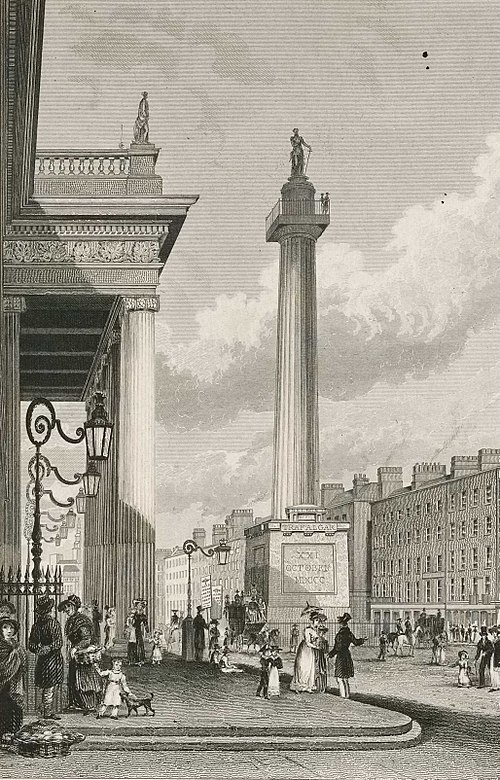
One of the most prominent monuments to be build was named Nelson’s Pillar. Commissioned shortly after the battle and completed four years later, the pillar stood on O’Connell Street downtown. The combined height of the pillar and the monumental statue that stood atop it was over 135 feet. The base was so large that people could climb to the top of the statue using a spiral staircase that wound its way through the pillar. When tourists or visitors would come to the city, it became practically a requirement that they would climb Nelson’s Pillar.

People in the city at the time of the monument’s construction were proud of what Nelson had accomplished. As much as 20% of Nelson’s sailors in the famous battle were either from the city or from the surrounding area. The citizens’ hearts swelled with patriotism when news of the victory came. Funding the monument wasn’t a problem at the time. The pillar stood in its prominent place and became a city landmark, a source of local pride.

But, then, in 1966, a man named Liam Sutcliffe climbed the stairway inside the pillar one evening as it was about to close. Liam left a package there. During the night, the package exploded and destroyed Nelson’s Pillar. All that was left was about half of the shaft of the pillar.

And no one seemed to mind too much.

Liam was never charged by the authorities for blowing up the monument. He even went on a radio station and bragged about his deed, even mentioning two accomplices who aided his act of blatant public vandalism. In fact, most people in the city and the nation applauded this act, this destruction of a monument dedicated to a great hero of British military history.

And they would, wouldn’t they?

The pillar was in Dublin, Ireland, after all.

On a New Pesticide

We’re familiar with the negative effects of such pesticides as DDT and 2,4-D, and the havoc such dangerous chemicals can have on people and the environment. In our efforts to increase crop yields, corporations employed chemists to create stronger and stronger pesticides to fight insects that literally ate people out of house and home. The need for stronger pesticides came as the pest themselves grew increasingly tolerant to the weaker chemical applications.

We still don’t know the long-term consequences of decades of the saturation of agricultural land with these pesticides. Besides the killing of other grasses and botanicals, pesticides can cause massive kill-offs of birds, rodents, and other wildlife. They can seep into the water table and the water cycle, dousing the human population with dangerous and harmful agents. Cancers, often lymphomas, and other illnesses result. Humans can inhale the molecules of these chemicals, and we are still learning of how they can affect the brain, our reproductive systems, and our natural resistances to other diseases.

The landlocked African nation of Lesotho has what they think may be a solution. Now, you’ve probably never heard of Lesotho, but it’s in extreme southern Africa, and it’s actually a kingdom. Most of the country is at high elevation. They farm grain crops in the valleys, and, in the past, they have suffered from infestations of various insects including beetles and grasshoppers as well as aphids, worms, and weevils. These swarms and some crop blights have caused famines and extreme hardship among the people over the centuries. The government tried using chemical pesticides and insecticides to fight these agricultural battles, but the nation decided that the negative effects of the chemicals outweighed the benefits.

So, turning to the scientists of the national university, the nation has turned to a new source of an effective insecticide. It’s one that came from a most unlikely source. And the efficacious rate is several times higher than any known chemical insecticide. When concentrated amounts of the substance was applied to plants as a spray, this natural repellent didn’t take long to have an impact on the insects that came in contact with it. In fact, the insects that had even the smallest interaction with this new application died within hours, not days or weeks. Studies show a 100% kill rate on such species as black aphids.

Most importantly, the naturally-occurring chemical is safe for humans. The crops are not affected negatively, and the surrounding environment remains healthy. What’s more, Lesotho feels strongly that using this new and natural insecticide could begin the long process of allowing nature to heal itself, to start a return to a safe and natural environment that can still produce high-yield crops to sustain a population.

Where does this natural chemical come from?

Why, it’s a yellow, sticky secretion that is highly toxic to most bugs and insects, and, ironically, it originates from the ducts of one of the most egregious and long-term offenders of agriculture.

The grasshopper.

On a Fat Man

Tum-Tum was one of the wealthiest, happiest, and dumbest people in all of Britain in the late 1800s. Of course, Tum-Tum wasn’t his name, but it’s what all his friends called him because, as you can imagine, this man had a rather corpulent bent to his frame. And his given, Christian name didn’t seem to fit him because, well, he was so jolly and fat. In fact, he was so fat that he couldn’t button the front of his suit vests.

And it should be no surprise that Tum-Tum’s money was from the aristocracy. He had large houses in and around London in which he threw amazing parties across several decades. He and his fellow revelers became known as the Smart Set because all their party exploits were splashed across the tabloids daily. All what this group of upper-crust snobs did was gobbled up by a public eager for news of what the rich were up to. If the wealthy people did it, then the common man wanted to do it, too. The Smart Set often set the pace in fashion, habits, and even things like what alcoholic drinks were to become popular. For example, because Tum-Tum couldn’t button his vests, the popular thing around the nation for a time was for gentlemen to also not button their vests.

And none of this accounts for the inordinate amount of adultery that went on at Tum-Tum’s parties. And the fact that he was married and had several kids didn’t slow him down. For such a fat man, Tum-Tum got around. He preferred his women newly married, it was rumored, because they were usually more “careful” about any possible “accidents” that might result from a rendezvous with him. There are photographs (this being the late 1800s after all) documenting Tum-Tum sitting at parties with his mistress du jour by his side. Looking at these women, they indeed look young but are always dressed properly and conservatively as a married woman should. Once, he had to testify in court at a divorce proceeding but, because of his wealth, his lies about his involvement with the woman in question were believed. The husband’s suit for divorce was dismissed.

Tum-Tum’s idea of a joke was to pour champagne on the head of someone else. He found this immensely humorous, and it caused him to hold his tum-tum and belly laugh uncontrollably. Again, he wasn’t the brightest bulb in the pack. Even his parents despaired of him. Mummy realized her son was a wastrel. His father said, of Tum-Tum’s intellect, that it was like “being robbed on a trip but finding that your weapon is buried somewhere at the bottom of a trunk.”

Ouch.

Eventually, Tum-Tum’s extravagant lifestyle finally caught up with him. A Jeroboam of champagne, twelve of the finest cigars and five meals a day will do that. He died in 1910. His last words were, fittingly, about a successful bet he had placed on a horserace. He was mourned, certainly, but some people didn’t really seem to miss him despite the fact that he was so popular for most of his life. A fitting epitaph was supposedly said by one of his friends that, “It was happy to have known him, but it is happier still that he is gone.”

At his funeral, it was remarked that while he was of the nobility, he was, “too human.” Of course, we’re speaking of King Edward VII of the United Kingdom, Emperor of India, and son of Queen Victoria.

On the Kaiser’s Generosity

Ulya and his friends wanted to travel from Switzerland to Russia, desperately. World War 1 was raging, and they deeply desired to go home and work to make their nation better, to solve the issues of the war, and fight–and die, if necessary–for their fellow Russians. And, so, the group of friends boarded a train in Zurich in April of 1917 and headed east.

Now, Ulya is short for Ulyanov, the man’s last name, and it’s what his pals called him. Some friends called him Nicky, but that was a nickname that had nothing to do with his real name and more to do with his larger-than-life personality that came across as a leader like Machiavelli wrote about or like an emperor, a czar–like Russia’s Nicholas II was. Born to an upper middle class family in a large city a few hundred miles east of Moscow, Ulya gave the impression that he felt he was somewhat better than others. His classmates in school agreed with this assessment, as had received the normal private education for a boy from a well-to-do family.

Before the war started, however, Ulya had been studying and writing in London and Munich and other places around Europe. He was, in fact, in Eastern Europe when the war broke out, and circumstances prohibited him from making his way back to Russia to offer his help in the war. He ended up finding a safe haven in neutral Switzerland; it was a place from which he could study and work in relative comfort and also plan to make his way back to Russia.

That was the trick, right? How could he cross the territories of Russia’s enemies, Germany and Austria Hungary, and reach Mother Russia? Even trying to reach water to attempt to reach his homeland by sea would require Ulya to attempt to traverse enemy-controlled land. So, for the first almost three years of the war, Ulya was unable to find a way to Russia.

Then, a miracle happened.

In what seemed like an incredible act of generosity and largesse, the Kaiser of Germany, Wilhelm II, a man who was a cousin of Czar Nicholas, offered to provide a train that would take all Russians who wished to go home back to Russia. That meant that Ulya and several of his fellow Russian citizens and friends could safely cross the enemy territory and return to Russia. A naturally suspicious man, Ulya and some of his buddies talked about the offer. Was this a trap? Could they trust the Kaiser to keep his word?

The desire to reach home finally proved stronger than any possible fear of being captured or imprisoned. And the Kaiser proved to be true to his word. The train was sent to Zurich, and Ulya and his fellow Russians boarded; they couldn’t believe their good fortune and the Kaiser’s miraculous provision. The route proved to be long and arduous, having to travel north into Scandinavia and come into Russia by the north, but it was worth it, Ulya believed. And, before you think that the Kaiser did this out the kindness of his heart, well, think again.

You see, the Kaiser had an ulterior motive. Within a few weeks, Ulya–Vladimir Ulyanov, known to the world as Lenin–and his fellow communists helped to overthrow the Czar and take Russia out of World War 1.