On a Poetry Manuscript

In 1869, the English artist and poet, Dante Gabriel Rossetti, was working on a book of poetry from a manuscript he’d written almost a decade earlier. Much had happened to the famous founder of the Pre-Raphaelite artistic movement in that time, and he was looking for a re-kindling of his earlier muse to get his creative juices flowing. And that’s why he was re-visiting this old handwritten book of poetry.

Well, that and the fact that he needed the money.

The Pre-Raphaelites combined legend, history, religion, and a bit of romanticism (not romanticized) to create paintings and books and poetry in a sincere (and less stylized, thus, before the time of the Italian painter Raphael) manner. While often religious in tone, the movement was actually anti-church. They felt that a more natural and simplistic religion was more in keeping with their artistic temperament. That has led other artistic and social movements to claiming the Pre-Raphaelites as their spiritual forebears, everyone from Tolkien to Led Zeppelin to the hippies of the 1960s.

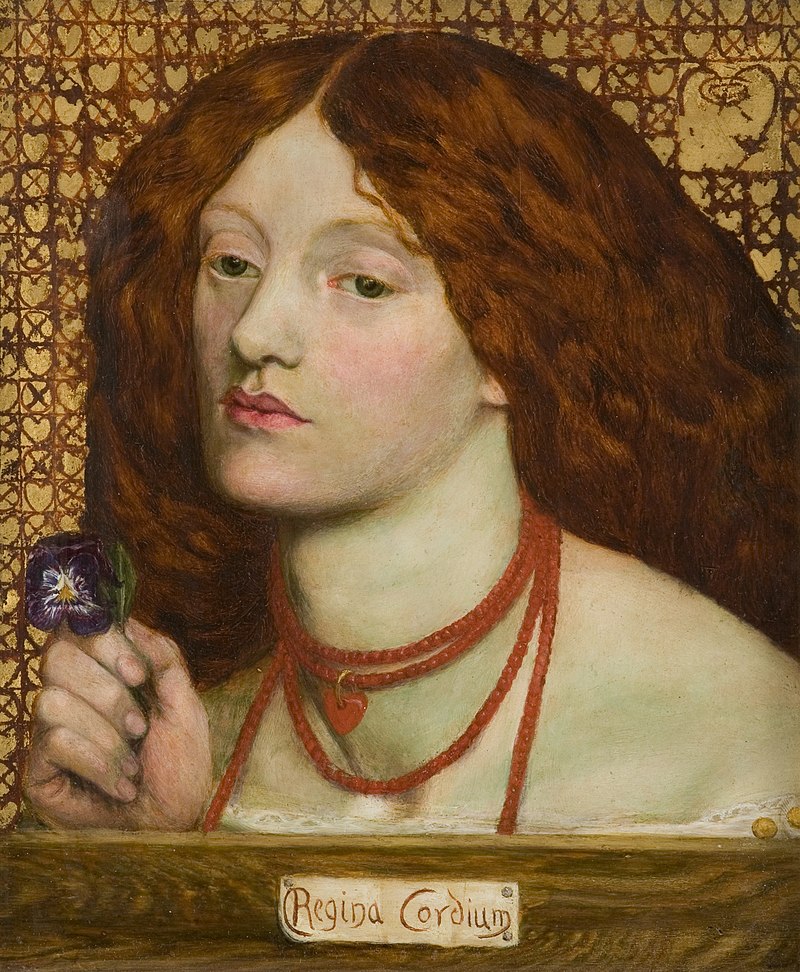
Rossetti had poured out his heart and soul into those old poems. His inspiration for them was a woman and fellow artist named Elizabeth Siddal. You’ve probably seen paintings of her (and possibly by her) because she inspired many of the artists of that time period with her look. You see, Rossetti was deeply in love with her as well as using her as a model for many of his works, both painted and written. In fact, he ended up marrying Elizabeth.

However, the poor woman had health issues and had died in 1862 at age 33 of an overdose of the drug laudanum. It was only a couple of years after the pair had wed. That untimely death of such an influential model and inspiration had only served to increase the myth surrounding her beauty and power over the artists of that movement. And Rossetti had not even looked at those poems since her death. Yet, here he was, seven years later, seeking to capitalize on the potential income that a book of poetry inspired by Siddal could bring.

So, he carefully took the handwritten book and began transcribing it and editing it for publication. The years had not been kind to the text. Worms had eaten holes through words in the manuscript. Mold and a foul smell emanated from it. Disinfectant had been used, but that only seemed to make the odor worse. The book had obviously been wet for some time. You could practically see the decay that overlaid every page. But Rossetti plowed through it, making the best of the poor situation, until he had copied out all that he could decipher. Then, when he’d finished, he had the original destroyed.

The resulting poetry book was published to in 1870 and received poor reviews for containing what was seen at the time as being extremely lewd poems.

And it makes sense that the manuscript had deteriorated over the seven years. That was because of where Rossetti had placed it when his wife died.

Elizabeth Siddal Rossetti famously had long, red hair. And, when she was put in her coffin, the artist placed the volume of poetry she’s inspired into her hair next to her face before the coffin lid was placed over his wife’s body.

Seven years later, he dug her up and took it back.

On a Shipwrecked Teenager

John had been forced to go to sea to support his family. His dad had died a few years earlier, and the 14 year old had an older brother, but that brother was sickly. Thus, John became the man of the house and, as was often the case in those days, the one to be the breadwinner. Growing up on the coast, it was natural that John would get a job with a fishing crew, and that’s what happened. The year was 1841, and times were tough. John was hired on by the small boat crew to be the helper and the cook during the days out at sea fishing with large nets held up by buoys.

But, on one of his first times out with the boat and crew, a storm blew up and sent the small vessel far off course. They ended up barely making it to a deserted island off the coast, where they were unable to get their craft seaworthy again. Thus, the five person crew had to endure six months of near starvation on the island, eating what fish they could catch near shore.

Then, miraculously, a whaling ship sailed by and spotted the castaways. The captain of the ship, William Whitfield, was happy to take the 4 men and the teenager aboard, but he told them that they’d have to go with his ship, the John Howland, on the whaling voyage before he could land them anywhere. The men eagerly agreed. Anything was better than dying on that island.

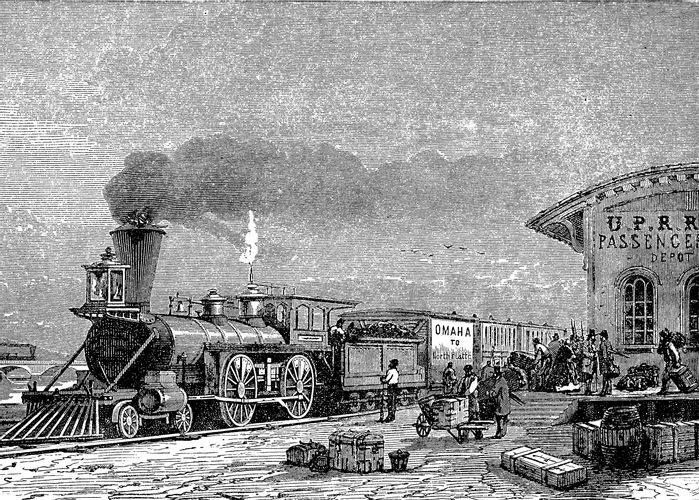
Finally, then the whaling ship reached port, the four adult men were happy to be put ashore, and they tried to make arrangements to somehow find their way back to their homes. But Captain Whitfield had taken a liking to John, and he offered the teen a chance for an education in Whitfield’s hometown of Fairfield, Massachusetts. John jumped at the chance. He was thrilled to go, and it was there that he saw things that amazed him. He rode a train for the first time. He learned navigation. He learned to read and write and a foreign language. He apprenticed as a barrel maker. And then Whitfield got John a place on the crew of another whaling ship.

By September, 1849, John was 22 and had a decent amount of money. He’d frugally saved as much as he could of his pay from the whaler, and he decided to join the thousands who were headed to California for the Gold Rush. There, even though he arrived a bit later than many, John managed to make a decent amount from his prospecting. And it was then that John decided that he wanted to return home, to the mother and small family he’d left almost a decade before.

And so he did. He was warmly received by his family and village on the coast, and he became somewhat of a minor celebrity in the area because of his adventures at so young an age. His family never grew tired of his tales of travel, of the things he’d experienced and seen, and of how educated and “proper” he’d become.

In the 1860s, his country called on John. Because of his travel and language experience, he was asked to serve as a sort of ambassador for some visitors to his country. It seems that no one else spoke the language he had picked up back in school in Massachusetts. The country needed John to interpret for them as they welcomed strangers to their shores.

You see, John wasn’t really his name, it was only the name that Captain Whitfield called him. His birth name was Manjiro, and he was one of the first Japanese men to have ever visited the United States. And, when Japan opened its doors to foreign trade, it was Manjiro who represented the Japanese emperor and who translated Japanese into that strange language he’d picked up in Massachusetts.

English.

On a History Theory

During a video work meeting recently, one of the moderators shared a video of a person using a pay phone. We were all struck with the fact that those things have pretty much gone from the landscape in much of the western world, an entire segment of the communication industry replaced by more modern methods of human interaction. Ask the harness makers from 120 years ago or the carriage companies from the same period about becoming obsolete. People are now being replaced in many areas of the manufacturing sector by robotics (and even in the logistics sector as well). Certainly, air travel, cell phones, and automated factories mark the modern world.

And that’s the way of the world, I suppose. Except maybe not. Let’s go backk (insert echo sound effect here in your head), backkk, bakkkk. We are really talking about innovations in three major areas of life throughout time: Communication, transportation, and manufacturing. It’s interesting to note that the ground-shaking changes in these three areas happened in an incredibly short time historically.

For most of recorded history, man traveled at the speed of, well, man. Ok, horses did speed up travel considerably (or camels or whatever beast a person rode in that culture). But, for the most part, people moved at the speed of people moving at speed. That means a person who walks at a normal pace could move about 3 miles per hour or 5 kilometers per hour. That was the pace of life. And, unlike what the western film genre tells you, horses couldn’t run for hours at a time. Most of the time, they walked not much faster than men did. Rivers were great ways to get around (and oceans, too), but when the current couldn’t pull a boat upstream, horses (or again whatever animal) did that work, too.

And people throughout history did indeed learn to communicate more rapidly than by foot. Birds where trained to carry messages. Signals (by fire or flag) also sped this up. But both were iffy and dependent on weather/visibility and limited to a small area compared to sending communications intercontinentally.

What about manufacturing. For much of history, mills that ground corn or even cut wood had to be built along rivers that powered the wheels that moved the machinery. True, some mills (think Holland and France, for example) were wind powered, but, again, humans were at the mercy of the breezes. So, if you needed consistent power, you’d have to have a water source.

So, what changed?

Well, according to historian Douglas T. Miller, the modern world wasn’t born anytime this century. Or the last one, either. No, Miller said that the modern world, especially modern America, was born in the relatively short window of 1820 to 1850. That seems crazy to have been so long ago (for us, 200 years), but that is incredibly recent in the long view of the history of mankind.

Miller argues that while steam engines had been used in factories and in manufacturing before 1820, it wasn’t until that year that the number steam powered plants equaled the number of water driven plants. By 1830, steam was well in the lead and never looked back. While water was still needed, factories didn’t need a constant supply of water running all the time and therefore they didn’t need to be along streams any more. 1826 saw the first practical use of steam applied to a train and the beginning of the wide use of steam powered boats on American waters. Suddenly, man, who, all of his existence, had been limited to travel at 3-5 miles per hour, now could go 40, 50, or more. That was mind-blowing to people at the time. And, it was 1844 that Samuel Morse sent the message, “What hath God wrought?” by telegraph, a message that was received miles away almost instantly.

And, what’s more, the airplane, the cell phone, and the automated factory are all extensions of those original creations and applications. In fact, Miller says that the revolution in those 30 years to society is greater than any modern revolution we’ve experienced.

That means a person who lived in those 30 years saw more fundamental change in transportation, communication, and manufacturing than any of us ever will.

On Three Dream Careers

Most kids play “What do I wanna be when I grow up” games. These usually take the form of some glamorous profession (I was going to star in the NBA then fall back on an Indiana Jones-like career making amazing archaeological discoveries in my retirement from the league). Here are three examples of these types of what-I-want-to-be-when-I-grow-up dream careers coming true.

  1. Soldier-Jonathan wanted to be a soldier beginning in his early teens. He dreamed of being a US Navy Seal, the toughest of the tough. Towards that end, he began training at age 16 for the difficult indoctrination required for that role. He enlisted in 2002, completed his Seal training, and was sent to the Middle East on over 100 covert missions during the Iraq War. There, he became a hero, rescuing wounded comrades and winning the Bronze Star and the Silver Star. Over the past 20+ years, Jonathan completed Officer Candidate School and had risen to the rank of Lieutenant Commander in the Navy.
  2. Doctor-Young had exemplary grades in high school. Advanced Placement classes were easy for him. In addition, he was on the swimming water polo teams. After an undergraduate degree from the University of San Diego in 2012, Young was admitted to the prestigious Harvard Medical School where he also excelled. From anything in the medical profession to choose, Young decided to specialize in Emergency Medical Care, and, after his internship at Massachusetts General Hospital (I wonder if he met Dr. Charles E. Winchester, III?), Young finished his medical education. His supervisor during his time as an intern and the head of the hospital ER, Dr. David Brown, said about Young, “He is absolutely fearless–which a good ER doctor needs to be–a remarkable young man, fiercely committed.”
  3. Astronaut-Kim remembers being the shy kid growing up who lacked the confidence he saw in others. However, he dreamed big. He majored in mathematics in college and received his degree. After his college career, Kim took a chance and applied to NASA’s astronaut program. But he knew that he would have to also learn to fly, so he took flying lessons and completed his solo flight in the late 2010s. Out of 18,000 applicants, he was chosen for astronaut training. He entered NASA’s program in August 2017. Kim completed two years of training (training in technical and operational instruction in International Space Station systems, Extravehicular Activities (EVA) Operations, T-38 flight training, robotics, physiological training, expeditionary training, field geology, water and wilderness survival training, and Russian language proficiency training) in 2019. He will be one of the astronauts going to the moon later this decade. 

Dream jobs and career paths, right?

Most people never follow their dreams, much less follow such amazing career paths such as these three descriptions.

Would it surprise you if I told you that the three people described to you came from the same Korean immigrant family in the United States?

And would you believe me if I said that all three of these descriptions are of the same person–39 year old Jonathan “Jonny” Young Kim?

On a University

Graduation time reminds me of one particular university that I always wanted to visit if not actually attend. Chicago, Illinois is home to 29 universities, including one of the major research universities in the world, the University of Chicago (it also happens to be the most expensive university in the United States, but that’s another issue). Several more colleges and universities rest in the surrounding suburbs. One of those universities that calls Chicago home touches many lives around the world every day, and that’s the rest of this story.

Almost 300,000 people have graduated from this fine institution since it started in 1961. And how it started is a fairly interesting tale. A man named Fred Turner began the university in the basement room below a restaurant. Fourteen students were in the first class who matriculated there.

Now, Fred Turner didn’t possess any higher education degree but did graduate from Drake University and served a stint in the US Army in the 1950s. After his military service, Fred got a job as a line cook at a local eatery. That was the level of his background and qualifications to open a university. From that lowly (literally) location beneath the restaurant, Fred’s university quickly grew, and enrollment skyrocketed.

The institution of higher learning moved to a suburban location in Oak Brook, Illinois on an 80-acre, beautifully manicured campus that could accommodate the burgeoning student population. In 2018, the university moved to a brand-new, especially designed campus in West Loop because the Oak Brook campus simply couldn’t keep up with the demand for the number of applicants and admitted students.

Today, that university that began in the basement in Chicago with Fred the fry cook now boasts campuses in such varied international locations as Tokyo, London, Sydney, Munich, São Paulo, Shanghai, and even Moscow. The Shanghai branch of the institution is so selective, only 1% of all applicants are admitted.

In fact, all of the campuses are selective in their admissions. You actually have to be invited to attend this university–there is no open enrollment. “Learning today, leading tomorrow” is the acknowledged motto of this school, and–this will probably surprise you–tuition, room, and board are all absolutely free. Of course, there is a catch.

Yes, it costs absolutely nothing for qualified employees to attend McDonald’s Hamburger University.

On a Whim

The Abraham Family had left India and immigrated to the United States. There, they embraced the new nation and its culture, history, and heroes. One day, the husband and wife, with the wife’s mother and infant daughter in tow, decided to do one of the most American things you can do–take a road trip.

This was November 1969, and the nation was in the middle of social unrest and upheaval. The 1960s had been a kidney stone of a decade. The decade had seen assassinations and wars. It amplified much of what had separated the disparate parts of America, putting us against each other in tribes of youth verses establishment, black against white, immigrant against native-born, and pro-war against anti-war. Yet, that is part of what made the Abrahams want to see America’s heartland, to seek out what made their newly adopted nation tick. So, they went to Ohio.

Wapakoneta, Ohio, probably doesn’t rank high on most people’s travel destination lists, but the Abrahams thought it was the perfect American place to see. So, they stopped in the town that today boasts less than 10,000 souls and rests between Toledo and Dayton. Anisha, the infant child, doesn’t remember the trip, but she talks about that visit to Wapakoneta to this day. You see, the reason she talks about that trip is that her family–both adult women wearing saris–decided to knock on the door of one of the houses in the small Ohio burg.

The older couple who lived there were named Stephen and Viola. Now, most people wouldn’t open the door to strangers in a small town, especially obviously foreign strangers. But Stephen and Viola did. Not only did they open the door, they welcomed the newly minted American multi-generational family into their home, the family who knocked on their door on a whim.

There’s a photograph that Anisha Abraham cherishes of that day. Standing on the front porch of Stephen and Viola’s house in that small Ohio town, we can see the three Abrahams, we see Anisha’s grandmother, and we see the welcoming Ohio couple who chose to open their house and hearts to this family. Viola, wearing a coat against the November chill, holds little Anisha. The men wear ties against white shirts. In many ways, it’s an odd composition, but it represents much of what is wonderful and good about the American Experiment: A spirit of camaraderie, a unity that brings disparate backgrounds and races and beliefs together and somehow makes them all, well, American.

Oh, and the photo was taken by Stephen and Viola’s 39 year old son, who just happened to be home visiting his parents that day. On one hand, it would have been great to have had a photo with him in it, but, in a way, it’s ok that it didn’t.

Still, not every immigrant family to America has proof that they knocked on the door of Neil Armstrong’s house on a whim.

On a Marketing Disaster

What happens when a corporation spends the equivalent of over 2.1 billion dollars on a product that ends up being a sales disaster? Well, for most companies, it would spell bankruptcy. And it certainly caused financial woes at this particular company. But we’ll come back to that in a second.

From almost every angle, this product should have been a winner. It came in the 1950s, at a time when consumer purchasing power was greater than it had ever been before in American History. The post-World War 2 boom in housing and consumer goods was still going on, and consumers were eager to spend the money a good economy was paying them. The market was right. The product should have been right. But, it failed. Why?

Well, turns out that the company that made the product was behind the times. Despite so much money spent on market research, the company ignored the fact that most people who were asked simply weren’t eager to purchase this new machine. The American public felt that the market for this particular product was saturated, that this new creation wasn’t, in fact, new at all. What was different about it was off-putting and weird to most people. And they weren’t efficient machines at all. In fact, at a time when people were starting to look more at user-costs to items, this particular product ended up being one of least cost-effective of its type.

And, sadly, the replacement parts for this machine proved to be one of the major reasons it flopped. No one wanted to spend money to repair something with hard-to-get parts that cost more than normal for a similar type of machine. Besides, so much money had been poured into marketing that little things, like gauges that didn’t work or seals that easily leaked were left unfixed or not well designed. Some poorly marketed products can survive bad naming or lack of popular support initially, but poor craftsmanship dooms any product. Critics panned it mercilessly.

Finally, there was the name. It stunk. In an era where forward-sounding, space-age marketed products were everywhere, this particular company named their product after…wait for it…some old guy. Yep. Nothing says “modern” like a product named after your grandfather. The name moved absolutely no one to purchase the product.

Thus, the product flopped. Spectacularly. Did I mention the over 2 billion dollars? And it was the first product by this major American corporation to do so. After making them for only three or four years, the company dropped the product. Surprisingly, the item was so bad and so disliked that, today, they have become highly valued by collectors; some of them can fetch as much as $100,000 in today’s market.

And that’s not a bad return on an investment in a failure, considering you could’ve bought an Edsel new for about $2,700 in 1958.

On a Wild Swimmer

Skinny dippin’ (yes, I purposely dropped the “g” because Alabama) used to be much more acceptable than it is now. People in other parts of the world outside the US refer to it as “wild swimming” or some such. This is about one older fellow who liked to swim in the buff. He took up the practice as a way to practice better health and to try to stay in shape as he aged. It worked to a degree–he lived into his 80s, so he did something right.

Anyway, this fellow, whom we will call John, would take one and all with him on his swims. When his sons came home from college, they’d go. When he had visitors at his house, he’d take them. When business associates asked to meet with John, he’d suggest they take the business down to the river where they’d leave their clothes in a pile and strike out into the water the way God made ’em.

One warm day in June, 1825, John and one of his sons and an employee of his went down to the river for a dip. John decided they should take a small boat, almost a canoe, across the river and then have the employee bring the little boat back. And so, they set out to cross the stream.

But halfway across, John realized the canoe leaked. And a wind blew up that caused ripples on the water of the river. The erstwhile skinny dippers jumped out of the sinking boat. The problem was that their clothes were so heavy as they filled with water, that John soon found himself in danger of drowning. Nowhere near shore, the older man realized the error of wearing his clothing as he struggled to make it out of the river alive.

Now, somehow, John made it back to shore. The old man lay on the bank and gasped for air. His son ordered the employee to run for help and get a carriage to take John home, to get some blankets and a fresh set of clothes so the old man wouldn’t catch cold. Luckily, no one was seriously injured, although John lost a waistcoat and one of his shoes; his employee lost his pocketwatch and some other items.

You’d think that the close call would make John reconsider his hobby of skinny dipping, but it didn’t damper his enthusiasm one bit. Sure enough, it wasn’t too long before President John Quincy Adams was back wild swimming in the Potomac River in Washington, D.C.

On a Ridiculous Commission

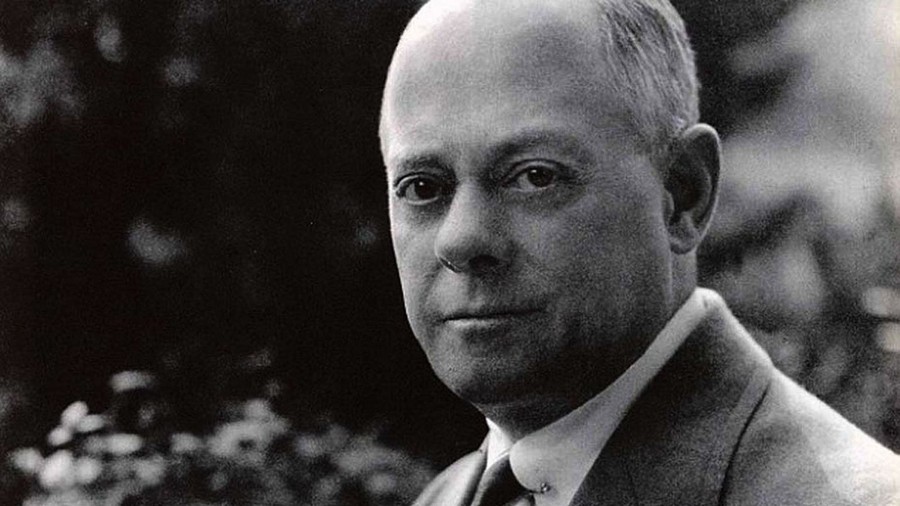
Henry Graves, Jr., was from what we usually call “old money” because his ancestry traces back to some of the wealthiest member of the group who first settled Massachusetts. By the time he came into the family’s fortune in the late 1800s, he was ready to take that money and make more. And so, he did. He invested in railroads at exactly the right time in American History that maximized his earnings, and his shrewd financial insights more than doubled his family wealth.

As one of America’s wealthiest men, Graves, like others of his ilk, was incredibly competitive. One of his major rivals in business and in other things was James Packard, the creator of the famous Packard automobile. The two business tycoons competed to outdo the other one in profit but also in possessions. In 1925, looking to best his rival, Graves commissioned the creation of a personal item that would become the envy of everyone he knew–especially Packard.

What Graves commissioned would take three years to design and five more years to complete and deliver to the wealthy man. By the time the item was delivered, of course, the United States had been plunged into the depths of the Great Depression. What seemed like a harmless jab at a rival at the time Graves had placed his order had then become symbolic of the excesses of the wealthy. Those excesses were a part of what many people felt had caused the economic downturn in the first place.

And then word spread that the commission had cost Graves $320,000 at a time when most people wouldn’t have paid more than $70 for an item that accomplished the same thing.

Graves received a piece of work that had 920 separate and individual parts. Yet, the work only weighed a little more than a pound. It boasted almost 450 screws, over 100 wheels, and 120 levers. To top it off, the piece also featured over 70 valuable jewels. On the front, the item showed the night sky over Central Park in New York City, accurately depicted in detail. Truly, it was a piece of art to behold, the most extravagant and complicated item of its kind ever produced.

But people cursed Graves and the item despite its obvious craftsmanship and beauty. Graves ignored the curses, but then, something curious happened. Soon after the wealthy man took delivery of the piece, his best friend died. Then, a few days later, his own son was killed in a car crash. Not a few people shook their heads and felt that Graves was certainly paying for the extravagance in such a commission while most people in the nation–and the world–were suffering. It seemed like justice for such a ridiculous commission.

Graves decided to put the thing away. He died in 1953.

And in 2014, the Patek Philippe Graves Supercomplication watch he commissioned sold for a record $24,000,000.

On an Early Colony

Growing up, my interest in history made me want to become an archaeologist. However, when I realized that 99% of that profession is in the pursuit of the artefact and not the actual finding of it, my innate laziness put the kibosh on that possible career. The opposite was true for a woman named Anne Stine Ingstad. Anne relished the pursuit, the chase, the digging, and the tedious research required by a classic archaeologist.

And Anne was led to excavate a site of one of America’s first colonies of European settlement. We probably all know about Roanoke Island, the first English attempt at settlement and how those colonists mysteriously vanished. Most of us have heard about colonial Jamestown or Williamsburg and those more successful attempt at a permanent English settlement in North America. But the site of the place of early attempt at a colony where Anne dug was a bit more north than what became Virginia.

Anne and her collaborator/husband, Helge, began surveying and carefully uncovering their site on the northeastern coast of North America in 1961 at a site called Grassland Bay. Locals pointed out the small settlement area to Anne by saying they thought the lumps of earth marked an old Native American campsite. However, Anne’s trained eye soon realized that it was a previously unknown and uncatalogued European site. For the next seven years, she and her husband and a growing team of researchers dug the site. What they discovered and uncovered was astounding and re-wrote the colonial history of America.

Over the years, the team was able to uncover and positively identify the remains of sod houses built on timber frames. Inside them, metal needles were found along with fragile bits of fabric, indicating that women were indeed part of the early settlement. They uncovered large, centralized cooking pits, proving that much of the food was prepared for the group rather than for individual houses and families. They found remnants of an iron forge, thus showing that the site didn’t belong to native tribespeople but rather to metal-working Europeans. And they found boathouses and boat-repair shops, indicating that the place was used as a way-station for other ships which passed by. All in all, the excavations carried out by Anne and the team proved beyond doubt that besides the fact that the colony was European, that it was occupied for some decades, and that it was from the early colonial settlement period.

But Anne’s work met some opposition in some corners of the history and archaeology disciplines. Since there was no corroborating narrative about an attempt at a colony at that site, there were skeptics who said that it was a much later site than what Anne and her team had proposed. Rather than a European colony, they argued, that it was merely an outpost of later settlements further down the North American coast.

But Anne then used carbon-dating methods to show that the wood used in the building of the sod huts was older than any of the other European colonial attempts. In fact, the proof Anne had showed that it may have been the oldest European settlement in North America–ever. She thus silenced her critics.

And, today, we recognize that Anne Stine Ingstad uncovered the fact that Vikings settled in Newfoundland, in North America a full 600 years before the English tried to colonize the New World.